
The Lifecycle of a Case: The DSA as a Tool of Intimidation and Harassment
The experiences of the journalists facing DSA cases demonstrate that the DSA was primarily used as a tool of intimidation and harassment, rather than one to prosecute legitimate cyber-crimes. As the UN High Commissioner for Human Rights has noted, “[t]he Digital Security Act [was] used across Bangladesh to arrest, harass and intimidate journalists and human rights defenders, and to muzzle critical voices online.”210
Our data reveals that (i) complaints under the DSA were filed by anyone concerned by the speech at issue, making it easy to weaponize; (ii) journalists were often arrested without a warrant, held incommunicado for hours and subjected to prolonged pre-trial detention; (iii) yet these cases were not actively pursued by the authorities thereafter—in most cases the police did not complete the investigation, let alone take the case to trial. Almost all of the cases that went to trial resulted in acquittals, demonstrating the baseless nature of these cases.
A. Initiation of a Case
Our data shows that proceedings under the DSA could be triggered by anyone, even if they were not directly harmed or mentioned by the speech in question. Indeed, in close to 30% of the cases in the larger dataset (63 of 222), the complainants were not the direct victims/subjects of the speech that was the basis for the complaint.
For instance, Mamunur Rashid Noman faced charges for allegedly taking photos of a mayor by a river, after which a crowd beat him.211But it was not the mayor who filed the case: instead, it was a councillor from the city.212 Likewise, in the case of Abu Zafar (the journalist prosecuted for reporting on alleged corruption), it was the organizing secretary of a unit of Volunteer wing of the Awami League who filed the complaint. According to Abu Zafar, the complainant and the official who was the subject of the reporting may have been close.213
Many journalists in our dataset also faced multiple cases—30 journalists faced two cases; five faced three; one journalist faced for four; and three journalists faced five cases. Many times these multiple cases were filed by different individuals for the same reporting, since the DSA did not have any clear restriction on who could file complaints. For example, journalist Shafiqul Islam Kajol, whose case TrialWatch has monitored, was charged in three separate DSA cases, for sharing a newspaper article on social media.214 The newspaper article related to an alleged sex scandal involving Bangladeshi politicians affiliated with the Awami League.215 The complaints were filed by an Awami League MP and two members of the Bangladesh Jubo Mohila League (youth female wing of the Awami League).216
This reflects the way in which the DSA permits persistent targeting, even where the same reporting is at issue, as different complainants are able to seek registration of cases. It also dramatically increases the burden on the defendant.
The Media Reform Commission came to the same conclusion with respect to criminal defamation cases: “Although the law clearly states that only the individual who is the victim of defamation can file a case under this law, and multiple cases cannot be filed, the opposite has been seen in reality. Third parties have filed cases with the logic that ‘defamation of my leader is defamation of me and my party,’ and numerous cases have been filed in different places. Surprisingly, the courts have accepted these cases, and accused individuals have been arrested.”217
Current Position
The CSO contains a provision that provides that “[n]o person shall file a case under this Ordinance except an aggrieved person directly or a person authorized in writing by him or a member of the law enforcement agency.”218 It will be important to monitor the extent to which this restriction is applied.
B. Arrest and Pre-Trial Detention
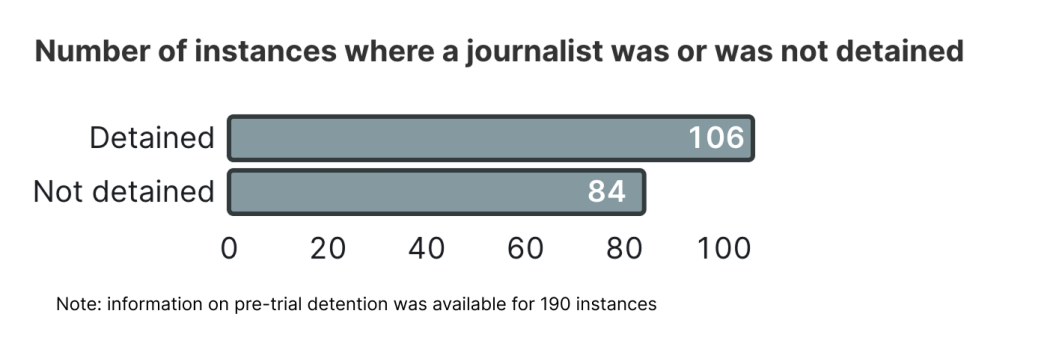
Journalists facing DSA charges were often arrested and subject to pretrial detention. In the larger dataset, journalists were detained in 55% of the incidents (where information was available).219 And among the 30 case studies analysed, 90% of the journalists faced arrest (27 of the 30).
These rampant arrests were enabled by Section 43 of the DSA, which allowed for warrantless searches, seizures and arrests when a police officer had “reasons to believe that an offence under this Act has been or is being committed, or is likely to be committed in any place, or any evidence is likely to be lost, destroyed, deleted or altered or made unavailable in any way.” As noted by the OHCHR, the “unfettered discretion” police officers had to arrest persons, without prior court approval, is contrary to the recommendations of the UN Human Rights Committee and falls short of international standards.220 The case studies analysed for this report show that police officers did not even observe the stipulations of Section 43, and proceeded to conduct arbitrary arrests, including when there was no apprehension of an offence being committed or evidence being destroyed. Instead, journalists reported arrests taking place at odd hours, involving large numbers of officers, sometimes being blind-folded and held incommunicado, demonstrating the use of the DSA as a tool of intimidation.
Intimidatory Arrests
Almost half the journalists arrested (12 of 27) reported that they were arrested at odd hours, i.e. late at night or during early morning hours, and often by officers in plainclothes. And over half of the journalists arrested (18 of 27) reported that multiple police officers, in some cases 30-40 officers, came to arrest them.
For instance, in the case of the journalist who reported on alleged diversion of funds from a construction project, he says that the FIR was registered after midnight, and 10 officers arrived at his house around 1am, accompanied by the complainant. Upon entering the residence, he alleges that law enforcement officers seized his phone and obtained his password through force.221 Likewise in Lutfur Rahman Shawon’s case, he says that five or six officers came to his house in the middle of the night, around 12:40 AM—and again, they seized his phone.222
In MD Hedait Hossain Molla’s case, he says he was arrested by plainclothes officers, who held a gun to his head. He says that when he reached the police station, his cell phone, bank cards, wallet, and belt were all removed. 223
In many cases, journalists were not even told they were being arrested, much less the reason why. For instance, in Ikhtiyar Uddin Azad’s case, he recounted that he was initially invited by the police to go with them to cover news regarding a relief distribution event during the lockdown. According to him, the police even assured his father and family members that they would also escort him to return home after the event. Instead, he was kept in a moving police van for several hours and was brought to the police station only after midnight.224 Likewise, in Abu Zafar’s case, he said he was called to the police station on the pretext that they had information for him for a story, and that when he went to wash his hands after eating food, he found his two phones were gone.225
International Standards
Article 9 of the ICCPR protects the right to liberty and prohibits arbitrary detention.226 Article 9(1) of the ICCPR stipulates that no one may be deprived of liberty or “subjected to arbitrary arrest or detention … except on such grounds and in accordance with such procedures as are established by law.”227 Arbitrariness “is not to be equated with ‘against the law’, but must be interpreted more broadly to include elements of inappropriateness, injustice, lack of predictability, and due process of law.”228 As discussed in greater detail below, individuals also have a right to be informed of the reasons for arrest.
The fact that some journalists were ‘invited’ by the police to cover news as a pretext for depriving them of their liberty does not mean that they should not be considered to have been ‘arrested’ from the outset. According to the European Court of Human Rights, to determine whether an individual has actually been deprived of their liberty, “the starting-point must be his or her specific situation and account must be taken of a whole range of factors such as the type, duration, effects and manner of implementation of the measure in question.”229 There is both an objective and subjective element to the qualification of whether an individual is ‘detained.’ The objective element includes factors such as the degree of control the authorities have over a person’s movements, the extent they have isolated the person and the availability of social contacts.230 The subjective element on the other hand focuses on whether the person “has not validly consented to the confinement in question.”231 In these cases, seeking to conceal that journalists were being arrested not only does not absolve the authorities of the requirement to disclose the reason for arrest, since they were effectively deprived of liberty, but may also constitute an independent violation of the accused’s rights on arbitrariness grounds.
Further, the European Court has held that a “psychological ordeal to which [defendants] [a]re allegedly subjected [during an arrest] . . . could in principle be characterised as inhuman and degrading treatment.”232 The Court has, for instance, considered cases where, among other measures, “the authorities used a dozen masked and armed officers to arrest the [defendant] although it appears that he did not present a particular security risk.”233 Raids during the middle of the night by large numbers of plainclothes police, without justification, may also give rise to concern in this regard.
Failure to Comply with Arrest Safeguards
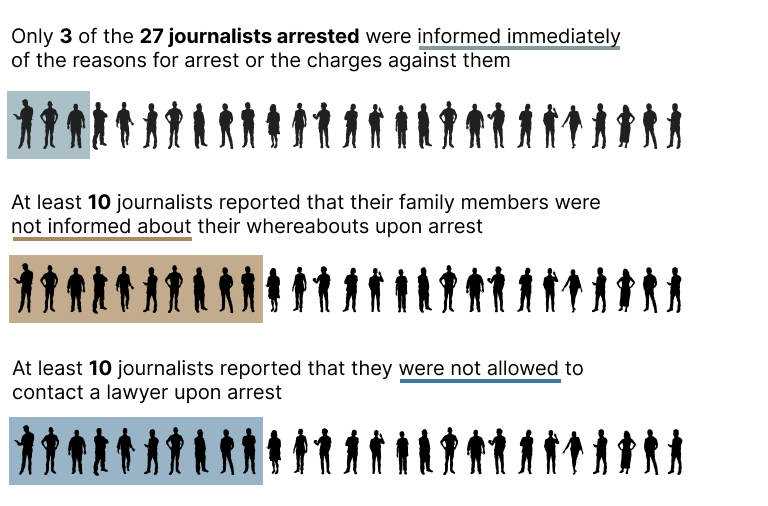
Only three of the 27 journalists arrested were informed immediately of the reasons for arrest or the charges against them. In K M Belal Hossen Swapon’s case, he said he only learned the sections he was charged with violating when he was taken to court the next day.234 Shanto Banik, another journalist, reported that 35 persons came to his house at midnight, and he was taken into a minivan where he was blind-folded and hand-cuffed. The police did not inform him where they were taking him much less the reasons or grounds for his arrest.235 He remained in the minivan for most of the night and was taken the police station only in the morning.236
Of the 27 journalists arrested, at least 10 reported that their family members were not informed about their whereabouts upon arrest. Similarly, at least 10 reported that they were not allowed to contact a lawyer upon arrest. Some of these journalists reported that the police actively obstructed them from contacting their family or a lawyer. The remaining did not speak to this issue, so it is possible the violations were more widespread.
Wee People Copyright © 2018 ProPublica and Alberto Cairo CC BY-NC_ND 3.0 US
For instance, in K M Belal Hossen Swapon’s case, he says that upon his arrival at the police station, when he sought to contact a lawyer, his phone was taken away from him.237
Five journalists interviewed also stated that they were not brought before a court within 24 hours of arrest. For example, Mamunur Rashid Nomani reported being secretly taken to jail in a police car at 11am the day after his arrest without being presented in court.238
International Standards
Article 9(2) of the ICCPR requires that the authorities give prompt notice of the reasons for arrest at the time of the arrest, enabling the arrestee “to seek release if [they] believe that the reasons given are invalid or unfounded.”239 The Human Rights Committee has commented that reasons given for an arrest must include both legal and factual grounds, including the alleged crime(s) and identity of any alleged victim(s), and must be in a language the arrested person understands.240 The Committee has also stated that an individual must be provided with such an explanation “immediately upon arrest” barring exceptional circumstances, such as the need for an interpreter.241 In M.T. v. Uzbekistan, for example, the Committee found a violation of Article 9(2) where police officers failed to promptly inform a human rights defender of the reasons for her arrest, charging her only the subsequent day.242
Under Article 9(3) of the ICCPR, all individuals detained on a criminal charge must be brought “promptly” before a judge or other person exercising “judicial power.” This applies “even before formal charges have been asserted, so long as the person is arrested or detained on suspicion of criminal activity.”243 Under Articles 14(3)(b), (d) of the ICCPR, everyone charged with a criminal offense has the right to the assistance of counsel of his or her choosing, including the right to communicate with counsel. The right to counsel applies at all stages of criminal proceedings and is particularly vital during periods of detention.244 In this regard, the UN Human Rights Committee has stated that “States parties should permit and facilitate access to counsel for detainees in criminal cases from the outset of their detention.”245 In Zhuk v. Belarus, for example, the Committee found a violation of Article 14(3)(b) where a detainee had “only been allowed to see a lawyer for five minutes and ha[d] effectively been deprived of legal assistance during the initial phases of the investigative proceedings, and … was forced to participate in investigative actions [including police interrogation] without legal advice, despite his requests for a lawyer.”246
The behaviours described in the case studies run afoul of these standards.
Prolonged Pre-trial Detention
Journalists arrested under the DSA remained in pre-trial detention for prolonged periods—eight journalists from the larger data spent over 100 days in detention.
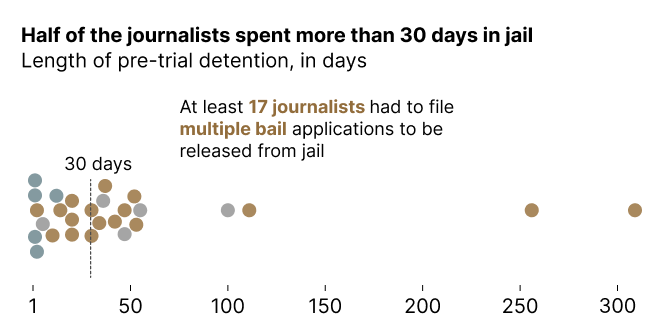
And among the 30 cases analysed, 50% of the journalists spent more than 30 days in jail.
This can be attributed to the significant time it took for journalists to obtain bail. For instance, journalist Shafiqul Islam Kajol was in pretrial detention for eight months—after being subject to enforced disappearance for 53 days prior to that.247 The prolonged pre-trial detention was in part due to the fact that he faced multiple cases and had to seek bail in each of them separately.
In other cases, it took many attempts/hearings to obtain bail. Out of the 30 cases analysed, at least 17 had to file multiple bail applications to be released from jail. For instance, in Ikhtiyar Uddin Azad’s case, it reportedly took 17 hearings before the High Court before bail was granted, and the defendant spent eight months in jail.248 In the case involving alleged use of quotes that had not actually been given by a police officer, one of the defendants had to seek bail five times before it was granted.249
Among the incidents where journalists were subject to pre-trial detention, the provisions were known in 49 incidents. Over 80% of these incidents included Sections 25 and 29, often clubbed with non-bailable offences such as Section 31 (32 incidents); Section 23 (11 incidents); and Section 26 (10 incidents), enabling authorities to arrest and subject the journalists to pre-trial detention.
Similarly, in the case studies analysed, Section 25 and 29 were most often clubbed with Section 31—this clubbing of charges allowed for pre-trial detention.
International Standards
As to the decision to detain, in many of the cases, placing journalists in pre-trial detention would be inconsistent with international standards because the offences fail to meet the principle of legality or are not ones where a sentence of imprisonment could ever be deemed proportionate.
The UN Human Rights Committee has explained that “any substantive grounds for arrest or detention must be prescribed by law and should be defined with sufficient precision to avoid overly broad or arbitrary interpretation or application. Deprivation of liberty without such legal authorization is unlawful.”250 As discussed above, many of the offences most charged in our dataset, including in particular Section 31, which presumably formed the basis for many detentions, are unlawfully vague.
Likewise, the UN Human Rights Committee has made clear that where imprisonment is not an appropriate penalty for an offence, pretrial detention pursuant to such an offence is arbitrary. In a case in which a defendant was charged with defamation and calumny, the Committee held that the accused’s pretrial detention was arbitrary because “[i]f defamation should never result in a penalty of deprivation of liberty being imposed on the grounds that it is not an appropriate penalty, then a fortiori no detention based on charges of defamation may ever be considered either necessary or proportionate.”251
Several of the offenses under the DSA are not ones for which imprisonment could ever be appropriate—including in particular defamation. As the UN Human Rights Committee has explained, “imprisonment is never an appropriate penalty” for defamation offenses.252 That means that any pretrial detention under Section 29 would necessarily be arbitrary.
Mistreatment During Detention
Numerous journalists also raised concerns about their treatment by the police and/or in detention. This reflects the devastating stories of Bangladeshi writer Mushtaq Ahmed, who was detained under the DSA in May 2020 for allegedly posting criticism of the government’s response to the Covid-19 pandemic on Facebook, and died in police custody,253 and cartoonist Ahmed Kishore, who was arrested at the same time and released eventually, and who reported incidents of torture while in custody.254
At least 14 journalists interviewed stated that they were subject to abuse and mistreatment during arrest or while in detention. For instance, in Mamunur Rashid Nomani’s case (involving allegedly taking photos of a mayor), he says that he was kept in pretrial detention for fourteen days, did not have access to counsel during the arrest, was not treated for injuries he had suffered when the mayor’s supporters had beaten him, and was left to suffer.255 In MD Hedait Hossain Molla’s case, he says that the Officer in Charge ‘held his chin and said not to talk too much, if he talked too much, it would be dangerous.’256 Likewise, in Abu Zafar’s case, an officer at the station reportedly said that “it would not be good for him if the officers covered his face with a black cloth and beat him up” and “it is better to agree with them and tell them what they want to know.”257
In some cases, the mistreatment by the authorities appeared to be a tactic to elicit a coerced confession or to get the accused to provide other information. For instance, in Azharul Haque’s case, the journalist states that the magistrate recording his testimony told him confess to the accusation and threatened him with facing consequence like ‘crossfire’ (an extra judicial killing) if taken to remand.258 And Abdul Kaium says he was slapped around and beaten, by ununiformed police officers who could not be identified, in order to get him to divulge his passwords.259
International Standards
In addition to prohibiting arbitrary arrest and detention, Article 9(1) of the ICCPR encompasses broader guarantees for the physical integrity of an individual. In interpreting Article 9(1) the UN Human Rights Committee has explained that it “protects individuals against intentional infliction of bodily or mental injury, regardless of whether the victim is detained or nondetained. For example, officials of States parties violate the right to personal security when they unjustifiably inflict bodily injury.”260
Additionally, Article 7 of the ICCPR establishes that “no one shall be subjected to torture or to cruel, inhuman or degrading treatment or punishment.” In recognition of the vulnerability of those in state detention, Article 10 of the ICCPR further states that “[a]ll persons deprived of their liberty shall be treated with humanity and with respect for the inherent dignity of the human person.” In this regard, the Committee has noted that detainees should not “be subjected to any hardship or constraint other than that resulting from the deprivation of liberty.”261
The behaviours described by affected journalists violate these standards.
Current position
Section 35 of the CSO provides for warrantless arrests albeit in much more limited circumstances—it permits warrantless searches where there “there is a possibility of deletion, alteration, destruction, loss of evidence or any other means of making it scarce or unavailable through cyberattack on important information infrastructure or illegal entry or intrusion or hacking into computers, computer systems, digital devices, etc.” and the police may arrest any persons at the place searched if it is suspected that the person “has committed or is committing any crime under this Ordinance.”262 However, the blatant disregard of the pre-conditions under Section 43 of the DSA for conducting warrantless arrests, as seen in our data, raises concerns about whether these requirements in the CSO will be followed by the police in practice.
While the Police Reform Commission has made several recommendations to the interim government, including relating to implementation of guidelines governing warrantless arrest,263 public reporting suggests these are “far away,”264 and the interim government does not seem to have introduced any substantial reforms on police abuses, or accountability for violations. In fact, reports suggest that journalists continue to be subjected to arbitrary arrests and suffer mistreatment while in custody.265
C. Seizure of Devices
As is evident in the case studies cited above, journalists’ phones and other digital devices were often seized before or after they were arrested. At least 15 journalists in the smaller dataset reported their mobile phones or other devices being seized by the police.
This was enabled by the broad search and seizure powers under the DSA: Section 41 provided that investigating officers had the power to take into their custody any “computer, computer programme, computer system, computer network or any digital device, digital system, digital network or any programme, data-information which has been saved in any computer or compact disc or removable drive or by any other means.” Further, Section 43 authorized warrantless entry into premises based simply on the belief that an offense has been committed, and authorized police to “seize the computer, computer systems, computer network, datainformation or other objects which were used in committing the offence.”
In numerous cases, journalists recounted that officers simply took their devices or demanded that they open them for searching. For instance, in MD Hedait Hossain Molla’s case, the officers simply took his mobile device.266 The same transpired in Ikhtiyar Uddin Azad’s case.267 As described in the section on arrests above, this was sometimes done without informing the accused about the charges faced or grounds of search/arrest. Several journalists reported that since their phones were seized, they could not inform their family of their whereabouts, or contact a lawyer.
International Standards
Article 17(1) of the ICCPR provides that “[n]o one shall be subjected to arbitrary or unlawful interference with his privacy, family, home or correspondence.” The UN Human Rights Committee has made clear that “the concept of arbitrariness in article 17 is intended to guarantee that even interference provided for by law is in accordance with the provisions, aims and objectives of the Covenant and, in any event, is reasonable in the particular circumstances.”268
Parallel provisions of the European Convention have been subject to significant interpretation. As to the question of whether an interference with privacy is lawful, the European Court has stressed, “the Court must assess the quality of the relevant domestic law in relation to the requirements of the fundamental principle of the rule of law.”269 Among the criteria to consider are whether there are “adequate and effective guarantees against arbitrariness and the risk of abuse.”270
And as to the question of whether an interference is ‘arbitrary,’ in a recent case involving the search of journalists’ devices, the European Court looked to “whether the search was undertaken pursuant to a warrant issued by a judge and based on reasonable suspicion; the circumstances in which the search warrant was issued; whether the scope of the warrant was reasonably limited; and the manner in which the search was carried out, including the presence of independent observers during the search in order to ensure that materials subject to professional secrecy were not removed.”271
While international and regional standards do not preclude warrantless searches and seizures, the European Court has stressed the importance of post factum judicial review in such cases: “The Court thus needs to examine whether the post factum judicial review offered sufficient guarantees that the applicants’ right to respect for their private life was not breached.”272
Both as on their face and as applied—as reflected in our data—the provisions of the DSA regulating seizure of digital devices are deficient. They do not appear to require judicial authorization. The standard appears to be far below ‘reasonable suspicion’ insofar as the law refers to the ‘possibility’ of an offense being committed.273 Finally, where devices are seized and searched without a warrant, it is unclear whether there is any possibility of post-factum judicial review.
270 Id.
Current Position
The CSO is somewhat improved in this regard. Section 35 provides much more limited authorization for warrantless search and seizure—in particular, where “there is a possibility of deletion, alteration, destruction, loss of evidence or any other means of making it scarce or unavailable through cyber-attacks on important information infrastructure or illegal access or intrusion or hacking into computers, computer systems, digital devices.” Nevertheless, as mentioned above, safeguards in the DSA were not observed in practice, raising questions about whether narrower provisions will in fact be protective under the CSO.
D. Investigation/Submission of Chargesheet
Our data shows two significant trends: in a majority of cases, the police did not complete the investigation and left the cases pending without submitting a chargesheet; and in cases where the investigation was completed and a chargesheet was filed, the investigation appears to have been superficial, suggesting the cases may have been baseless from the beginning.
Delays in Completing the Investigation
A shocking majority of cases in our larger dataset—125 of 222 (56%)— remained at the initial stage of police investigation as of July 2024 (as per public sources). This means that the police did not complete the investigation and take the case to trial, but rather kept the case open/pending for years on end. This demonstrates the use of the DSA as a tool of harassment, rather than for the prosecution of legitimate cybercrimes.
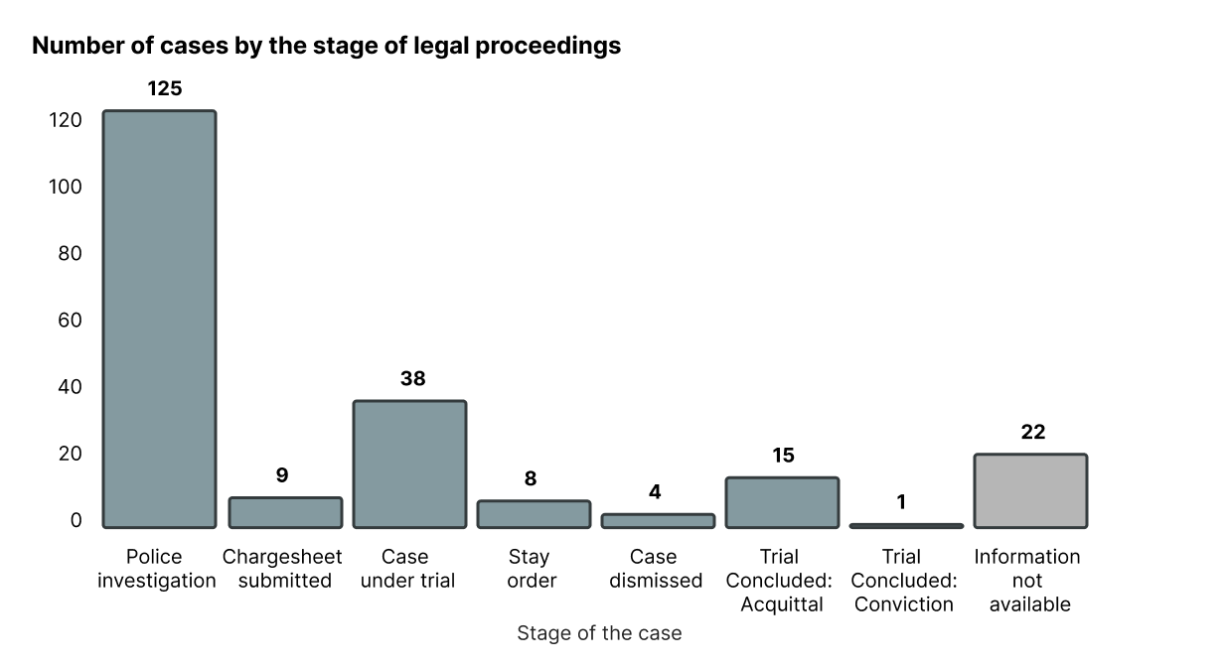
Journalists were arrested in over 50% of the incidents that remained pending at the stage of police investigation—suggesting a pattern where people are arrested but their cases never proceed to trial—making the process the punishment.
Under Section 40 of the DSA, an investigation must be concluded within 60 days from the date it is assigned to the investigating officer. If the officer is unable to complete the investigation within this period, an extension of up to 15 days may be granted with the written approval of the controlling officer.
If the investigation remains incomplete after this extended period, the investigating officer is required to record the reasons for the delay in writing and submit a formal report to the court i.e. the Cyber Tribunal. Upon reviewing the report, the Tribunal may authorize an additional extension not exceeding 30 days.274 Any further extension beyond this timeframe may be allowed only at the Tribunal’s discretion.275
These rules appear not to have been respected in practice. In fact, as discussed above, a defining feature of the DSA cases in our dataset is a prolonged delay in submitting chargesheets. Among the 265 incidents that remained pending at the stage of police investigation, a significant portion (48%) were from 2020 and 2021—meaning they had been delayed by three-four years,276 long past the time by which an investigation was expected to have been completed.
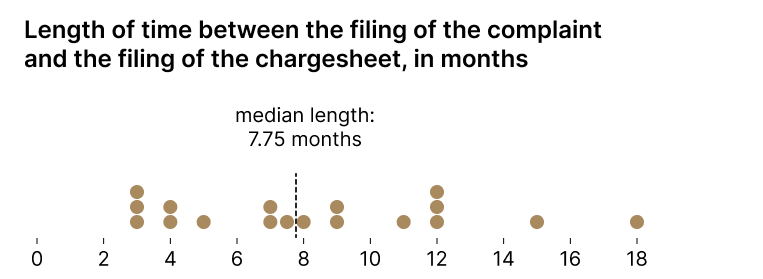
Indeed, 15 out of 30 journalists among the case studies analysed waited more than three months after the filing of the complaint before a chargesheet was filed. In fact, the median length of time between the filing of the complaint and the filing of the chargesheet in these case studies was an astounding 7.75 months.
In MD Hedait Hossain Molla’s case, for instance, the chargesheet against the journalist was not filed for more than a year after his arrest. When the investigation eventually concluded, the chargesheet stated that there was: “no specific information or evidence to prove the allegations of the said case against the said accused.”277 During this time, the journalist incurred legal expenses totalling between Taka 2 to 2.5 lakh, despite the case making no progress in court.278
In another case involving reporting on alleged embezzlement/the misappropriation of government-distributed rice intended for low-income individuals,279 the journalist has spent years making monthly court appearances.280 These examples point to not just an inordinate delay in completing investigations, but suggest that the cases were baseless in nature. This is discussed in more detail below.
International Standards
Article 14(3)(c) of the International Covenant on Civil and Political Rights provides that anyone charged with a criminal offence is entitled to be tried without undue delay. The purpose of this guarantee is to limit the uncertainty and hardship caused by prolonged proceedings.281 The period for assessing undue delay begins once a person is arrested282 or charged and continues until the final judgment on appeal,283 with international jurisprudence evaluating reasonableness in light of the case’s complexity, the conduct of the accused, and the diligence shown by the authorities.284 The burden lies with the State to justify the length of proceedings, and this burden is heightened where defendants remain in detention.285
The UN Human Rights Committee has likewise stated clearly that “[i]t is impermissible for a State party to indict a person for criminal defamation but then not to proceed to trial expeditiously – such a practice has a chilling effect that may unduly restrict the exercise of freedom of expression of the person concerned.”286
The data above suggests that these rights were not being respected in many of the cases against journalists in our dataset.
Current Position
The CSO prescribes a longer time period for investigation than the DSA— the investigating officer must complete the investigation within 90 days (instead of 60 days), which can be extended for an additional 15 days with the approval of the controlling officer.287 Like the DSA, if the investigation remain incompletes after this extended period, the investigating officer is required to record the reasons for the delay in writing and submit a formal report to the court, i.e. the Cyber Tribunal, on the basis of which the Tribunal may authorize an additional extension not exceeding 30 days.288 If the investigation is still not complete “due to technical limitations,” further extension beyond this timeframe is allowed at the Tribunal’s discretion.289 The CSO does not specify the implications if the investigation is delayed for non-technical reasons, or if the Tribunal does not grant further extension. Apart from the vagueness, the story of the DSA shows us that these stipulations are not followed in practice.
Superficial Investigations
Investigations in many of the DSA cases in our dataset appear superficial and of low quality. In lieu of a thorough inquiry and investigation, authorities have often limited their role to seizing and sending digital devices (often cell phones) in for forensic analysis (as discussed above). Based on our review of 15 chargesheets, many of them referenced only the forensic analysis of a digital device as the primary form of investigation, with no mention of corroborating interviews or additional investigation. Moreover, we reviewed three forensic reports and found that they were very limited in scope, typically only focusing on whether specific content underlying the allegations originated from the accused’s devices. In some instances, these reports pointed towards the accused’s innocence by failing to substantiate the allegations. For example, Lutfur Rahman Shawon’s case,290 the forensic report stated that the content in question (the comment regarding the courts being beholden to Former Prime Minister Hasina) had not been posted from his device, undermining the prosecution’s claim that he was responsible for the posts.291
In Sabur Rana’s case,292 a forensic report determined that no post corresponding to the screenshot submitted by the investigating officer was found under the Facebook name of the defendant;293 nevertheless, his case remained under a stay order as of the close of data collection.294
In a third case—that of K M Belal Hossen Swapon—the police centered a large part of their investigation around a forensic report concerning the journalist’s seized cell phone. It does not appear that any further investigative steps were taken to substantiate the allegations against him. Ultimately, the Cyber Tribunal found in its judgment that based on the testimony of the prosecution’s three witnesses, the authorities had failed to prove the charges against the journalist beyond doubt.295
Finally, in Rahim Shuvo’s case, the forensic investigation indicated that the Facebook accounts attributed to the defendant and his co-defendant could not be located or verified.296
International Standards
Under international standards, “[d]etention pending trial must be based on an individualized determination that it is reasonable and necessary.”297 The European Court of Human Rights has extensive jurisprudence regarding the requirement that there must be a ‘reasonable suspicion’ to justify placing an individual in detention for allegedly having committed a crime. For the European Court of Human Rights, this refers to “the existence of facts or information which would satisfy an objective observer that the person concerned may have committed the offence.”298
The European Court has thus had occasion to assess the adequacy of investigations in the context of the existence, or not, of a reasonable suspicion. This can also arise in the context of an initial, warrantless arrest.299 For instance, in one case the Court looked to limitations on the post-arrest investigation of an alleged crime to find a lack of reasonable suspicion.300
Here, in many cases it appears that the quality of the investigations would give rise to concerns regarding whether they were sufficient to ground a ‘reasonable suspicion’ given their limitations.
E. Trials
The data on cases that went to trial demonstrate similar themes as discussed above: There were tremendous delays in bring the case to trial, and even the few cases that went to trial took years to conclude. Then, most cases brought to trial ended in acquittals—again suggesting the meritless nature of these cases.
Delays
As mentioned above, the vast majority of the cases did not even go to trial. Only 24% of the cases in the larger dataset went to trial—out of which only a shocking 7% (16 cases) concluded. Four cases were dismissed/journalists were exonerated by the court before conclusion of the trial. In eight cases courts issued “stay orders” pausing any movement on the case and the cases haven’t proceeded since (at least as of the close of data gathering).
Overall, only 20 of the 222 cases (less than 10%) in the larger dataset concluded, i.e. the trial concluded or the case was dismissed.
Section 52 of the DSA provided for a 180-day limit for disposal of cases— from the date “on which the charge is framed.” Section 52 further provided for a potential extension of 90 days, after which the court was expected under that section to record the reason and bring it to the knowledge of the High Court Division in the form of a report.
Our data shows that this was not followed in practice. For instance, Lutfur Rahman Shawon’s case, it not only took seven months for the authorities to file a chargesheet,301but despite the FIR being registered in December 2021, the case was ongoing as of July 2024.302 According to the defendant, the impact of the DSA on his life has been profound: he and his family accumulated over Taka 8 lakhs of debt, and his reputation within the journalist community had been tarnished.303
Among the 30 case studies analysed, 11 ended in acquittals. However, five out of 11 acquitted journalists faced delays of over 20 months between the initial complaint and disposal of the case—far exceeding the maximum 180 days provided for in Section 52 of the DSA. In Ikhtiyar Uddin Azad’s case, it took almost three years for the journalist to obtain an acquittal. During this period, he not only lost his job with the newspapers for which he had been working, but suffered financially from the number of hearings that he was required to attend throughout the course of his case, in addition to the lawyer fees he had to pay.304
Current Position
Like the DSA, the CSO provides for a 180-day limit for disposal of cases; however, this is calculated from the date of framing of charges. The provision, Section 45, further provides for a potential extension of 90 days, after which the court must “record the reasons therefor and inform the High Court Division in the form of a report and continue the proceedings of the case.” Without further mechanisms to ensure compliance, this provision could be disregarded by courts/law enforcement as seen as with cases under the DSA.
Baseless Cases
The weaknesses in the cases is evidenced by their ultimate disposition. Only one case out of 222 cases in the larger data ended in a conviction.305
Among the 30 case studies analysed, eleven cases resulted in acquittals; five cases were dismissed and six cases were stayed by superior courts (meaning that the court temporarily halted the proceedings)—reflecting the apparently baseless nature of these cases.306
For example, in MD Hedait Hossain Molla’s case, he was acquitted after the investigation spelled out in his chargesheet that there was “no specific information or evidence to prove the allegations of the said case against the said accused.”307 And Ikhtiyar Uddin Azad’s case was dismissed after an almost 3-year battle.308
International Standards
The United Nations Guidelines on the Role of Prosecutors establish that prosecutors should “perform their duties fairly, consistently and expeditiously …”.309 Parallel guidelines issued by the Council of Europe clarify that “fairness” in the execution of prosecutorial duties encompasses, among other things, assisting the court in arriving at the truth, using evidence “reasonably believed to be reliable”, and declining to prosecute a case “beyond what is indicated by the evidence.”310
In many of these cases, however, chargesheets were filed despite such paucity of evidence, suggesting that they were a matter of rote rather than carefully considered.
Current Position
Under Section 28 of the CSO, filing false complaints is a criminal offence; yet the Ordinance does not provide any consequences for law enforcement officers who pursue such false and baseless cases. A similar provision was present in the CSA (Section 34), yet baseless and abusive prosecutions under the CSA persisted. The interim government may have to create other mechanisms to ensure there are consequences for the filing and prosecution of baseless cases.
Notes
- OHCHR, Bangladesh: Türk Urges Immediate Suspension of Digital Security Act as Media Crackdown Continues, (Mar. 31, 2023), available at https://www.ohchr.org/en/press-releases/2023/03/bangladesh-turk-urges-immediatesuspension-digital-security-act-media. ↩
- Interview, Mamunur Rashid Nomani. ↩
- FIR 39, 574/2020, Kotwali Police Stattion, September 13, 2020, Mamunur Rashid Nomani. 65 ↩
- Interview, Abu Zafar. ↩
- Clooney Foundation for Justice, Bangladeshi Newspaper Editor Should Be Released From Pre-Trial Detention On Speech Charges, Oct. 17, 2020, available at https://cfj.org/news/bangladeshi-newspaper-editor-should-be-released-from-pre-trialdetention-on-speech-charges/. ↩
- Id. ↩
- Daily Star, Kajol’s DSA Plight: Charges in 3 Cases Framed in 1 Day, Nov. 9. 2021, available at https://www.thedailystar.net/news/bangladesh/crime-justice/news/kajolsdsa-plight-charges-3-cases-framed-1-day-2225141. 66 ↩
- Media Reform Commission Report, p. 68. ↩
- Section 40(1). ↩
- Since information in the dataset was gathered from publicly available sources, information on pre-trial detention was available in a minority (189 of 451) of incidents. 67 ↩
- See OHCHR Technical Note, pg. 6 ↩
- Interview. ↩
- Interview, Lutfur Rahman Shawon. ↩
- Interview, MD Hedait Hossain Molla. 68 ↩
- Interview, Ikhtiyar Uddin Azad. ↩
- Interview, Abu Zafa. ↩
- United Nations General Assembly, “International Covenant on Civil and Political Rights”, Treaty Series 999, Dec. 1966, Article 9 [hereinafter “ICCPR”]; United Nations General Assembly, “The Universal Declaration of Human Rights”, Dec. 1948, Article 3. ↩
- ICCPR, Article 9(1). ↩
- UN Human Rights Committee, General Comment No. 35: Article 9 (Liberty and Security of Person), UN Doc. CCPR/C/GC/35, Dec. 16, 2014, para. 12 [hereinafter “General Comment No. 35”]. ↩
- European Court of Human Rights, De Tommaso v. Italy, App. No. 43395/09, Feb. 23, 2017, para. 80. 69 ↩
- European Court of Human Rights, Guzzardi v. Italy, 1980, para. 95; European Court of Human Rights, H.M. v. Switzerland, App. No. 39187/98, Feb. 26, 2002, para. 45; European Court of Human Rights, H.L. v. the United Kingdom, App. No. 45508/99, Oct. 5, 2004, para. 91; European Court of Human Rights, Storck v. Germany, App. No. 61603/00, Sep. 16, 2005, para. 73. ↩
- European Court of Human Rights, Storck v. Germany, App. No. 61603/00, Sep. 16, 2005, para. 74. ↩
- European Court of Human Rights, Hrisotvi v. Bulgaria, App. No. 42697/05, Oct. 11, 2011, para. 80 (discussing a “a terrifying experience when several heavily armed and masked police officers entered their apartment, pointed guns at them and shouted death threats”). ↩
- European Court of Human Rights, Miroslaw Garlicki v. Poland, App. No. 36921/07, June 14, 2011, para. 75. ↩
- Interview, K M Belal Hossen Swapon. 70 ↩
- Interview, Shanto Banik. ↩
- Interview, Shanto Banik. 71 ↩
- Interview, K M Belal Hossen Swapon. ↩
- Interview, Mamunur Rashid Nomani. ↩
- General Comment No. 35, para. 25. ↩
- Id. paras. 25, 26 ↩
- Id. para. 27. ↩
- Human Rights Committee, M.T. v. Uzbekistan, Comm. No. 2234/2013, UN Doc. CCPR/C/114/D/2234/2013, Oct. 21, 2015, paras. 2.1, 7.7–7.8. ↩
- General Comment No. 35, para. 32. 72 ↩
- UN Basic Principles on the Role of Lawyers (Sept. 7, 1990), Principle 1; UN General Assembly, Body of Principles for the Protection of All Persons under Any Form of Detention or Imprisonment, UN Doc. A/RES/43/173 (Annex) (9 Dec. 1988), Principles 1, 17(1), 18. ↩
- General Comment No. 35, para. 35. ↩
- UN Human Rights Committee, Zhuk v. Belarus, UN Doc. CCPR/C/109/D/1910/2009, Oct. 30, 2013, paras. 2.1, 8.5. 73 ↩
- Dhaka Tribune, Photojournalist Kajol Finally Walks out of Jail After 237 Days, Dec. 25, 2020, available at https://www.dhakatribune.com/bangladesh/234287/photojournalist-kajol-finally-walksout-of-jail. ↩
- Interview, Ikhtiyar Uddin Azad. ↩
- Interview, Shanto Banik. 74 ↩
- General Comment No. 35, para. 22. ↩
- UNHRC, Lydia Cacho Ribeiro v. Mexico, UN Doc. CCPR/C/123/D/2767/2016, Aug. 29, 2018, para. 10.8. 75 ↩
- General Comment No. 34, para. 47. ↩
- Faisal Mahmud, Anger in Bangladesh Over Dissident Writer’s Death in Prison, Al Jazeera, Feb. 26, 2021, available at https://www.aljazeera.com/news/2021/2/26/angerin-bangladesh-over-prominent-writers-death-in-prison. ↩
- Amnesty International, Bangladesh: Cartoonist Tortured, Writer Dies in Jail: Ahmed Kabir Kishore, Mar. 8, 2021, available at https://www.amnesty.org/en/documents/asa13/3800/2021/en/. ↩
- Interview, Mamunur Rashid Nomani. ↩
- Interview, MD Hedait Hossain Molla. ↩
- Interview, Abu Zafar. 76 ↩
- Interview, Azharul Haque. ↩
- Interview, Abdul Kaium. ↩
- General Comment No. 35, para. 9. ↩
- Human Rights Committee, General Comment No. 21, U.N. Doc. HRI/GEN/1/Rev.1 at 33 (1994), Apr. 10, 1992, para. 3. 77 ↩
- Section 35(1)(D), CSO. ↩
- Mamum Abdullah, What’s in the Police Reform Commission’s Sweeping Overhaul Plan?, Dhaka Tribune, Jan. 23, 2025 (“It also stresses adhering to Supreme Court directives on arrests and questioning, urging the government to withdraw a review petition hindering implementation.”), available at https://www.dhakatribune.com/bangladesh/371583/what%E2%80%99s-in-the-policereform-commission%E2%80%99s-sweeping. ↩
- Shadique Mahbub Islam, Uniforms Have Changed, But Will Police Culture Follow?, The Business Standard, Nov. 17, 2025, available at https://www.tbsnews.net/features/panorama/uniforms-have-changed-will-police-culturefollow-1288316. ↩
- Doughty Street Chambers, Imprisoned Bangladeshi Journalists Farzana Rupa and Shakil Ahmed Complain to the United Nations over Arbitrary Detention, Jan. 22, 2025, available at https://www.doughtystreet.co.uk/news/imprisoned-bangladeshi-journalistsfarzana-rupa-and-shakil-ahmed-complain-united-nations-over. 78 ↩
- Interview, MD Hedait Hossain Molla. ↩
- Interview, Ikhtiyar Uddin Azad. ↩
- Human Rights Committee, Mullina et al. v. Uzbekistan, UN Doc. CCPR/C/138/D/3025/2017, Feb. 7, 2024, para. 8.5. ↩
- European Court of Human Rights, Dudchenko v. Russia, App. No. 37717/05, Nov. 7, 2017, para. 95. 79 ↩
- European Court of Human Rights, Man v. Romania, App. No. 39273/07, Nov. 19, 2019, para. 86. ↩
- European Court of Human Rights, Prezhdarovi v. Bulgaria, App. No. 8429/05, Sept. 30, 2014, para. 47. ↩
- Cf. Dudchenko, supra, para. 96 (“In the Roman Zakharov case the Court has found, in particular, that the judicial authorisation procedures provided for by Russian law are not capable of ensuring that covert surveillance measures are not ordered haphazardly, irregularly or without due and proper consideration. In particular, the CCrP does not instruct judges ordering covert surveillance measures to verify the existence of a ‘reasonable suspicion’ against the person concerned or to apply the ‘necessity’ and ‘proportionality’ tests.”). 80 ↩
- Section 40(1)(c), DSA. ↩
- Section 40(2), DSA. 82 ↩
- The data was last updated in July 2024. ↩
- Chargesheet No. 36/1, March 23, 2020, MD Hedait Hossain Molla. ↩
- Interview, MD Hedait Hossain Molla. ↩
- FIR 12/59, Baliadangi Police Station, April 17, 2020, Rahim Shuvo. ↩
- Interview, Rahim Shuvo. 83 ↩
- UN Human Rights Committee, General Comment No. 32, Article 14: Right to equality before courts and tribunals and to a fair trial, UN Doc. CCPR/C/GC/32, Aug. 23, 2007 [hereinafter “General Comment No. 32”], para. 35. ↩
- Human Rights Committee, Engo v. Cameroon, U.N. Doc. CCPR/C/96/D/1397/2005, para. 7.9 (“[T]he fact that a period of eight years elapsed between the author’s arrest and the delivery of a final judgement by either the court of appeal or the court of cassation . . . constitutes a violation of article 14, paragraph 3 (c), of the Covenant.”). ↩
- General Comment No. 32, para. 35. ↩
- Id. ↩
- Human Rights Committee. Barroso v. Panama, U.N. Doc. CCPR/C/54/D/473/1991, para. 8.5. ↩
- General Comment No. 34, para. 47. 84 ↩
- Section 32, CSO. ↩
- Section 40(1)(c), DSA and Section 32(1)(c) CSO. ↩
- Section 32(2), CSO. ↩
- FIR 20/355, Chhatak Police Station, December 25, 2021, Lutfur Rahman Shawon. 85 ↩
- Forensic Report on Facebook Activity of Lutfor Shawon, Issued By IT Forensic Branch, CID Bangladesh, April 20, 2022. ↩
- FIR 25/140, Khulna City Police Station, April 20, 2021, Sabur Rana. ↩
- Forensic Report on Facebook Activity of Sabur Rana, issued by IT Forensic Branch, CID Bangladesh, May 3, 2021. ↩
- Interview, Sabur Rana. ↩
- Chargesheet No. 131, July 18, 2021, K M Belal Hossen Swapon; Rajshahi Cyber Tribunal Verdict, [Date Unclear]. ↩
- Forensic Report on Facebook Activity of Rahim Shuvo, issued by IT Forensic Branch, CID Bangladesh, Date Unknown, as referenced in Chargesheet, [Number Unknown], April 30, 2022, Rahim Shuvo. ↩
- General Comment No. 35, para 38. 86 ↩
- European Court of Human Rights, Kavala v. Turkey, App. No. 28749/18, para. 127 (2019). ↩
- See, e.g., European Court of Human Rights, Fox et al. v. United Kingdom, Apps. Nos. 12244/86; 12245/86; 12383/86, Aug. 30, 1990. ↩
- European Court of Human Rights, Ibrahimov & Mammadov v. Azerbaijan, App. No. 63571/16 et al., Feb. 13, 2020, para. 130 (“As regards the scope of the criminal investigations at stake, the Court reiterates that the investigative measures carried out were mainly limited to conducting the relevant searches, without any further investigative steps being taken. The circumstances relating to the applicants’ alleged acquisition and selling of drugs, the alleged existence of organised criminal groups and the applicants’ alleged role therein were completely left aside by the investigating authorities. . . . .”). 87 ↩
- Interview, Luftur Rahman Shawon. ↩
- This was when we closed data gathering on this case. However, subsequently he has said that he was since acquitted. ↩
- Interview, Lutfur Rahman Shawon. ↩
- Interview, Ikhtiyar Uddin Azad. 88 ↩
- A second case ended in conviction at trial, but the case was stayed by the High Court. ↩
- Seven cases were ongoing as of the date data collection closed and one case resulted in a conviction (this is the same case that ended in a conviction in the larger dataset). ↩
- Chargesheet No. 36/1, March 23, 2020, MD Hedait Hossain Molla. ↩
- Interview, Ikhtiyar Uddin Azad. ↩
- United Nations, Guidelines on the Role of Prosecutors, Sept. 7, 1990, para 12, available at https://www.ohchr.org/en/instruments-mechanisms/instruments/guidelinesrole-prosecutors. 89 ↩
- Council of Europe Consultative Council of European Prosecutors, Opinion No. 9 (2014) on European Norms and Principles Concerning Prosecutors, Dec. 17, 2014, available at https://rm.coe.int/168074738b, paragraphs XV and 14. 90 ↩