

The Law: Provisions of the DSA and Their Weaponization Against Journalists
Data on the provisions invoked was available for 176 of the 451 incidents of criminalization. Analysis of this data reveals several important trends: (1) the provisions most invoked against journalists invoked are vague and especially easy to weaponize; (2) journalists faced multiple offenses in many cases, even though prosecuting the same speech for these multiple offenses was not necessarily logical—in particular, bailable offenses were seemingly arbitrarily clubbed with non-bailable provisions, leading to pretrial detention of journalists; and (3) non-speech offenses, which have not received much attention in the debates regarding the misuse of the DSA, were also invoked relatively frequently against journalists.
The two provisions most weaponized against journalists were Section 25 (offensive, false or threatening information with intention to annoy or insult a person or false information or propaganda to affect the reputation of the country) and Section 29 (defamatory information)—both were invoked over 150 times (in over 70 cases).
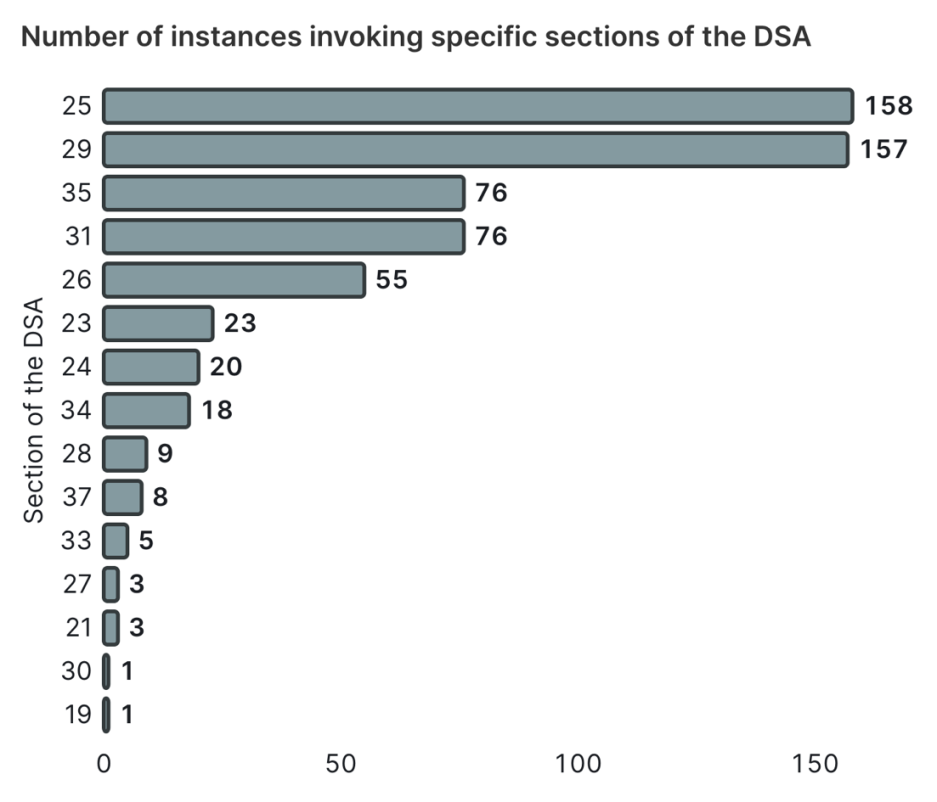
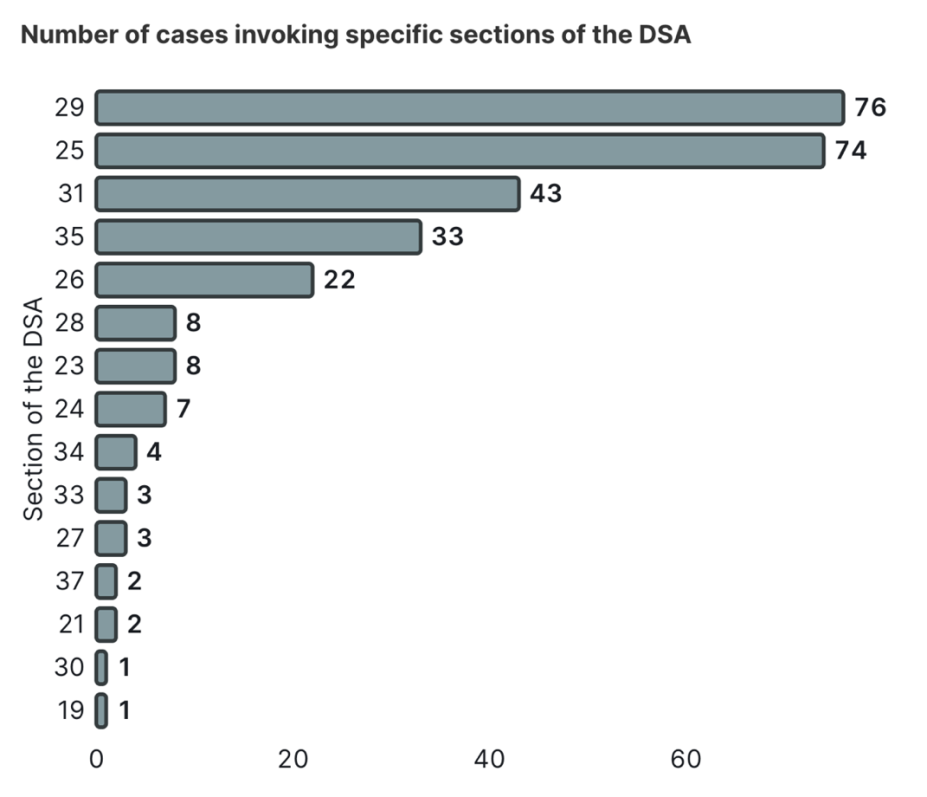
Section 31, which deals with publishing or spreading information that creates enmity or deteriorates law and order, was invoked 76 times (43 cases). Section 35, which deals with the offence of abetment (instigating, engaging with or aiding the commission of an offence) was also invoked 76 times (33 cases).
The remaining offences that were used most against journalists were not offences restricting certain kinds of expression, but ‘non-speech’ offences including: unauthorised use/collection of identity information,111 digital fraud,112 identity fraud/personation113 and hacking.114 For instance, Section 26 (unauthorized use/collection of identity information) was invoked 55 times in 22 cases. That section provides that “[i]f any person without any legal authority collects, sells, takes possession, supplies or uses any person’s identity information, then, that activity of that person will be an offense under the Act.”
Most cases invoked multiple offences—in 95% of instances, the case included more than one offence. This indicates that the authorities concerned do not generally narrow down (or likely carefully consider) the offence to be applied to the allegedly ‘criminal’ activity of the journalist, but rather slap a wide range of offences against them, creating a further chilling effect.
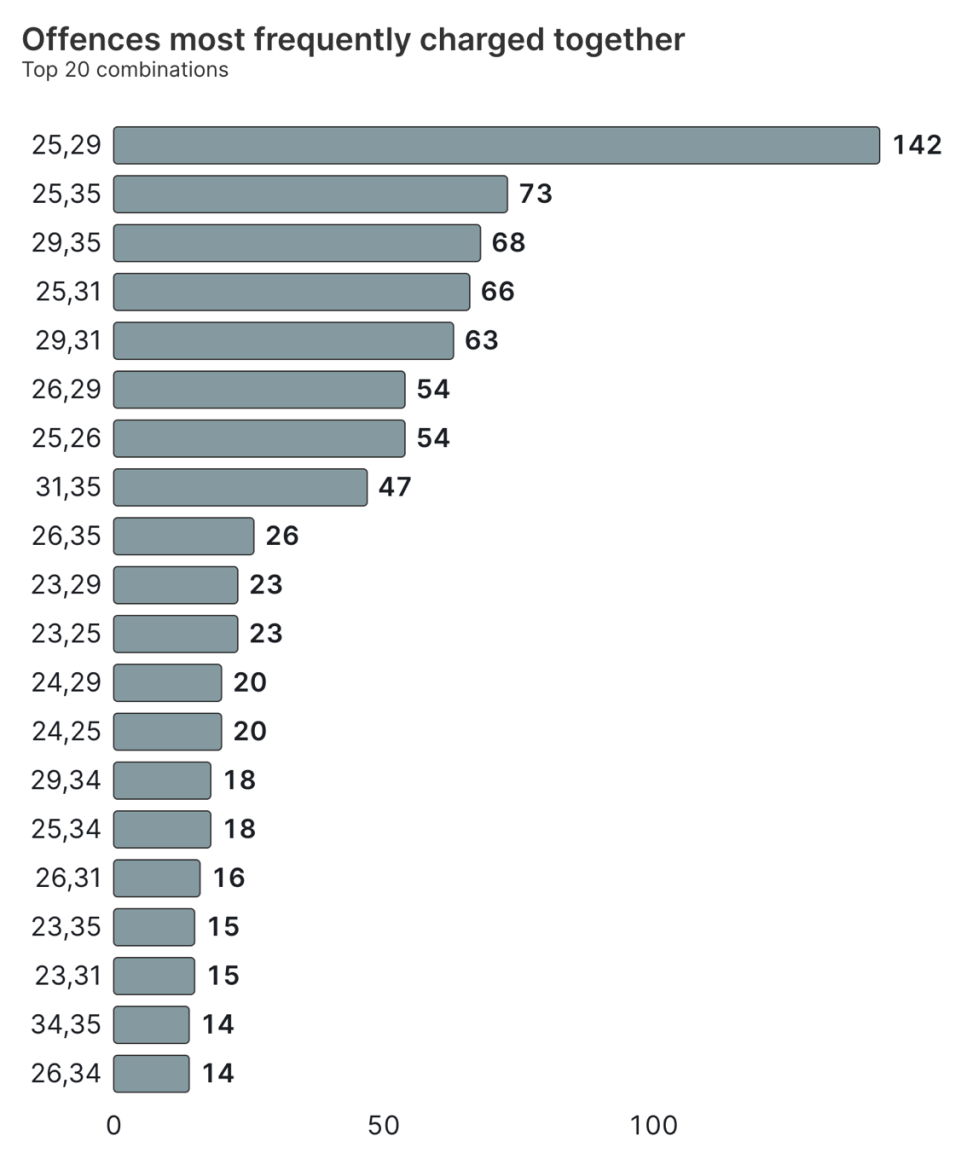
For instance, Sections 25 and 29 were charged together in over 140 incidents. But other offenses were clubbed with less of a logical nexus.
This chart shows the offences most frequently charged together.
For instance, in Molla’s case (for reporting on apparent voting irregularities), the FIR was registered under Sections 25, 31, 33, and 35 of the DSA.115 It is not clear why the journalist’s reporting should constitute both offensive or false information and unlawful access to official information (Section 33).
Section 25 and 31 were also often charged together. But these two offenses are conceptually distinct: Section 25(1)(a), at least, concerns an individual and their reputation or reaction whereas Section 31 (speech creating enmity, hatred or hostility among people) concerns community reaction.
For instance, K M Belal Hossen Swapon was charged with violating Sections 25 and 31 for publicizing a request for a proper investigation into an allegation that a political candidate had been accused of rape. The FIR alleged that the journalist had “undermin[ed] law and order including defamation of character by publishing defamatory false threatening information.”116 But it is far from obvious why an alleged false statement about someone would undermine law and order—rather, the chargesheet simply asserts that due to the post, “there was tension in the area.”117 The chargesheet itself is highly prejudicial, stating that “it is known that the arrested accused . . . is a clever fake news presenter.”118 The journalist was ultimately acquitted in this case.119
Indeed, in some cases, the chargesheet appears to indicate that provoking criticism of someone should be deemed tantamount to creating disorder. For instance, in Shawon’s case (involving the comment about the courts being ‘under Sheikh Hasina’s skirt’), the complaint alleges that “there has been an adverse reaction among the members of Bangladesh Awami League and Chhatra League and various affiliated organizations.
As a result, the harmony of the area is destroyed and there is a fear of creating instability or chaos.”120
The sections that follow provide analysis of the core provisions invoked against journalists and then highlights those that have been carried forward in the CSO.
A. Provisions
Sections 25 and 29
The Law
Section 25(1)(a) and Section 29 both deal with speech against an individual—Section 25(1)(a) criminalizes spreading or publishing data/information that is known to be “offensive, false or threatening in order to annoy, insult, humiliate or malign a person,” while Section 29 criminalises publishing or transmitting defamatory information online— based on the offence of defamation in Section 499 of the Bangladesh Penal Code. Notably, the sentences for defamation in the DSA are harsher than those in the Penal Code: up to three years and/or a fine, and up to five years and/or a fine if repeated in the DSA, as opposed to two years and/or a fine and an exception on the basis of public interest, in the Penal Code.
Section 25(1)(b), by contrast, makes publishing or spreading propaganda or false information with an intention to affect the image or reputation of the country, or to “spread confusion,” punishable with a potential threeyear prison sentence. Unlike Section 25(1)(a), this section appears to be focused on the effect of speech on the wider community.
The wide scope of Section 25—insofar as its provisions apply both to speech about an individual and affecting communities—made it especially susceptible to weaponization. Importantly, the authorities did not clearly specify whether charges were filed under Section 25(1)(a) or 25(1)(b)— leading to further confusion and arbitrariness in its implementation.
One important distinction between Sections 25 and 29 is that the former does not appear to have any exception for true statements. By contrast, Section 29, because it refers to Section 499 of the Penal Code, incorporates a limited defense of truth.
Trends from Data and Case Studies
Section 25 and 29 were invoked by all kinds of complainants—politicians, government employees, journalists, lawyers, educators and businessmen.
For instance, journalist Abu Taiyub Munshi published an article about a mayor with the title “Bond License Managing Director is Khulna City Mayor? 2.5 million taka fine for customs evasion, 5.53 million taka claim. Bond license was cancelled.”121 The article alleged that a company with which the mayor had been or was affiliated had been involved in a customs duty evasion scheme, pointing to a document with the mayor’s signature on it. The mayor in turn filed a complaint alleging that the article constituted “yellow journalism” and was “false and misleading.” The FIR in the case was registered under Sections 25, 29, 31, and 35 of the DSA, claiming that the article created a “conspiracy to create hatred in the public mind by disseminating false, baseless, offensive and defamatory information through digital devices.”122
As indicated by this FIR, in many of the cases, the concepts of ‘offensive’ and ‘defamatory’ speech are conflated, a public reaction is presumed, and any speech or reporting deemed unwelcome is characterized as violating both Sections 25 and 29.
Journalists charged with both Sections were often subject to pre-trial detention—over 80% of the incidents where journalists were arrested and the provision was known included Sections 25 and 29, despite the fact that these offences were bailable. This can be explained by the fact the cases often also included a non-bailable offence, such as violations of Section 23, 24, 26, 31, 31 or 34.
For instance, in the case involving posting of allegations regarding diversion of funds from a construction project, the journalist spent 12 days in jail because the FIR included not only Sections 25 and 29, but also Section 26, which criminalizes use of personal information without permission. The basis for this latter charge was that the journalist had posted photos of the political figures he had written about without obtaining their permission.123 A forensic report that confirmed he had ‘intentionally’ collected the pictures was apparently enough of a predicate for this charge124—despite the fact that under international human rights standards, the publication of news-worthy photographs about public officials is protected by the right to freedom of expression.125
International Human Rights Analysis
Sections 25 and 29 are both inconsistent with international standards and constitutional decisions by courts in other jurisdictions.
First, as to Section 25(1)(a), the terms used, such as ‘offensive,’ are
too vague to comply with the requirement that any restriction on the right to freedom of expression be “provided by law.” This principle requires that the law “must be formulated with sufficient precision to enable an individual to regulate his or her conduct accordingly … [and] may not confer unfettered discretion for the restriction of freedom of expression on those charged with its execution.”126 Courts in several other jurisdictions have struck down similar ‘offensive communication’ provisions on vagueness grounds. For instance, the Indian Supreme Court found unconstitutional Section 66A of India’s Information Technology Act, which criminalized the use of communication devices to transmit “any information that is grossly offensive or menacing and character … or any [electronic communication] for the purpose of causing annoyance.” The Court reasoned that “expressions such as ‘grossly offensive’ or ‘menacing’ are so vague that there is no manageable standard by which a person can be said to have committed an offence or not to have committed an offence.”127 Likewise, the Constitutional Court in Uganda found that Section 25 of the Computer Misuse Act No. 2 of 2011, which criminalized ‘offensive communication’ (in particular, using “electronic communication to disturb or attempt to disturb the peace, quiet or right of privacy of any person with no purpose of legitimate communication”), “does not specify what conduct constitutes offensive communication,“128 and is “not clear and without knowing the ingredients of an offence, one cannot meaningfully prepare his/her defence.”129 On this basis, the Court concluded that “the words used under Section 25 are vague, overly broad and ambiguous” and the law “gives the law enforcer the discretion to pick and choose what qualifies as offensive.”130 It went on to hold that the law was null and void.131 Most recently, in Malaysia, the Court of Appeal struck down a similar provision in its Communication and Multimedia Act, 1998, finding that the law “does not provide any standards as to what amounts to offensive or what would amount to an intent to annoy. When all types of speeches could potentially be offensive if a single person finds it so then freedom of speech has become illusory and enforcement becomes arbitrary.”132
Second, as to Section 25(1)(b), many of the same concerns obtain—in particular, as to the vagueness of terms such as ‘propaganda or false,’ ‘spread confusion’ and ‘affect the image of the nation.’ The Indonesian Constitutional Court, for instance, recently struck down a law that had criminalized “[a]ny person disseminating news or issuing information that can cause disruption among the public, while such person ought to expect that such news or information is false.” The Court found that the wording of the provisions—“false news or information” and news “that is uncertain, or news that is exaggerated”133—was ambiguous “due to the difficulty of determining the standards or parameters of the ‘truth’ of the information.”134 The Court acknowledged that the “the judgement of whether that information is ‘true’ or ‘exaggerated’ is highly dependent on the judgement of legal subjects who have different backgrounds [and] religious, cultural and social values.”135 Likewise, the East African Court of Justice has held that a provision of Tanzanian law that purported to criminalize publications “likely to cause fear and alarm to the public” was unlawfully vague.136
Moreover, the UN Human Rights Committee has been clear that “States parties should not prohibit criticism of institutions, such as the army or the administration” and that “[t]he penalization of a media outlet, publishers or journalist solely for being critical of the government or the political social system espoused by the government can never be considered to be a necessary restriction of freedom of expression.”137
Both sub-sections also refer to ‘information.’ As Article 19 notes, criminalising the spreading of “false information” is problematic because facts are not easily distinguishable from opinions.138 And indeed, the European Court has found that the criminalization of ‘information’—by failing to draw this distinction—is an “indiscriminate approach to the assessment of speech” and a per se violation of the right to freedom of expression.139
Third, as to Section 29, the UN Human Rights Committee has recommended that defamation be decriminalised,140 and in any event, defamation should never be sanctioned with imprisoned, as the DSA permits. Further, Section 29 cross references Section 499 of the Penal Code, which has its own flaws.
Under international law, “penal defamation laws[] should include such defences as the defence of truth.”141 The Human Rights Committee has found a violation of Article 19 when a radio commentator was convicted under a defamation law that permitted the proof of truth only under restricted conditions.142 In a case where an Angolan journalist was charged with defamation for alleging corruption against the President, the Committee emphasized the importance of the defence of truth, finding an Article 19 violation because the “proposed truth defence against the libel charge was ruled out by the Courts.”143 The Committee also expressed “concern” that South Korea’s defamation law allowed for criminal prosecution for true statements, “except when such statements are made solely for the public interest.”144
Section 499 of the Penal Code only permits a defence of truth “if it be for the public good that the imputation should be made or published.” This is the kind of limitation to the defence that is inconsistent with international standards.
Current Position
Neither Section 25 not 29 is included in the CSO. Nevertheless, defamation continues to be an offence under the Bangladesh Penal Code, punishable with two years imprisonment,145 and has been used in the past “frequently” against critical journalists.”146
Further, cases in our dataset suggest that Section 26 of the CSO will continue to be a threat. Section 26 provides, “[i]f any person intentionally or knowingly or under a pseudonym illegally enters his own or another’s ID and publishes or circulates or causes to be published in cyberspace anything that is related to any religion or communal hate speech or racial hatred and which creates violence or creates anxiety or directs disorder or criminal activities, then such an act shall be considered” an offense. While many of the elements of Section 26 are successors to elements of Section 31 of the DSA (discussed next), the concept of ‘creating anxiety’ is similar to the notion of ‘spreading confusion’ found in Section 25(1)(b) of the DSA.
Indeed, in one case under Section 25 (among other provisions, including Section 31), the chargesheet alleged the defendant had propagated “false information, which has created confusion in the public mind, created an unstable, chaotic environment”147—effectively merging the violation of Section 25 (creating confusion) with the violation of Section 31 (deteriorating the law and order situation). This suggests that the ‘creates anxiety’ element of the new Section 26 may be used in some similar ways to Section 25, although Section 26 is restricted to various forms of alleged hate speech.
Section 31
The Law
Section 31, which relates to spreading or publishing material that “creates enmity, hatred or hostility among different classes or communities,” creates “unrest or disorder” or “deteriorates the law and order situation,” was invoked 76 times in the dataset (in 43 cases).
Section 31 permits harsh sentences—imprisonment of up to 7 years. This is harsher than the two-year prison sentence prescribed in the Penal Code for a similar offence—Section 153A (promoting enmity or hatred between different classes). Further, Section 31 is a non-bailable offence, meaning those charged with the provision can be subject to pre-trial detention.
Trends from Data and Case Studies
Section 31 was often clubbed with Sections 25 and 29 (66 and 63 times respectively). As discussed above, this is surprising given that Section 31 is a public order provision, whereas Section 29 and Section 25(1)(a) deal with speech about or directed toward an individual. Section 31 was also invoked in close to 80% of the incidents filed by government employees; and 55% of those filed by politicians.
Journalists facing charges under Section 31 were more likely to be arrested and detained pending trial—70% of the incidents involving Section 31 led to pre-trial detention (where information was known).148
The cases show how speculative the threshold for registering a case was. For instance, in Ikhtiyar Uddin Azad ‘s case (relating to alleged food shortages during the height of the COVID-19 outbreak), an FIR was registered on the theory that the post “discredit[ed] the image of the state and the government, create[d] fear and panic among the public, [and] attempt[ed] and aid[ed] the deterioration of law and order.”149 The FIR offered no explanation for why criticism of the government’s response to a pandemic would necessarily lead to panic and deterioration of the law and order situation.
Likewise, in the case against three journalists for reporting on alleged reduced food quantities in the COVID-19 ward of a hospital, the chargesheet simply said that “[b]y grossly tarnishing and defaming the image of the representative of the contracting organization and spreading the said defamatory, false information degrading the law and order by publishing and spreading rumours, public distrust towards Modern District Headquarters Hospital during the current epidemic of Covid-19 virus, hostility between the public of different classes or communities, hatred, public anger, hatred and confusion in the said hospital due to deterioration of law and order, it is necessary to take legal action against the reporters of the said reports along with their accomplices.”150
Likewise, journalist Abu Zafar faced charges under Section 31 for a piece about alleged corruption by the Officer in Charge (OC) of an area.151 Interestingly, it was not the officer himself who filed the complaint, but the organizer of the local Swecchasebak league (the volunteer wing of the Awami league).152 The theory of the complaint was that criticism of local law enforcement would create a “situation of instability and chaos.”153 Again, why this would necessarily be so went unexplained.
International Human Rights Analysis
As with Sections 25 and 29, Section 31 includes a number of vague and broad terms, including in particular ‘unrest or disorder’ and ‘enmity, hatred or hostility.’ For instance, in analysing Indonesia’s ‘fake news’ law, which the Constitutional Court struck down, the Court noted that the Articles at issue require the speech to cause, or have the likelihood to cause, ‘disruption,’ but “there is a lack of clarity regarding the scale or parameter that constitutes the limit of danger”154 and that “what can or may happen is a subjective judgement that has the potential to create arbitrariness.”155 At the international level, in several decisions, the UN Working Group on Arbitrary Detention has found that provisions criminalizing incitement to ‘social disorder’156 or ‘disobedience to the authorities or riots’157 were impermissibly vague. The same is true as to ‘unrest or disorder.’
The Rabat Plan of Action on the prohibition of advocacy of national, racial or religious hatred that constitutes incitement to discrimination, hostility or violence, which was adopted by experts following UN workshops around the world, recommends that “States … consider including robust definitions of key terms such as hatred, discrimination, violence, hostility, among others” so as to avoid opening the door to prosecutions based on criticism, insult, and inappropriate words.158 Such definitions are lacking in Section 31.
Moreover, international law requires that restrictions on speech be necessary and proportionate to achieving a legitimate objective. Under the International Covenant on Civil and Political Rights, restrictions on speech are only permitted for “respect of the rights or reputations of others” or “the protection of national security or of public order, or of public health or morals.” This is an exhaustive list.159 Section 31 would appear to have two main objectives: protecting groups from hostility and hatred and protecting public order.
To the extent the objective of Section 31 is the protection of groups from “enmity, hatred or hostility” it is not clear that it is limited to “individuals and communities belonging to ethnic, national or religious groups,” as indicated by the Rabat Plan,160 as opposed to, for instance, political groups. Indeed, in one case several journalists were charged with violating Section 31 for a story that allegedly created animosity or hatred regarding a District Committee of the Bangladesh Awami League,161 making clear the wide scope of application of Section 31.
To the extent the objective of the law is protecting public order, it would not seem limited to the kinds of harms encompassed by that term. In a recent decision, Malaysia’s High Court analysed the difference between ‘public order’ and ‘law and order,’ having reference to the developed jurisprudence of India’s Supreme Court. In so doing, the court noted that “‘law and order’ . . . comprehends disorders of less gravity than those affecting ‘public order.’”162 In this case, Section 31 is plainly meant to protect ‘law and order.’ It thus exceeds the scope of the objectives in pursuit of which speech can be limited.
Finally, as to necessity and proportionality, the Rabat Plan suggests that hate speech must have “a reasonable probability . . . [of] inciting actual action against the target group, recognizing that such causation should be rather direct,” rather than simply arousing ‘feelings’ or criminalizing incitement to an offence, no matter now indirect the connection.163 The UN Special Rapporteur on contemporary forms of racism, racial discrimination, xenophobia and related intolerance has for instance suggested that Singapore’s somewhat similar law should be reviewed to be brought into compliance with international standards.164 With respect to the DSA, the later clause of Section 31 applies to speech that “deteriorates” or “advances to deteriorate” law and order. It is not clear whether “advances to deteriorate” is tantamount to likely, or possibly, or some other standard.
Current position
Section 31 has been partially carried forward in the CSO. As discussed above, Section 26 of the CSO provides “[i]f any person intentionally or knowingly or under a pseudonym illegally enters his own or another’s ID and publishes or circulates or causes to be published in cyberspace anything that is related to any religion or communal hate speech or racial hatred and which creates violence or creates anxiety or directs disorder or criminal activities.” This includes a number of elements in common with Section 31 of the DSA, including the concept of racial ‘hatred’ and the potentially overlapping concerns regarding ‘disorder’ and ‘anxiety.’
Anxiety, in particular, is an undefined term that is capable of wide construction. Further, the scope of ‘communal’ is not clear—including whether it includes or excludes political parties.
The main improvement, however, is that Section 26 of the CSO is bailable and non-cognizable, unlike Section 31, which was non-bailable and cognizable.
Section 28
The Law
Section 28 criminalizes publication of information that “hurts religious sentiment or values.” This provision was invoked in 8 cases in our data.
For instance, in the case of Henry Swapon, he faced charges under Section 28, in addition to charges under Section 29 and 31. The basis for the charges was a post suggesting the local catholic church was insensitive for organizing a cultural program at a time when a series of bomb blasts had targeted churches in Sri Lanka.165 Swapon said he thought the case was retaliation for his reporting on alleged corruption within the church.166 The High Court eventually issued a stay order in his case in 2022—three years after the FIR was registered.167
International Human Rights Analysis
Terms such as ‘hurt religious sentiment or values’ are vague, and thus provisions such as Section 28 violate the right to freedom of expression. Further, the UN Human Rights Committee has made clear that “[p]rohibitions of displays of lack of respect for a religion or other belief system” are not compliant with the right to freedom of expression except where the allegedly blasphemous speech fits within the framework of Article 20 of the ICCPR.168 The Special Rapporteur on Freedom of Expression has reached similar conclusions. As stated by the Rapporteur, “anti-blasphemy laws fail to meet the legitimacy condition of article 19(3) of the Covenant, given that article 19 protects individuals and their right to freedom of expression and opinion … [article 19 does not] protect ideas or beliefs from ridicule, abuse, criticism or other ‘attacks’ seen as offensive.”169
166 Id
167 Id
Current Position
As discussed above, Section 26 of the CSO covers religious hate speech, which would seem to raise similar concerns to those posed by Section 28 of the DSA.
This concern is borne out by abuses identified with other laws criminalising hurting religious feeling as well. As the Media Reform Commission has noted, “[t]he existing law regarding ‘hurting religious sentiments’ has been misused against journalists and others, especially against people of minority communities.”170
Section 35
The Law
Section 35 makes abetting the commission of any offence under the DSA punishable with the same imprisonment as provided for the offence. Section 35 does not define abetment. Section 107, Bangladesh Penal Code, defines abetment as “instigat[ing] any person to do that thing,” “engag[ing] with one or more other person or persons in any conspiracy for the doing of that thing, if an act or illegal omission takes place in pursuance of that conspiracy” or “intentionally aid[ing], by any act or illegal omission, the doing of that thing.”
Section 35 was invoked 76 times (in 33 cases) and most often in conjunction with Sections 25 and 29 (73 and 68 times respectively).
Trends from Data and Case Studies
Section 35 was invoked frequently to implicate more than one journalist— 63% of the cases invoking Section 35 (21 of 33 cases) covered more than one journalist.
Among the 30 case studies, three journalists faced charges for reposting or sharing content on social media. In these cases, journalists were not being penalized for original speech, but rather for amplifying content already in public circulation. Both cases where the provisions were known included Section 35. This suggests a trend where journalistic amplification alone can become grounds for prosecution in Bangladesh.
One journalist faced charges under Sections 25, 29, 31, and 35 for sharing news on Facebook that alleged corruption involving a mayor.171 Despite merely amplifying an existing report, he was prosecuted under multiple provisions and detained for 34 days before being granted bail by the Sessions Court.172
And in another case two editors and a journalist were criminalized for allegedly publishing a story that included a quote from a police officer that he said he never gave.173 The FIR invoked Sections 25, 29, 31, and 35.174 One of the defendants was not involved in the online news (handling only the print version), but he was nevertheless swept up in the case before eventually being acquitted.175 The second editor likewise said he had nothing to do with the story, and was also eventually acquitted more than a year after his colleague.176 This suggests that Section 35 permits the authorities to investigate and charge not only those who repost allegedly unlawful information, but also anyone involved in a publication, whether they had a role in the speech/story in question, or not.
International Human Rights Analysis
Section 35 has been criticized for failing to include an element of intention in the offence, and for failing to define what constitutes abetment.177 This raised concerns that it could be used to “criminalise a wide range of Internet users”178—concerns that are made out in the data collected for this report.
Current Position
Under the CSO, abetting an offense remains a crime. In fact, it mirrors the language of the DSA nearly verbatim. While the fact that the principal offenses have been limited may reduce its scope for abuse, it is easy to see how it could be coupled with Section 26 to sweep in those who repost critical comments that are alleged to ‘cause anxiety.’
Non-Speech Offences
As mentioned earlier, the remaining offences that were most used against journalists did not relate to content of the speech or reporting. While the criticism of the DSA has generally focused on the so-called “speech provisions”—such as Sections 25, 28, 29, and 31, discussed above, as well as Sections 21 and 27179–our data suggests that other provisions were also prone to misuse.
Section 26, for instance, which makes the unauthorized collection, possession, sale and use of the identity information of another person punishable with imprisonment for up to five years, featured 55 times in our dataset (in 22 cases).
This section was invoked in particular in cases involving publication of photos. As discussed above, one journalist faced a case for posting photos of the political figures he had written about without obtaining their permission.180 In another case journalist Khondokar Rakib faced charges under Section 26 (and others) for publishing a photo showing an individual alleged to be involved in the drug trade on stage at a public event at a police station to promote drug awareness. In that case, the chargesheet simply stated that the Section 26 offence involved “using personal information (photos) without the permission of the plaintiff.”181 The cases thus appear to concern photos of public figures or bearing on the public interest. But international and regional standards generally find the public interest in such photos outweighs the individual being photographed’s privacy interest.182
Likewise, Section 23, which pertains to commission of digital and electronic fraud (defined to include changing, deleting, adding or tampering with any information of a computer programme, computer system, computer network, digital device, digital network or social media with the intention to gain benefit or cause harm to the other person), was invoked 23 times (in 8 cases). In one case, journalist Abdul Kaium alleged that he faced repeated harassment by the son-in-law of a local MP—all meant to impede his work. According to Kaium, he had been asked to create a website for a madrasa. When he arrived at the premises for payment, he was offered U.S. dollars, which he declined; he was nevertheless arrested shortly after leaving the madrasa based on the allegation that he was carrying $200 for ‘illegal work’ (even though no such funds were found on him, as he had declined the payment).183 The next day, an FIR was lodged against him under the DSA, invoking Sections 25 and 29, as well as Section 23, based on alleged comments on social media, which the journalist denied having made.184
Section 34 which deals with the offence of hacking was also invoked 18 times (in 4 cases) against journalists. For example, the provision was applied against the journalist publishing a report alleging corruption/preferential treatment given to a restaurant owned by the daughter of a former Member of Parliament (MP).185
Finally, Section 27 criminalizes cyber terrorism, which requires damage or intrusion into digital systems. And yet in Ikhtiyar Uddin Azad’s case (involving alleged food shortages during the pandemic), this provision was invoked, alongside others. It is not at all clear why, however, since the FIR simply states that the ‘crime’ consisted of “publishing false information through Facebook about the ongoing Corona virus through digital devices, discrediting the image of the state and the government, creating fear and panic among the public, attempting and aiding the deterioration of law and order.”186
The arbitrary application of non-speech provisions raises concern about provisions in the CSO being similarly weaponized.187
Current Position
While Section 26 of the DSA (use of identity information) has no equivalent in the CSO, the CSO retains provisions for hacking and fraud in cyber-space.
Of particular concern is the cyberterrorism provision in the CSO, which is substantially similar to that of the DSA, raising concerns that it could be abused—including in particular by reference to such broad terms as “any purpose contrary to friendly relations with a foreign state or public order.”188
This data shows that whether or not as many ‘speech offenses’ remain available, abusive tools remain in the toolbox, which can be used alongside even more narrowly-drawn offences.
B. Basis of Charges
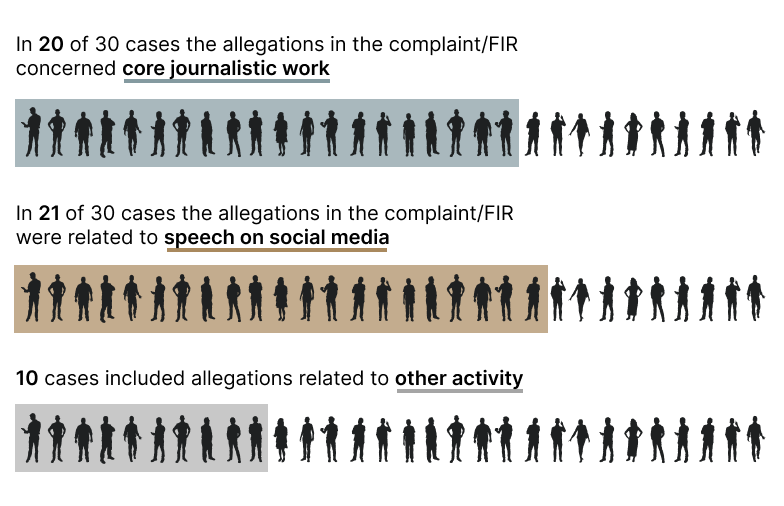
Our analysis reveals a clear pattern, evident also from the examples above: individuals were frequently targeted and prosecuted for engaging in core journalistic functions or for critical comments on social media. As discussed, in 20 of 30 cases the allegations in the complaint/FIR concerned core journalistic work—reporting on or sharing news related to public interest issues (such as investigations into corruption or reporting on misconduct by public officials). In MD Hedait Hossain Molla’s case, described above, he was stationed at an official’s office reporting voting results as they came in during the 2018 elections.189 For relaying to colleagues in his newsroom concerns about the tallies, he faced charges under Sections 25, 31, 33, and 35 of the DSA.190 During the investigation, however, he was vindicated, with the chargesheet ultimately indicating “no specific information or evidence to prove the allegations of the said case against the said accused.”191
Reporting on the conduct of elections is, of course, a quintessential journalistic function. As both the European Court and Human Rights Committee have concluded, “[t]here is little scope . . . for restrictions on debates on questions of public interest.”192 The European Court has also stressed that “[t]he ‘public watchdog’ role of the press is no less pertinent at election time.”193
The three journalists who published a report on the quality and quantity of food provided to patients in the COVID-19 ward of a hospital were charged under Sections 25, 29, 31, and 35 of the DSA.194 But this is a second kind of core public interest speech—reporting on public health. For instance, in a case before the European Court, the court stressed that reporting on such issues (in that case, mercury quantities in a soft drink) was public interest speech. As the court put it, “this clearly pertains to an important aspect of human health . . . . Accordingly, the impugned news items conveyed information of considerable public interest.”195
Likewise, Munir Uddin Ahmed faced charges for posting on a clash between police and protesters on social media.196 Ahmed believes that ‘the higher ups of the police force have ordered this arrest being afraid of facing public rage about the deaths.’197
Importantly, 70% of the cases related to core journalistic work involved commentary/criticism of the government or government functionaries.
For instance, Abu Taiyub Munshi faced charges for reporting on alleged corruption of a mayor, who said that he was previously, but was no longer, associated with the institution that had come into question for customs duty issues.198 In his case, the FIR invoked Sections 25, 29, 31, and 35 of the DSA.199
As with reporting on matters of public interest, reporting on public officials and candidates for office enjoys heightened protection. The UN Human Rights Committee has specifically stated: “the value placed by the [ICCPR] upon uninhibited expression is particularly high in the circumstances of public debate in a democratic society concerning figures in the public and political domain.”200
The second main category of speech at issue was allegedly caustic speech online. Many times this was on social media. In fact, 21 of 30 cases in our smaller dataset were filed against journalists’ alleged expression on social media platforms. This includes cases such as the one where the journalist posted about a clash between police and protesters on social media, but also others where the journalists were expressing their personal opinions. For instance, in the case involving the journalists charged for apparently failing to refer to magistrates as ‘sir’ the theory of the case was that they had gone on Facebook Live and made “various taunts” about the mobile court, “various bad comments” about the District Commissioner, and “various ugly and defamatory comments
20, 2019, available at https://www.thehindu.com/news/international/4-killed-50-injuredas-protesters-clash-with-police-over-blasphemous-facebook-post-inbangladesh/article29751887.ece.
about learned magistrates.”201 Likewise, Lutfur Rahman Shawon was prosecuted for allegedly commenting that the courts were Prime Minister Hasina’s petticoats.202
In many of these cases, these posts were considered insulting. And yet the Human Rights Committee has said that defamation laws “should not be applied with regard to those forms of expression that are not, of their nature, subject to verification.”203 It has also held that the mere fact that “forms of expression are considered to be insulting … is not sufficient to justify the imposition of penalties.”204 The European Court of Human Rights has likewise stressed the difference “between statements of fact and value judgments. While the existence of facts can be demonstrated, the truth of value judgments is not susceptible of proof. The requirement to prove the truth of a value judgment is impossible to fulfil and infringes freedom of opinion itself.”205 By their nature, value judgments may be insulting. In 2005, for example, the European Court heard a case where the applicant used the phrase “No shame and no scruples!” to publicly describe the Governor of Ulyanovsk Region (Oblast) in Russia.206 Despite the phrase’s unpleasant connotations, the European Court held that the contested statement was “a quintessential example of a value judgment that represented the applicant’s subjective appraisal of the moral dimension” of the Governor’s behaviour.207
To be sure, these categories are not neatly divisible. In our dataset, most charges based on material critical of government functionaries were for alleged speech on social media (73%–11 of 15 cases), underscoring how online, digitized platforms have become the primary space where critical reporting and commentary have led to legal action.
Wee People Copyright © 2018 ProPublica and Alberto Cairo CC BY-NC_ND 3.0 US
Ten of 30 cases in our dataset fell into the category of “other activity,” where the allegation in the complaint was not directly tied to journalistic reporting.208 In these cases, the allegations involved a personal dispute or activities unrelated to journalistic or political content, yet most journalists (at least six) claimed it was in retaliation for their reporting. This includes the case of Abdul Kaium who was arrested for allegedly receiving illegal money, and faced a case under the DSA filed by the son-in-law of a local MP; as well as journalist Mamunur Rashid Nomani, who faced charges for allegedly secretly taking photos of a mayor by a river. Nomani alleged that the Mayor filed the case in retaliation for his reporting on the waterlogging situation in the city.
C. Conclusion: Current Position of Cases
Despite repeal of the DSA by the CSA, and the further repeal of the CSA by the CSO, pending DSA cases were not, at least initially, withdrawn by the interim government. The savings clause in the CSA—Section 59(2)— had provided that “cases pending under the said Act [DSA] immediately before such repeal, shall be conducted and disposed of in the concerned Tribunal and the appeals against the orders, judgments or sentences passed in similar cases shall be conducted and disposed of in the concerned Appellate Tribunal as if the said Act had not been repealed.” However, with the repeal of the CSA by the CSO, there is no longer a legal basis for cases under the DSA to proceed.
This has been partially clarified by the amendment to the CSO of October 2025. However, this new provision only dismisses cases pending under certain provisions of the DSA—Sections 21, 24, 25, 26, 27, 28, 29, and 31 of the DSA, as well as abetment of these offenses, instead of all cases.
Litigation may be necessary to clarify that even as to those Sections of the DSA to which the amendment does not apply, there is no legal basis for those cases to continue. It is possible that certain speech-restrictive prosecutions were filed under these provisions. For instance, as discussed above, the case against MD Hedait Hossain Molla (for reporting on vote tallies) also invoked Section 33 of the DSA, which is not covered by the recent amendment to the CSO.
Further, the CSO repealed the CSA, but saved certain cases under the CSA. It specifically excepted “all pending cases under sections 17, 18, 19, 20, 22, 23, 30, 32, and 35 of the said Act [CSA], including cases relating to offences of abetment of such offences.”209 This includes, for instance, cyberfraud, which appears in our DSA database. Moreover, neither the CSO nor the CSO Amendment specifically require withdrawal or quashing of ICT Act cases, many of which, with the adoption of the CSA, no longer have a legal basis.
Finally, the interim government has not issued an exhaustive list of all cases dropped/withdrawn as a result of the CSO amendment, nor clarified the implications for persons who have already suffered unjust prosecutions under the law. This could become an acute concern in the event the CSO is not adopted by the incoming Parliament, in which case the status of the cases would become more uncertain with the CSA (and its savings clause as to the DSA) potentially snapping back into place.
Thus, the concerns highlighted in the section below are not just lessons for the future, but continue to be relevant for the journalists in the dataset.
Notes
- Section 26. ↩
- Section 23. ↩
- Section 24. ↩
- Section 34. 39 ↩
- FIR 06/221, Batiaghata Police Station, December 31, 2018, MD Hedait Hossain Molla; Chargesheet No. 36/1, March 23, 2020, MD Hedait Hossain Molla. ↩
- Interview, K M Belal Hossen Swapon; FIR 16/225, Chatmohor Police Station, December 26, 2020, K M Belal Hossen Swapon. ↩
- Chargesheet No. 131, July 18, 2021, K M Belal Hossen Swapon. ↩
- Chargesheet No. 131, July 18, 2021, K M Belal Hossen Swapon. ↩
- Rajshahi Cyber Tribunal Verdict, [Date Unclear]. 41 ↩
- Complaint as the basis for FIR 20/355, Chhatak Police Station, December 25, 2021, Lutfur Rahman Shawon. 42 ↩
- Complaint as the basis for FIR 25/140, Khulna Sadar Police Station, April 20, 2021, Abu Taiyub Munshi; Interview, Abu Taiyub Munshi. ↩
- FIR 25/140, Khulna Sadar Police Station, April 20, 2021, Abu Taiyub Munshi; Interview, Abu Taiyub Munshi; Complaint as the basis for FIR 25/140, Khulna Sadar Police Station, April 20, 2021, Abu Taiyub Munshi. 43 ↩
- Interview; Complaint; Chargesheet. ↩
- Chargesheet. ↩
- European Court of Human Rights (Grand Chamber), Axel Springer v. Germany, App. No. 39954/08, Feb. 7, 2012, paras. 90-91 (recognizing “the contribution made by photos or articles in the press to a debate of general interest” and stressing that in balancing the right to freedom of expression against the right to privacy, “[t]he role or function of the person concerned and the nature of the activities that are the subject of the report and/or photo constitute another important criterion . . . . [and] a distinction has to be made between private individuals and persons acting in a public context, as political figures or public figures.”). ↩
- UN Human Rights Committee, General Comment No. 34, Article 19: Freedoms of Opinion and Expression, UN Doc. CCPR/C/GC/34, Sept. 12, 2011 [hereinafter “General Comment No. 34”], para. 25. 44 ↩
- See Indian Supreme Court, Shreya Singal v. Union of India, Writ Petition (Criminal) No. 167 of 2012 (2015). ↩
- Constitutional Court of Uganda, Karamagi et al. v. Attorney General, Judgment, Constitutional Petition No. 5 of 2016, pg. 15. ↩
- Id., at pgs. 11-12. ↩
- Id., at pg. 12. ↩
- Id. at pg. 16. See also High Court of Kenya at Nairobi, Andare v. Attorney General et al., Judgment, Apr. 19, 2016, paras. 77-78 (striking down a law that criminalized “send[ing] a message or other matter that is grossly offensive or of an indecent, obscene or menacing character” or “send[ing] a message that [a person] knows to be false for the purpose of causing annoyance, inconvenience or needless anxiety to another person.”). ↩
- Court of Appeal, Heidy Quah Gaik Li, Judgment, No. B-01(A)-514-10/2023, para. 73.45 ↩
- This language is found in another sub-section of the provision. ↩
- Constitutional Court Judgment [translation], Case No. 78/PUU-XXI/2023, para. 3.18.2, ↩
- Id. ↩
- EACJ, Media Council of Tanzania and Ors. v. Attorney General of the United Republic of Tanzania, Reference 2 of 2017, [2019] EACJ 2, Mar. 28, 2019 (First Instance Division), available at https://globalfreedomofexpression.columbia.edu/wpcontent/uploads/2019/05/Referene-No.2-of-2017.pdf (see also case cited therein). ↩
- General Comment No. 34, paras. 38, 42. ↩
- Article 19, Bangladesh: Digital Security Act 2018, Legal Analysis (November 2019), pg. 16, available at https://www.article19.org/wp-content/uploads/2019/11/Bangladesh-Cyber-Security-act-2018-analysis-FINAL.pdf. 46 ↩
- See, e.g., ECtHR, Gorelishvili v. Georgia, App. No. 12979/04, Sept. 5, 2007, para. 38; ECtHR, Fedchenko v. Russia, App. No. 33333/04, June 28, 2007, para. 37. ↩
- General Comment No. 34, para. 47. ↩
- See General Comment No. 34, para. 47; see also Amal Clooney & David Neuberger, Freedom of Speech in International Law, Oxford University Press, pgs. 114–116 (2024). ↩
- UNHRC, Adonis v. Phillipines, U.N. Doc. CCPR/C/103/D/1815/2008/Rev.1, Oct. 4 to Nov. 4, 2011, para. 3.5 (The law in consideration in this case was “[A]rticle 354 of the Revised Penal Code, according to which ‘every defamatory imputation is presumed to be malicious, even if true, if no good intention and justifiable motive for making it is shown, except in the following cases … 2. A fair and true report, made in good faith, without any comments or remarks of any judicial, legislative or other official proceedings which are not of confidential nature, or of any statement, report or speech delivered in said proceedings, or of any other act performed by public officers in the exercise of their functions.’”). ↩
- UNHRC, Marques de Moraís v. Angola, U.N. Doc. CCPR/C/83/D/1128/2002, Mar. 29, 2005, para. 6.8. 47 ↩
- UNHRC, Concluding Observations on the Fourth Periodic Report the Republic of Korea, U.N. Doc. CCPR/C/KOR?CO/4, Dec. 3, 2015, para. 46; Amal Clooney & David Neuberger, supra, pg. 115. ↩
- The Penal Code, 1860, Sections 499 and 500. ↩
- Amnesty International, Caught Between Fear and Repression: Attacks on Freedom of Expression in Bangladesh, (May 2017), pg. 8, available at https://www.amnesty.org/en/documents/asa13/6114/2017/en/. ↩
- Chargesheet No. 36/1, March 23, 2020, MD Hedait Hossain Molla. 48 ↩
- In 30 of the 76 incidents where Section 31 was invoked, information on pre-trial detention was not known. ↩
- FIR 20/194, Patnitala Police Station, May 13, 2020, Ikhtiyar Uddin Azad. 49 ↩
- Chargesheet No. 141, June 23, 2022, Tanvir Hasan Tanu, Rahim Shuvo, and Abdul Latif Litu. ↩
- Interview, Abu Zafar; Complaint as basis for FIR [Number Unclear], Dohar Police Station, February 20, 2019, Abu Zafar. ↩
- Id. ↩
- Id. 50 ↩
- Constitutional Court Judgment [translation], Case No. 78/PUU-XXI/2023, para 3.18.5. ↩
- Id. ↩
- UN Working Group on Arbitrary Detention, Ros Sokhet v. Cambodia, U.N. Doc. A/HRC/WGAD/2021/75, Jan. 27, 2022, para. 66. ↩
- UN Working Group on Arbitrary Detention, Opinion No. 57/2024 concerning Saparbek Akunbekov, UN Doc. A/HRC/WGAD/2024/57, Mar. 3, 2025, para. 104 (“This provision, by criminalizing broad and vague concepts such as ‘disobedience’ and ‘riots’, fails to meet the rigorous standards set by article 19 (3) of the Covenant.”). ↩
- OHCHR, The Rabat Plan of Action, Oct. 5, 2012, para 21. ↩
- General Comment No. 34, para. 21. 51 ↩
- Rabat Plan of Action, para. 11.
- Complaint (discussing “creat[ing] animosity, or hatred between classes or sects regarding that sacred political institution”) (emphasis added) [note that in this case the journalist’s name is withheld on their request]. ↩
- Heidy Quah, supra, para. 37 (citing Dr. Ram Manohar Lohia v State of Bihar and Others). ↩
- Rabat Plan of Action, para. 29. ↩
- Human Rights Council, Report of the Special Rapporteur on Contemporary Forms of Racism, Racial Discrimination, Xenophobia and Related Intolerance, Githy Muigai, UN Doc. A/HRC/17/40/Add.2, Mar. 25, 2011, available at https://documents.un.org/doc/undoc/gen/g11/123/13/pdf/g1112313.pdf. The law in Singapore is most closely analogous to Section 153A of the Bangladesh Penal Code, to which Section 31 bears some similarity. 52 ↩
- Interview, Henry Swapon; Bangladesh Supreme Court High Court Division, Court Order, June 5, 2022. 53 ↩
- General Comment No. 34, para. 48 ↩
- UN General Assembly, Report of the Special Rapporteur on the promotion and protection of the right to freedom of expression, U.N. Doc, A/74/486, Oct. 9, 2019, para. 21. See also Human Rights Council, Report of the Special Rapporteur on Freedom of Religion or Belief, U.N. Doc A/HRC/31/18, Dec. 23, 2015, para. 61 (“[T]he employment of criminal sanctions against expressions which do not advocate for violence or discrimination but which are deemed ‘blasphemous’” is “incompatible” with the right to freedom of expression.”). 54 ↩
- Media Reform Commission Report, pg. 70. 55 ↩
- FIR 25/140, Khulna City Police Station, April 20, 2021, Sabur Rana. ↩
- Interview, Sabur Rana. ↩
- Interview, Ramjan Ali Pramanik; Interview, Shanto Banik. ↩
- FIR 7/71, Palash Police Station, April 30, 2020, Ramjan Ali Pramanik and Shanto Banik. ↩
- Interview, Ramjan Ali Pramanik. ↩
- Interview, Shanto Banik. ↩
- Article 19, Bangladesh: Digital Security Act 2018, Legal Analysis, (November 2019), pg. 17, available at https://www.article19.org/wp-content/uploads/2019/11/Bangladesh-Cyber-Security-act-2018-analysis-FINAL.pdf. ↩
- Id. 56 ↩
- Section 21, which makes publishing “any propaganda or campaign against the liberation war of Bangladesh, spirit of liberation war, father of the nation, national anthem or national flag,” featured three times in our dataset, and Section 27, which relates to cyber-terrorism, also appeared three times in our dataset. In its Technical Note, the OHCHR specifically called for the repeal of Section 21 (pg. 2) and recommended the amendment or repeal of eight other sections, including Section 27. In its review of the DSA, Article 19 recommended repeal of Section 21 (pg. 15). ↩
- Interview; Complaint; Chargesheet. ↩
- Chargesheet No. 165, December 31, 2022, Khondokar Rakib. 57 ↩
- ECtHR, Von Hannover v. Germany (No. 2), App Nos. 40660/08 and 60641/08, Feb. 7, 2012. ↩
- Interview, Abdul Kaium. ↩
- Interview, Abdul Kaium. ↩
- The Daily Star, Ex-MP’s Daughter Files DSA Case Against 6 Journos of Rangamati, Sept. 19, 2022, available at https://www.thedailystar.net/news/bangladesh/crime-justice/news/ex-mps-daughterfiles-dsa-case-against-6-journos-rangamati-3123231. 58 ↩
- FIR 20/194, Patnitala Police Station, May 13, 2020, Ikhtiyar Uddin Azad. ↩
- Other non-speech provisions invoked included Section 24, which criminalizes identity theft and impersonation, which arose in 7 cases. ↩
- Section 23(1)(D). The CSO also criminalizes cyberfraud in substantially similar terms to the DSA. 59 ↩
- Chargesheet No. 36/1, March 23, 2020, MD Hedait Hossain Molla; Interview, MD Hedait Hossain Molla. ↩
- FIR 06/221, Batiaghata Police Station, December 31, 2018, MD Hedait Hossain Molla; Chargesheet No. 36/1, March 23, 2020, MD Hedait Hossain Molla. ↩
- Chargesheet No. 36/1, March 23, 2020, MD Hedait Hossain Molla. ↩
- Orlovskaya Iskra v. Russia, App, No. 42911/08, Feb. 21, 2017, para. 107. ↩
- Id. para 130. ↩
- FIR 7/206, Thakurgaon City Police Station, July 9, 2021, Tanvir Hasan Tanu, Rahim Shuvo, and Abdul Latif Litu. ↩
- OOO Regnum v. Russia, App. No. 22649/08, Sept. 8, 2020, para 68. ↩
- FIR 23/511, Khulna Sadar Police Station, October 21, 2019, Munir Uddin Ahmed. For reporting on the underlying incident, see The Hindu, 4 Killed, 50 Injured as Protesters Clash with Police Over Blasphemous Facebook Post in Bangladesh, Oct. 60 ↩
- Interview, Munir Uddin Ahmed. ↩
- In fact, the license in question bore the Mayor’s name as Managing Director: Complaint as the basis for FIR 25/140, Khulna Sadar Police Station, April 20, 2021, Abu Taiyub Munshi. ↩
- FIR 25/140, Khulna Sadar Police Station, April 20, 2021, Abu Taiyub Munshi. ↩
- General Comment No. 34, para. 34. 61 ↩
- Complaint; Interview. ↩
- FIR 20/355, Chhatak Police Station, December 25, 2021, Lutfur Rahman Shawon. ↩
- UN Human Rights Committee, General Comment No. 34, Article 19: Freedoms of Opinion and Expression, UN Doc. CCPR/C/GC/34, Sept. 12, 2011, para. 47. ↩
- Id. at paras. 11 and 38. ↩
- ECtHR, Fedchenko v. Russia (No. 5), App. No. 17229/13, Oct. 2, 2018, para. 44. ↩
- ECtHR, Grinberg v. Russia, App. No. 23472/03, July 21, 2005, para. 9. ↩
- Id. at para. 31. 62 ↩
- This category, and ‘core journalist’ cases, were considered mutually exclusive. But a case could involve both ‘other activity’ and refer to speech on social media, for instance. 63 ↩
- Section 50(2). 64 ↩