
Background
A. Bangladesh’s Succession of Cybercrime Laws
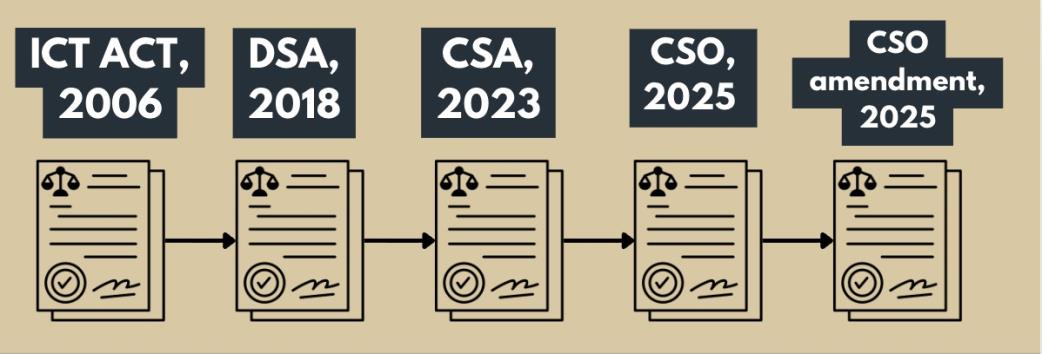
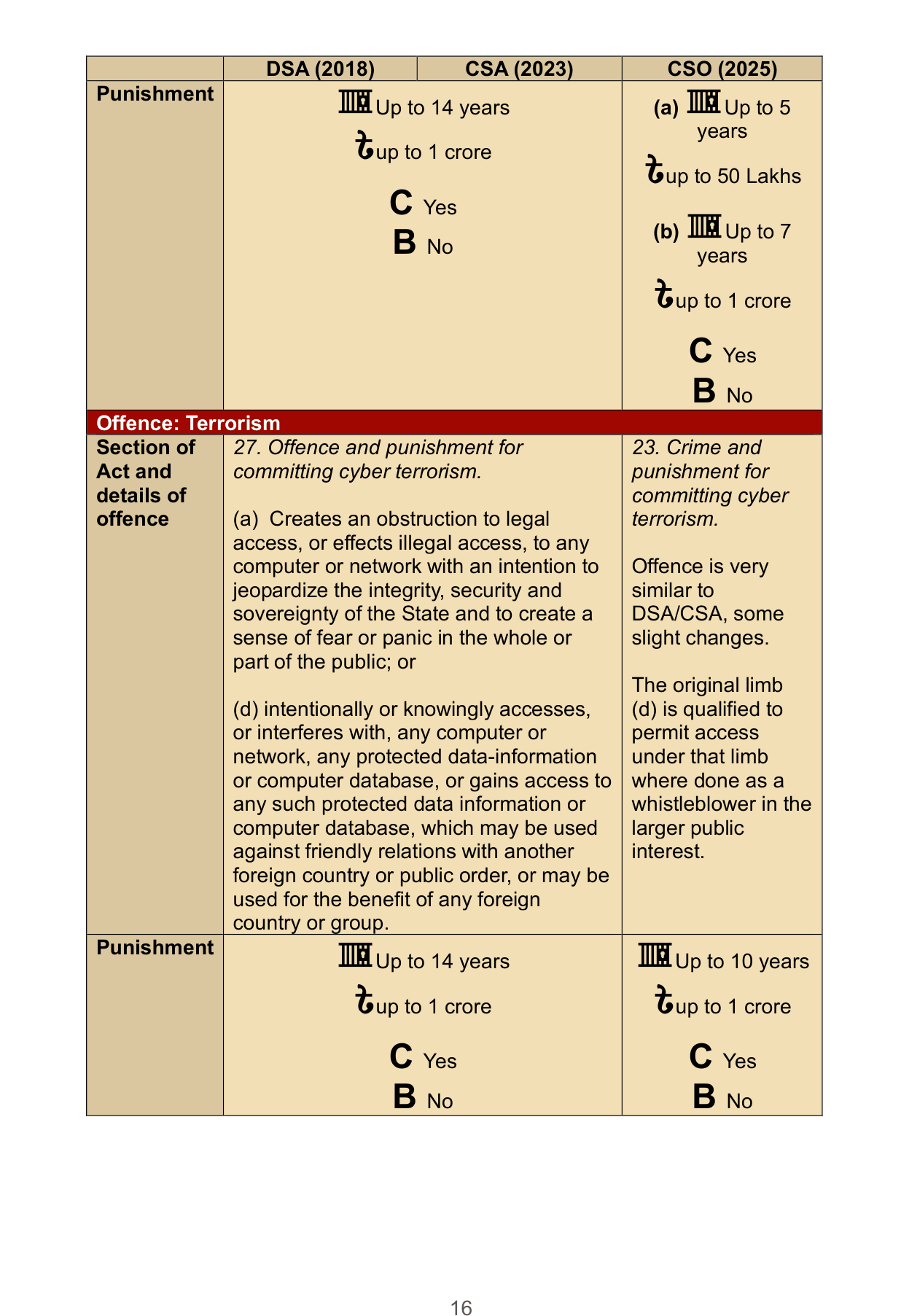
Bangladesh has had a string of cyber-crime laws, starting from the Information and Communication Technology Act, 2006, provisions of which were repealed and replaced by the Digital Security Act, 2018, which in turn was repealed and replaced by the Cyber Security Act, 2023.4 Most recently, the Cyber Security Act was repealed and replaced by the Cyber Security Ordinance, 2025.5
Though each new law has been introduced as a measure of reform, the misuse of these laws to target speech online has persisted (although it is too early to tell how the Cyber Security Ordinance will be applied). This report looks at the weaponization of the Digital Security Act against journalists, and the lessons this analysis offers to protect freedom of speech in Bangladesh.
The Digital Security Act (“DSA”)6was introduced in 2018 as a response to criticism of its predecessor legislation—the Information and Communication Technology Act, 2006 (“ICT Act”). Among other criticisms, the ICT Act was condemned for being vague and overbroad— particularly Section 57, which criminalized certain forms of online expression.7The Awami League government committed to repealing these provisions and claimed that the DSA would “establish[] balance between freedom of expression and public morality [and] interest.”8
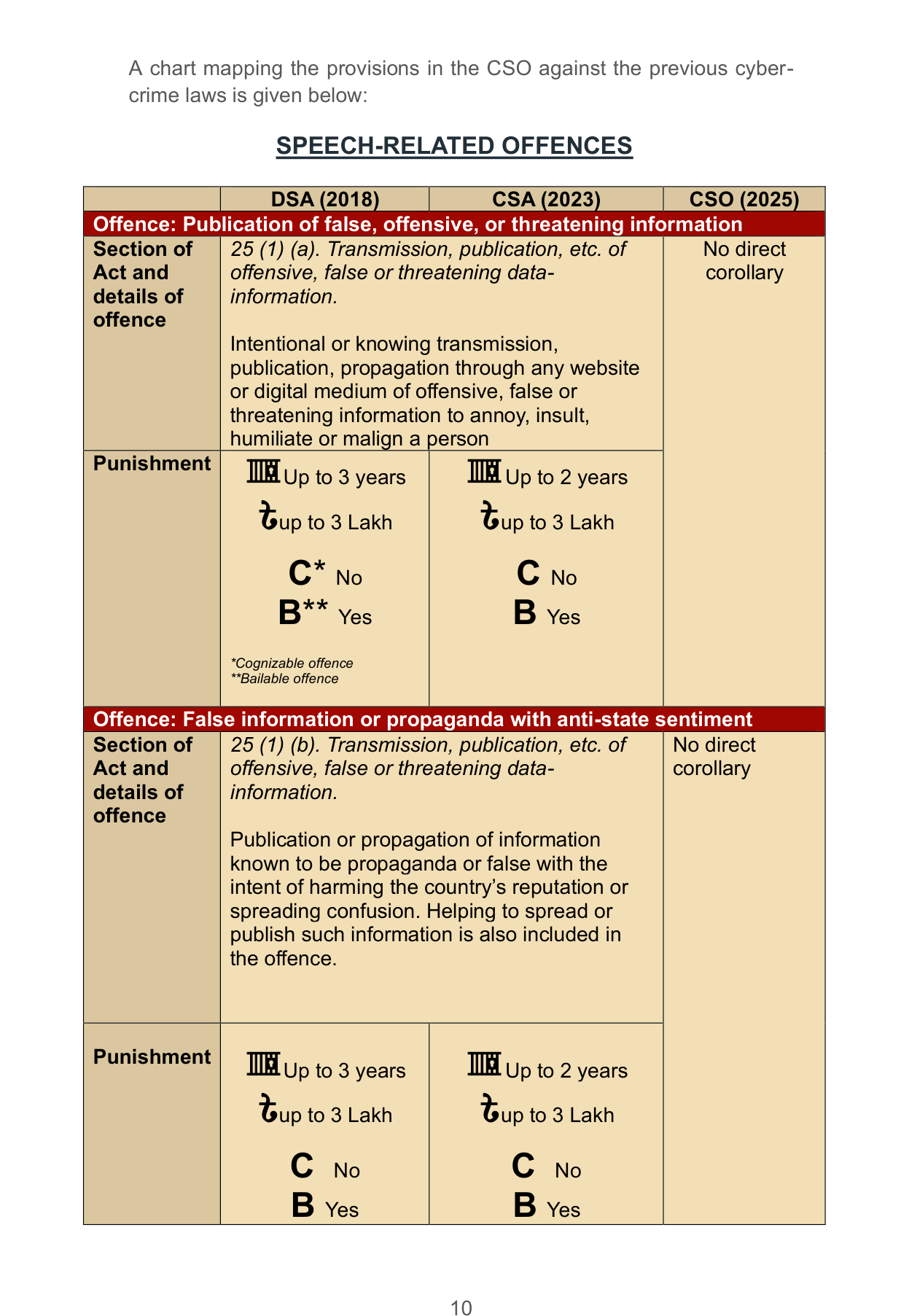
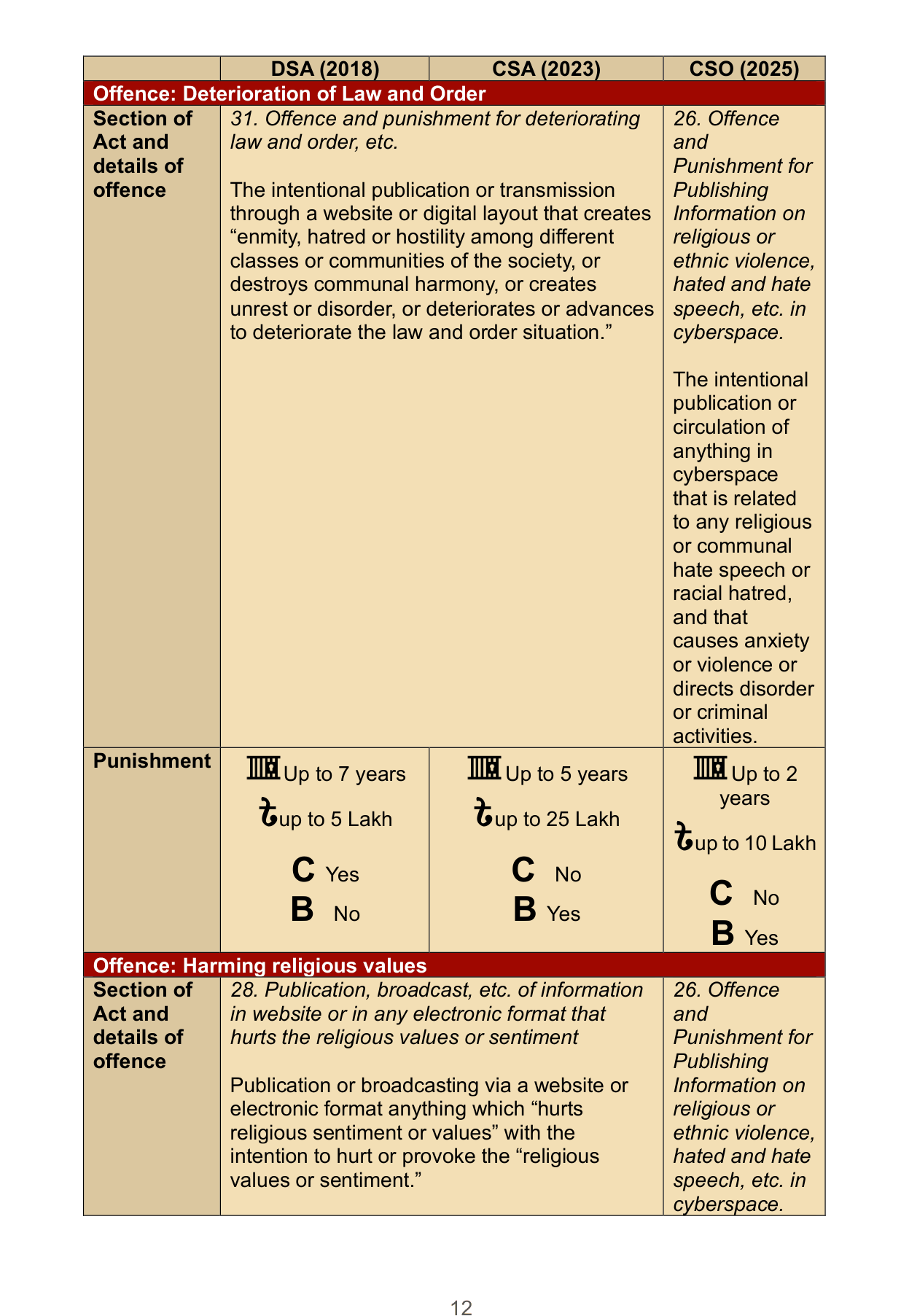
However, the DSA maintained the substance of repealed provisions, effectively splitting what had been covered by Section 57 of the ICT Act into different offenses under the DSA and imposing even harsher penalties.9 The DSA criminalized the online:
(i) publication, transmission, or propagation of “offensive, false or threatening” information to “annoy, insult, humiliate or malign a person,” with a potential three-year prison sentence;10
(ii) publication or propagation of propaganda or false information with an intention to “affect the image or reputation of the country, or to spread confusion,” with a potential three-year prison sentence;11
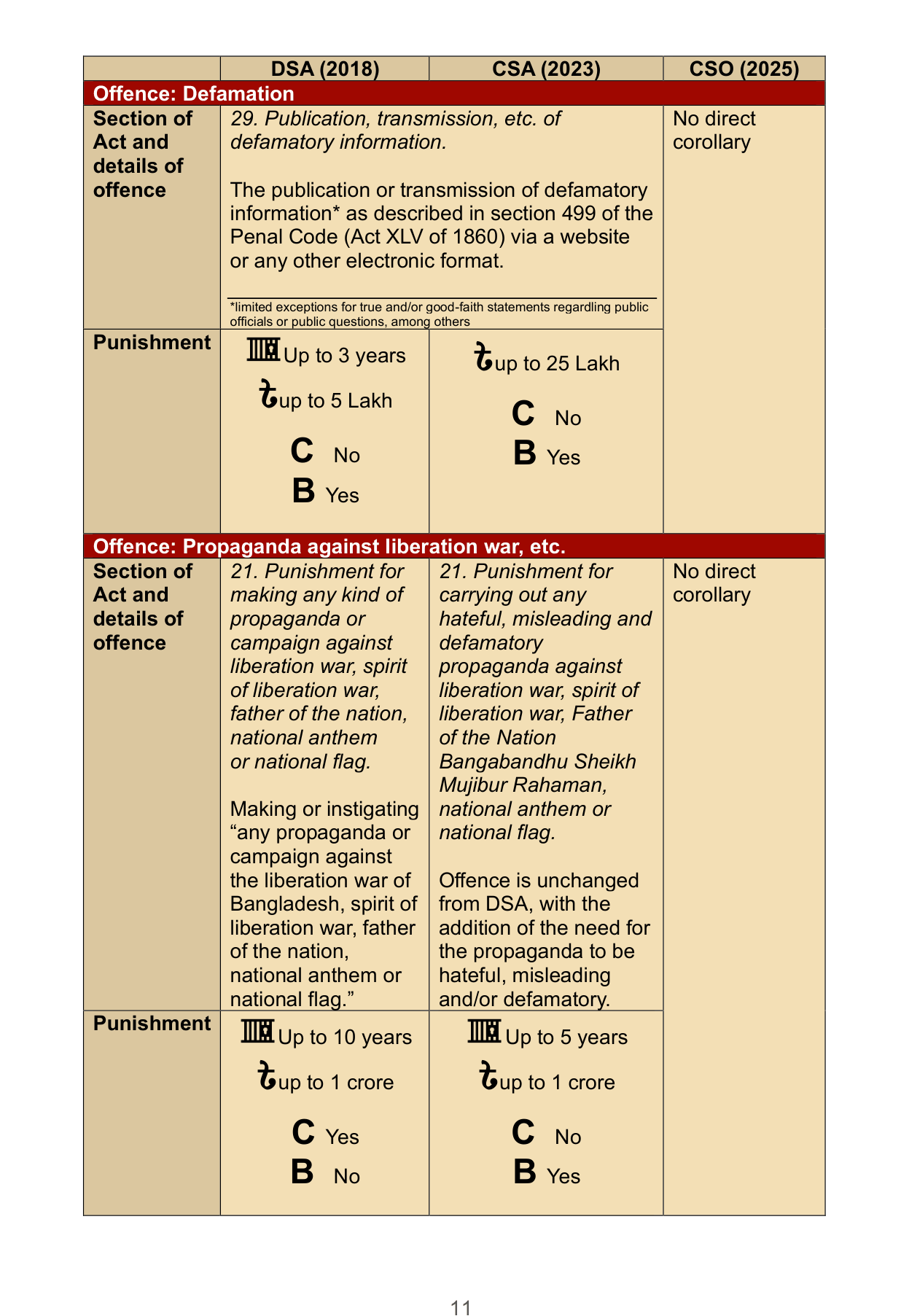
(iii) publication or transmission of defamatory material, with a potential three-year prison sentence;12 (iv) publication or transmission of information that “deteriorates … law and order,” with a potential seven-year prison sentence;13
(v) making or instigating to make any “propaganda or campaign against the liberation war of Bangladesh, spirit of liberation war, father of the nation, national anthem or national flag,” with a potential ten-year prison sentence;14 and
(vi) publication or broadcast of information that intentionally “hurts religious sentiments or values,” with a potential five-year prison sentence.15
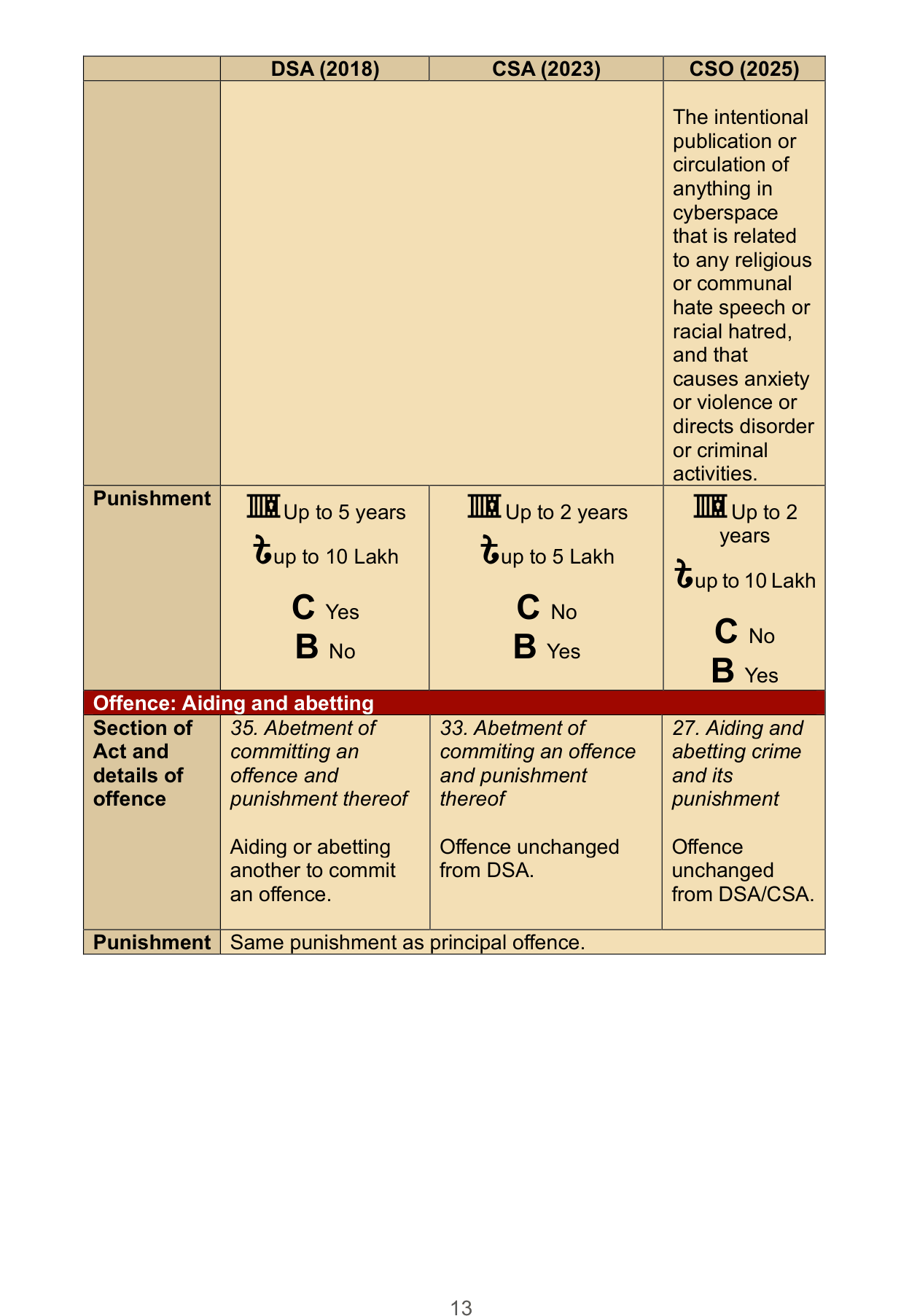
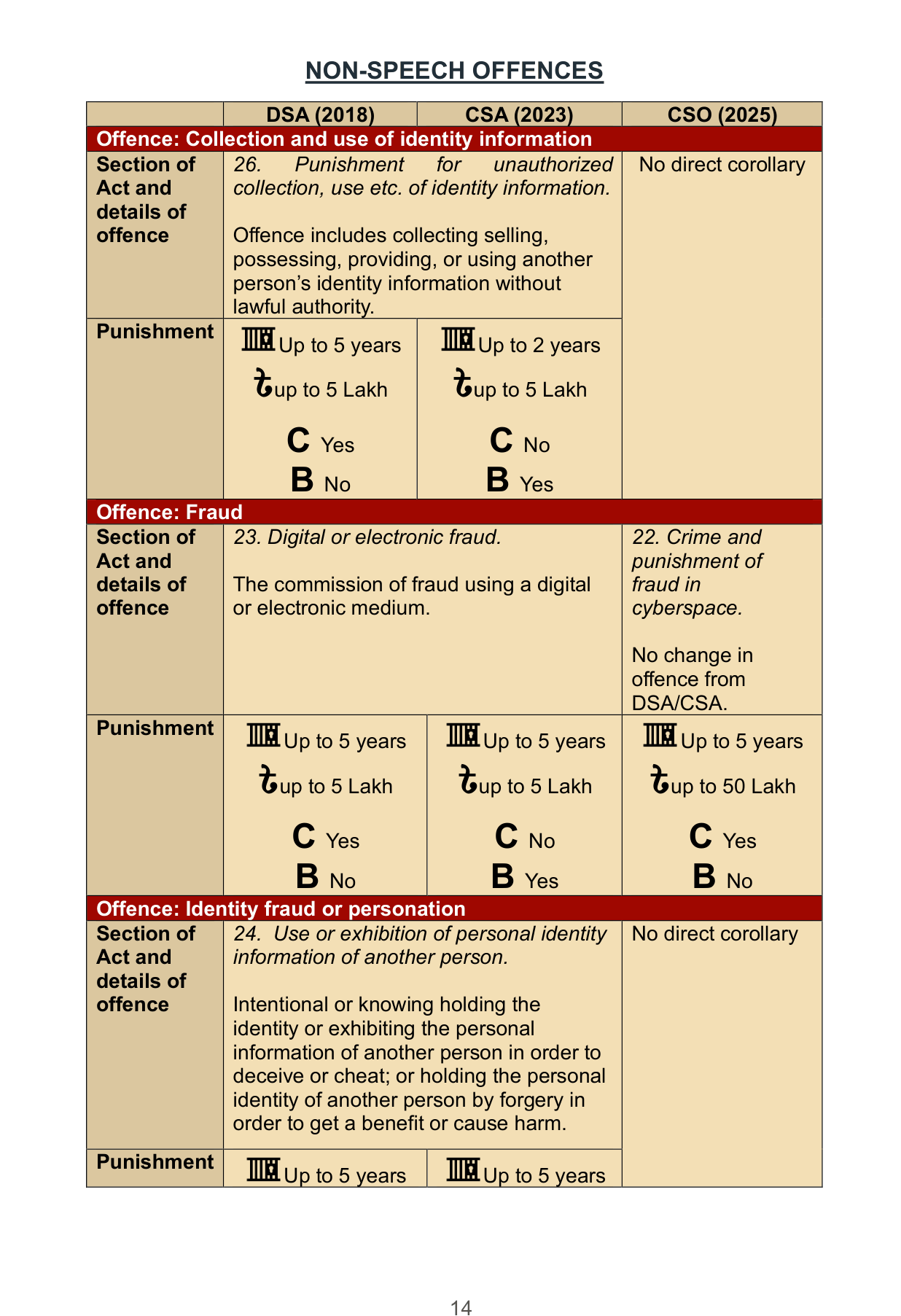
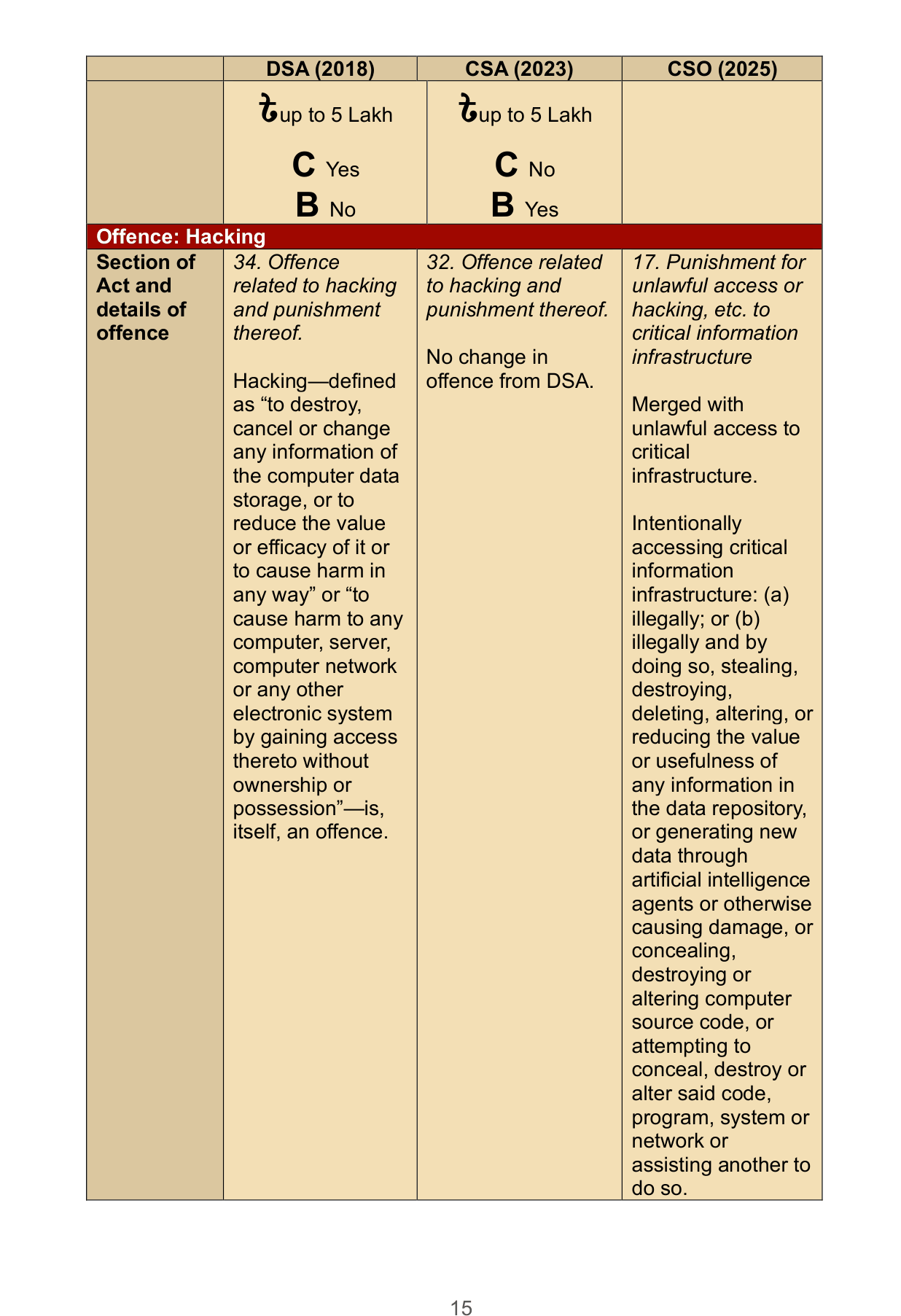
Many civil society organizations and international bodies raised concerns about the DSA.16 In March 2023, the UN High Commissioner for Human Rights called on the Bangladeshi government to “suspend immediately its application of the [DSA],” expressing concern that the law was being used to “arrest, harass and intimidate journalists and human rights defenders, and to muzzle critical voices online.”17 In response to the widespread criticism of the DSA and in the face of mounting pressure to repeal the law, the then Government of Bangladesh (still led by the Awami League at that time) introduced the Cyber Security Act of 2023 (“CSA”). The government described the new law as a “modernized” version of the DSA without provisions that could be “misused” by anyone.18 However, the CSA retained all the vague provisions outlined above, with reduced penalties as the primary change.19 In addition to reducing penalties, the CSA made most offenses, barring a few,20 bailable (meaning that accused persons are entitled to bail as a right and pretrial detention is not an option)21 and non-cognizable (meaning that police officers must obtain a warrant to arrest individuals).22
However, the problematic offenses themselves were largely left in place. As Amnesty International reported, “the CSA repackage[d] almost all repressive features of the DSA (and Section 57 of the ICT Act that
18 Faisal Mahmud, Bangladesh to Tone Down ‘Draconian’ Digital Security Law, Al Jazeera, Aug. 7, 2023, available at https://www.aljazeera.com/news/2023/8/7/bangladesh-to-tone-down-draconian-digitalsecurity-law.
preceded it).”23 Although there is no publicly available official data on the cases filed under the CSA, data gathered by CGS reflects that at least 71 cases were filed under the CSA accusing 447 individuals from 18 September 2023 to 11 February 2025.24 Amnesty reports that cases were filed under the CSA for posts considered defamatory or insulting towards then Prime Minister Sheikh Hasina or members of the Awami League.25
As discussed in greater detail below, the DSA ‘saved’ cases under the ICT Act—meaning that even though the DSA repealed the ICT Act, certain cases under the ICT Act were nevertheless allowed to continue. In turn, the CSA ‘saved’ cases under the DSA. This created a patchwork of cases under the various laws over time.
In June-July 2024, nationwide protests erupted in Bangladesh against the Awami League government. The protests, which were met with a brutal crackdown,26 ultimately led to the ousting of the then Prime Minister Sheikh Hasina on August 5, 2024.27 The President dissolved the Parliament the next day28 and on August 8, 2024, a civilian interim government with Nobel Laureate Professor Muhammad Yunus at its helm was appointed to oversee a transition to fresh elections.29 The interim government has promised to uphold “democracy, justice, human rights, and freedom of speech.”30
The interim government announced that the cyber-crime laws would be reviewed and directed the Law Ministry to not register cases and make arrests under the CSA.31 In October 2024, the interim government announced that the CSA would be repealed32 and subsequently released drafts of a Cyber Protection Ordinance, 2025 (meant to replace the CSA, and which eventually evolved into the CSO) and a Personal Data Protection Ordinance, 2025.
International civil society groups criticized these new proposed laws for being fast-tracked without sufficient transparency or consultation.33 As per reports, drafts were made public only briefly in December 2024 (for three days) and again in January 2025 (for two weeks).34 The draft Cyber Protection Ordinance, 2025 was also criticized for including ambiguous and overbroad provisions, including related to “cyber-terrorism” and “hurting religious sentiments,” creating significant risks of misinterpretation and misuse.35 Meanwhile, despite the assurances of the interim government, cases continued to be registered under the CSA—
two writers faced charges under the CSA in March 2025 for “hurting religious sentiments.”36
On May 21, 2025, the interim government of Bangladesh promulgated the Cyber Security Ordinance, 2025 (“CSO”), which came into force and repealed the CSA with immediate effect. The CSO notes that the CSA “opened avenues for potential misuse and oppression” and “restricted freedom of expression,” without sufficient “measures for safeguarding citizens” and was therefore revoked.
The CSO marks a significant departure from the previous cyber-crime laws by repealing several speech-restricting provisions of the CSA (which in turn were carried forward from the DSA and ICT Act). However, certain ambiguous provisions, including in particular a provision criminalizing “publish[ing] or disseminat[ing] . . . in cyberspace anything that is religious or communal hate speech or racial hatred and that . . . creates anxiety,” remain in the law.
The CSO also quashed cases under certain provisions of the CSA.37 As discussed further below, however, there has been little clarity on exactly which ongoing cases are being or have been withdrawn or quashed.
B. Laws Repealed; Cases Continue
Despite repeal of the laws, cases registered under the ICT Act and the DSA have continued to-date (although it remains to be seen how the new amendment to the Cyber Security Ordinance dismissing DSA cases and quashing sentences will be implemented).
As noted above, the repeal and savings clause of the DSA permitted cases pending under the ICT Act to continue if they had reached a certain stage.38 Subsequently, the DSA was itself repealed by the CSA. The CSA contained its own savings clause, which allowed all cases filed under the DSA to continue.39 As a result, a majority of the cases under the DSA continued despite repeal of the law. Official figures suggest that around 6,000 cases, accounting for 86 percent of the cases filed under the law, were still “awaiting disposal” at the time of repeal.40 The savings clause of the CSA allowed all of these cases to continue even if the investigation or trial process had not commenced.41 As a consequence, the Bangladeshi government under the Awami League continued framing charges against individuals under the DSA several months after the law’s repeal.42 The savings clause of the CSA did not mention cases pending under the ICT Act.
After the fall of the Awami League government, the interim government announced plans to withdraw all pending speech-offence related cases under the three cyber laws—the ICT Act, the DSA and the CSA.43 The Cyber Security Ordinance, 2025 specifically quashes cases pending under the speech-restrictive provisions of the CSA but did not mention cases pending under the DSA or the ICT Act.44 The most recent amendment to the Ordinance dismisses cases pending under certain, but not all, provisions of the DSA.45 It too does not mention cases pending under the ICT Act.
As the TrialWatch and CGS report published in November 2024 highlights, there is no legal basis for cases under the ICT Act to continue since the DSA (which saved cases under the ICT Act) itself was repealed by the CSA, and the CSA was silent on cases under the ICT Act.
This principle applies to cases under the DSA as well—these cases continued on the basis of the savings clause in the CSA, which now stands repealed by the CSO. The CSO does not save ongoing cases under the DSA. This provides a further basis for dismissal of the cases, in addition to the recent amendment to the CSO (and applies to all cases, not just those under identified sections), and is discussed further below.
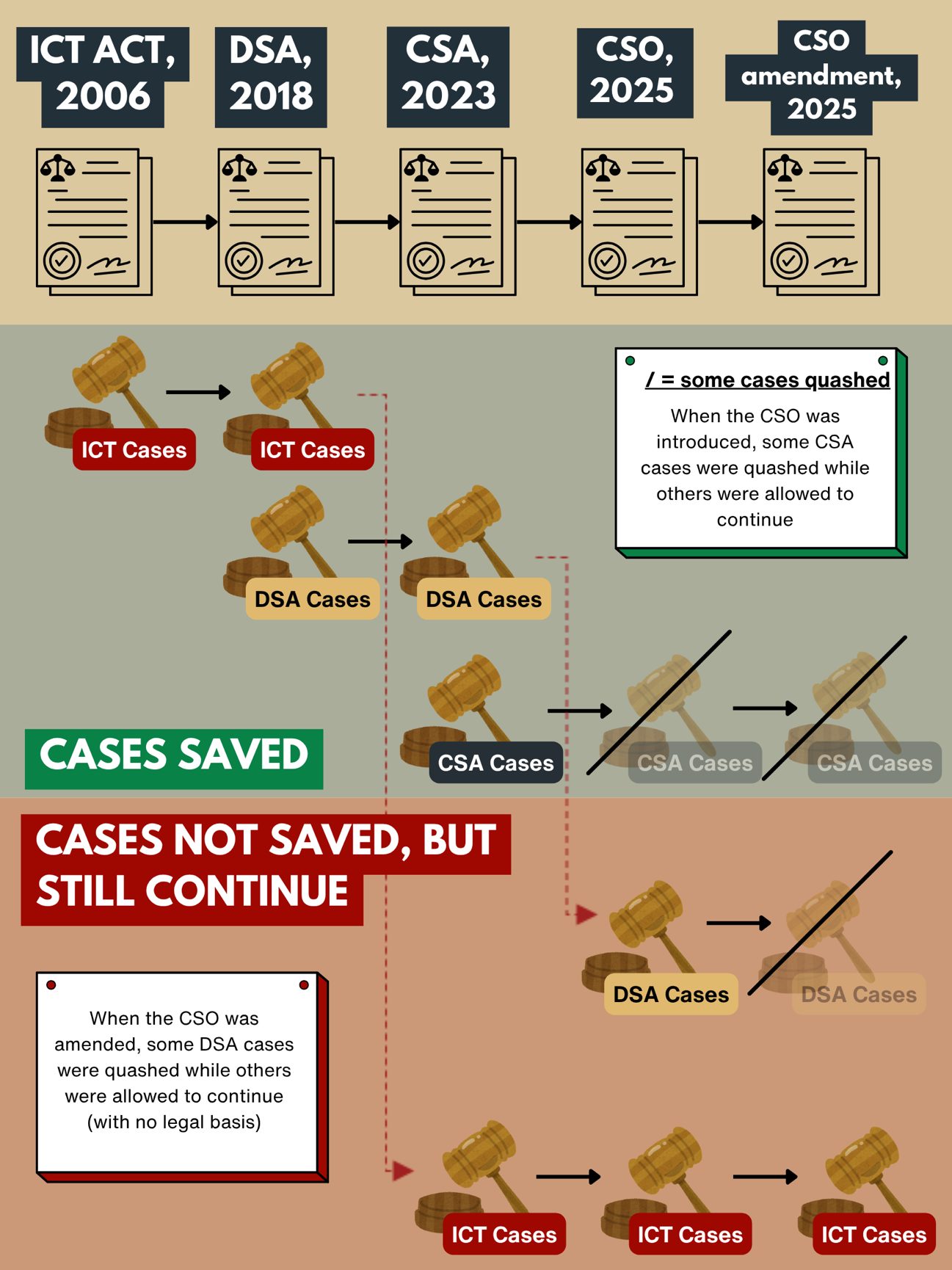
While the CSO ostensibly quashes all cases under the speech-restrictive provisions of the CSA (and now under the DSA), there is no official or publicly accessible list detailing which cases have been withdrawn. In fact, in June 2025, an 18 year old was arrested under the CSA for an “offensive” Facebook post—suggesting it was still being invoked despite its repeal.46 And prior to the CSO amendments, and even under this current government, cases under the DSA remained pending.47
Further, given that the CSO is an ordinance, if it is not adopted by the incoming Parliament, the status of cases that are not actually withdrawn and sentences that are not actually quashed could be uncertain.
C. Ongoing Criminalisation of Journalism in Bangladesh
This report analyses cases filed under the DSA against journalists to identify the risks to freedom of expression that potential cases under the CSO may pose, along with any ongoing cases under the ICT Act, DSA, and CSA.
More broadly, journalists perceived as supportive of Sheikh Hasina and her government have been at severe risk of criminalization since the interim government took over in August 2024.48 On August 21, 2024, Farzana Rupa, a former principal correspondent at Ekkator TV, and Shakil Ahmed, Rupa’s husband and former head of news at Ekkator, were arrested.49 Their phones and passports were confiscated by police, and both are facing charges of instigating murder during the protests that led to the overthrow of Hasina.50 On September 16, 2024 three other journalists—Mozammel Babu, Mahbubur Rahman and Shyamal Dutta— were arrested.51 In August 2024, a complaint was filed before the International Crimes Tribunal, Bangladesh against 52 individuals, including over two dozen senior journalists, in connection with alleged crimes against humanity and genocide during the protests.52 And 28 journalists are facing investigations in connection with the protests based on a criminal complaint submitted by a teacher—the charges against the broader group of 109 people include abduction, assault and publication of misinformation surrounding the July protests.53 Most recently, Reporters Without Borders has reported that Monjurul Alam Panna was arrested and detained under Bangladesh’s anti-terrorism law “after being invited to speak as a journalist at a roundtable debate about Bangladesh’s war of liberation and the constitution.”54
The targeting of these journalists is indicative of a larger, more systemic trend of arbitrary arrests and systemic prosecutions over the past several months. Between August 6 and September 25, 2024, police lodged cases against 92,486 people, most of them related to murder of persons who died in the protests in June-July 2024.55 Several of the complainants in these cases have reported not knowing who was named as the accused when they filed the case, noting that the police or local politicians simply told them to “sign the papers.”56 As per one report, 182 journalists have been targeted with criminal cases from August 2024-March 2025.57 Apart from criminalization, the interim government has also revoked press accreditations for journalists, drawing widespread condemnation.58 Journalists have also been subject to physical attacks from state and nonstate actors.59
These developments underscore the concern that overbroad digital speech laws remain dangerous, regardless of which political party is in power, and make clear the urgent need to protect journalists from abusive prosecutions.
55 Human Rights Watch. After the Monsoon Revolution: A Roadmap to Lasting Security Sector Reform in Bangladesh, Jan. 27, 2025, available at https://www.hrw.org/report/2025/01/27/after-monsoon-revolution/roadmap-lastingsecurity-sector-reform-bangladesh.
56 Id.
Notes
- The Cyber Security Act, 2023 came into force on September 18, 2023. ↩
- The Cyber Security Ordinance came into force on May 21, 2025. Note that it is possible that the CSA could snap back into place in the event that the CSO is not adopted/ratified by the incoming Parliament. See Article 93, the Constitution of the People’s Republic of Bangladesh, 1972. ↩
- Digital Security Act, 2018, http://bdlaws.minlaw.gov.bd/act-details-1261.html [hereinafter “DSA”]. 3 ↩
- Section 57 of the ICT Act allowed for the prosecution of anyone who published or transmitted “in electronic form any material” deemed “fake and obscene,” defamatory, or otherwise likely to “deprave or corrupt” its audience, while also enabling prosecutions arising from any online material that “causes to deteriorate or creates a possibility to deteriorate law and order, prejudice the image of the State or person or causes to hurt or may hurt religious belief or instigate against any person or organization.” ↩
- UN Human Rights Council, Bangladesh National Report Submitted in Accordance with Paragraph 5 of the Annex to Human Rights Council Resolution 16/21, U.N. Doc. A/HRC/WG.6/30/BGD/1, (Feb. 26, 2018), para. 33. ↩
- Ali Riaz, How Bangladesh’s Digital Security Act Is Creating a Culture of Fear, Carnegie Endowment for International Peace, (Dec. 9, 2021), https://carnegieendowment.org/2021/12/09/how-bangladeshs-digital-security-act-iscreating-culture-of-fear-pub-85951. ↩
- DSA, Section 25(1)(a); Section 25(2). ↩
- DSA, Section 25(1)(b); Section 25(2). ↩
- DSA, Section 29. 4 ↩
- DSA, Section 31. ↩
- DSA, Section 21. ↩
- DSA, Section 28. ↩
- Riaz, supra note 8; Press Release, OHCHR, Bangladesh: Türk Urges Immediate Suspension of Digital Security Act as Media Crackdown Continues, (Mar. 31, 2023), available at https://www.ohchr.org/en/press-releases/2023/03/bangladesh-turk-urgesimmediate-suspension-digital-security-act-media; OHCHR, Technical Note to the Government of Bangladesh on Review of the Digital Security Act, June 2022 [hereinafter “OHCHR Technical Note”], available at https://www.ecoi.net/en/file/local/2089968/OHCHR-Technical-Note-on-review-of-the-Digital-Security-Act-June-2022.pdf; Centre for Governance Studies, The Ordeal: Five Years of the Digital Security Act, 2018-2023, Apr. 2024, https://cgs-bd.com/cms/media/documents/e7678484-19ac-4716-8224-be3f706bfa66.pdf; Article 19, Bangladesh: Digital Security Act 2018, Nov. 2019, available at https://www.article19.org/wp-content/uploads/2019/11/Bangladesh-Cyber-Security-act-2018-analysis-FINAL.pdf. ↩
- Press Release, OHCHR, Bangladesh: Türk Urges Immediate Suspension of Digital Security Act as Media Crackdown Continues, (Mar. 31, 2023), available at https://www.ohchr.org/en/press-releases/2023/03/bangladesh-turk-urges-immediatesuspension-digital-security-act-media. 5 ↩
- Transparency International Bangladesh, Digital Security Act 2018 and the Draft Cyber Security Act 2023: A Comparative Analysis, Aug. 30, 2023, available at https://www.ti-bangladesh.org/upload/files/position-paper/2023/Position-paper-on-Digital-Security-Act-2018-and-Draft-Cyber-Security-Act-2023.pdf; Amnesty International, Bangladesh: Open Letter to the Government: Feedback on Proposed ‘Cyber Security Act,’ Aug. 22, 2023, available at https://www.amnesty.org/en/documents/asa13/7125/2023/en. ↩
- Cyber Security Act, 2023, Section 52 [hereinafter “CSA”]. Sections 17, 19, 27, and ↩
- Dhaka Tribune, Parliament Passes Cyber Security Bill 2023, Sept. 13, 2023, available at https://www.dhakatribune.com/bangladesh/325228/parliament-passescyber-security-bill-2023. ↩
- CSA, Section 52. Under Section 42 of the CSA, police officers could still arrest individuals without a warrant where there was “reason to believe that any offence under this Act has been committed or is being committed or is likely to be committed at any place or that evidence has been lost, destroyed, erased, altered or otherwise rendered inaccessible.” 6 ↩
- Amnesty International, Repackaging Repression: The Cyber Security Act and the Continuing Lawfare Against Dissent in Bangladesh, Aug. 8, 2024, pg. 4, available at https://www.amnesty.org/en/documents/asa13/8332/2024/en/. ↩
- Centre for Governance Studies, CSA Tracker, https://csa.freedominfo.net. ↩
- Amnesty International, Repackaging Repression: The Cyber Security Act and the Continuing Lawfare Against Dissent in Bangladesh, Aug. 8, 2024, available at https://www.amnesty.org/en/documents/asa13/8332/2024/en/. ↩
- Harindrini Corea and Nazia Erum, What is Happening at the Quota-Reform Protests in Bangladesh?, Amnesty International, July 29, 2024, available at https://www.amnesty.org/en/latest/news/2024/07/what-is-happening-at-the-quotareform-protests-in-bangladesh/. ↩
- OHCHR, Preliminary Analysis of Recent Protests and Unrest in Bangladesh, Aug. 16, 2024, available at https://www.ohchr.org/sites/default/files/2024-08/OHCHR-Preliminary-Analysis-of-Recent-Protests-and-Unrest-in-Bangladesh-16082024_2.pdf. ↩
- Redwan Ahmed, Bangladesh Parliament Dissolved a Day After Resignation of Prime Minister, The Guardian Aug. 6, 2024, available at https://www.theguardian.com/world/article/2024/aug/06/bangladesh-student-protestersto-meet-with-army-chief-after-pm-resigns. ↩
- Ruma Paul, Nobel Laureate Yunus Takes Charge of Bangladesh, Hopes to Heal Strife-Torn Country, Reuters, Aug. 8, 2024, available at 7 ↩
- Asia News Network, Election After Vital Reforms: Chief Adviser to Bangladesh Interim Government, Aug. 19, 2024, available at https://asianews.network/election-after-vital-reforms-chief-adviser-to-bangladesh-interim-government/. ↩
- Harun Ur Rashid Swapan, Asked Not to Arrest in Cyber Case: Nahid Islam, DW, Sept. 27, 2024, available at https://www.dw.com/bn/সাইবার-মামলায়-গ্রেপ্তার-না-করতে-বলা-হতয়তে-নাহহদ-ইসলাম/a-70348612. ↩
- of the CSA, which proscribe unlawful access to critical information infrastructure, damage to computers and computer systems, cyberterrorism, and hacking, respectively, were cognizable and non-bailable. Unlike under the DSA, the provision criminalizing hate speech or deteriorating law and order (Section 31) was made noncognizable and bailable. 32 Prothom Alo, Cyber Security Act To Be Repealed: Asif Nazrul, Oct. 3, 2024, available at https://www.prothomalo.com/bangladesh/edlki78nav. ↩
- Article 19, Bangladesh: Digital Laws Must Be Transparent and Protect Free Expression, Feb. 26, 2025 [hereinafter “Article 19 Report”], available at https://www.article19.org/resources/bangladesh-digital-laws-must-be-transparent-andprotect-free-expression/. ↩
- Article 19 Report. ↩
- Article 19 Report; Front Line Defenders & CIVICUS, Open Letter, Bangladesh: Concerns About the Draft Cyber Protection Ordinance, (Jan. 15, 2025), available at https://www.frontlinedefenders.org/en/statement-report/bangladesh-concerns-aboutdraft-cyber-protection-ordinance. 8 ↩
- Front Line Defenders, Human Rights Defender Nahid Hasan Knowledge Charged under Cyber Security Act for Hurting Religious Sentiments, available at https://www.frontlinedefenders.org/en/case/human-rights-defender-nahid-hasanknowledge-charged-under-cyber-security-act-hurting-religious; New Age, Citizens Demand Withdrawal of Cases, Repeal of CSA, Mar. 7, 2025, available at https://www.newagebd.net/post/country/259591/citizens-demand-withdrawal-of-casesrepeal-of-csa. ↩
- Section 50(4).9 ↩
- Section 61 of the DSA states that “[t]he proceedings or cases initiated before, or taken cognizance by, the Tribunal under the repealed sections … shall, if pending at any stage of trial, continue as if the said sections had not been repealed.” ↩
- CSA, Section 59. ↩
- The Daily Star, 86pc DSA Cases Pending Disposal: Law Minister, Sept. 10, 2023, available at https://www.thedailystar.net/news/bangladesh/news/86pc-dsa-casespending-disposal-law-minister-3415241. ↩
- CSA, Section 59(3). ↩
- Amnesty International, Repackaging Repression: The Cyber Security Act and the Continuing Lawfare Against Dissent in Bangladesh, Aug. 8, 2024, pg. 6, available at https://www.amnesty.org/en/documents/asa13/8332/2024/en/; see also New Age, Online Activist Pinaki, Ex-JCD Leader Ashik Charged in DSA Case, Apr. 28, 2024 (police submitted a charge sheet against Ashik under the repealed DSA based on spreading “false and deceptive information” on social media), available at https://www.newagebd.net/post/country/233832/charges-pressed-against-onlineactivist-pinaki-ex-jcd-leader-ashik-in-dsa-case; Prothom Alo, ‘রংপুরর হিহিটাল হিরাপত্তা আইহরর মামলায় সাংবাহিক কারাগারর’ [Journalist in Jail in Rangpur Digital Security Act Case], Feb. 4, 2024 (in February 2024, the Rangpur Cyber Tribunal sent the editor of a local newspaper to prison after his bail application was denied in a court hearing for a DSA case filed against him), available at https://www.prothomalo.com/bangladesh/district/kl13f7e3gr. 17 ↩
- Dhaka Tribune, Speech Offence Cases Under Cyber Laws to be Withdrawn, Arrestees to be Released, Sept. 30, 2024, available at https://www.dhakatribune.com/bangladesh/crime/360234/speech-offence-cases-undercyber-laws-to-be. ↩
- Cyber Security Ordinance, 2025 [hereinafter “CSO”], Section 50. ↩
- Cyber Security (Amendment) Ordinance, 2025 states that “any case or other proceedings pending in any court or tribunal or any case or proceedings under investigation . . . for the commission and abetment of the offence referred to in sections 21, 24, 25, 26, 27, 28, 29 and 31 of the Digital Security Act, 2018 . . . shall be quashed and no further proceedings shall be taken in respect thereof and the sentence and fine imposed by any court or tribunal under the said sections shall be deemed to be quashed.” 18 ↩
- Daily Star, 18-Yr-Old Lands in Jail Over ‘Offensive’ FB Post on Abu Sayed, June 28, 2025, available at https://www.thedailystar.net/news/bangladesh/crimejustice/news/18-yr-old-lands-jail-over-offensive-fb-post-abu-sayed-3927821?fbclid=IwQ0xDSwLNA3JleHRuA2FlbQIxMQABHvU7kAiGtQeZdFNR3c63Te7 WxdkG3n_4BmE8ITeum8nse_3dv5ARGvYisy4-_aem_7xJbo0BWHR9yikMKy-2U7Q. ↩
- See, e.g., Sangbad Sangstha, Court Issues Arrest Warrant Against Naem Nizam, 2 Others in DSA Case, New Age, July 27, 2025, available at https://www.newagebd.net/post/country/271309/court-issues-arrest-warrant-againstnaem-nizam-2-others-in-dsa-case. ↩
- Committee to Protect Journalists, Journalists Supportive of Ousted Bangladesh Leader Targeted with Arrest, Criminal Cases, Sept. 19, 2024 [hereinafter “CPJ Report”], available at https://cpj.org/2024/09/journalists-supportive-of-oustedbangladesh-leader-targeted-with-arrest-criminal-cases; see also Abdul Rahman, Bangladesh’s Interim Government Accused of Political Persecution of Journalists, People’s Dispatch, Sept. 17, 2024, available at https://peoplesdispatch.org/2024/09/17/bangladeshs-interim-government-accused-ofpolitical-persecution-of-journalists. 20 ↩
- Prothom Alo, Journalist Couple Shakil Ahmed and Farzana Rupa Detained, Aug. 21, 2024, available at https://en.prothomalo.com/bangladesh/ru0pzr91if. ↩
- Reporters Without Borders, Bangladesh: Journalists Farzana Rupa and Shakil Ahmed Must be Released, Aug. 27, 2024, available at https://rsf.org/en/bangladesh-journalists-farzana-rupa-and-shakil-ahmed-must-be-released. ↩
- CPJ Report. ↩
- The Daily Star, Crimes Against Humanity: Hasina, Over Two Dozen Journos Sued in ICT Case, Aug. 29, 2024, available at https://www.thedailystar.net/news/bangladesh/crime-justice/news/crimes-againsthumanity-hasina-over-two-dozen-journos-sued-ict-case-3689551. ↩
- International Federation of Journalists, Bangladesh: 28 Journalists Under Investigation, Sept. 9, 2024, available at https://www.ifj.org/media-centre/news/detail/category/press-releases/article/bangladesh-28-journalists-underinvestigation. ↩
- Reporters Without Borders, Journalist Arrested After Taking Part in Roundtable, In New Use of Bangladesh’s Anti-Terrorism Law, Nov. 12, 2025 (noting that after spending 75 days in jail, he was released on bail), available at Journalist arrested after taking part in roundtable, in new use of Bangladesh’s anti-terrorism law. 21 ↩
- Zyma Islam, World Press Freedom Day: 266 Journalists Face Criminal Cases So Far, Daily Star, May 3, 2025 (“This newspaper has found that at least 266 journalists have been implicated in various cases related to the events of July and August last year.”), available at https://www.thedailystar.net/news/bangladesh/crimejustice/news/world-press-freedom-day-266-journalists-face-criminal-cases-so-far-3885366, see also Rights and Risks Analysis Group, Bangladesh: Press Freedom Throttled Under Dr. Muhammad Yunus, May 3, 2025, available at https://www.rightsrisks.org/wp-content/uploads/2025/05/Bangladesh-Press-Freedom-Throttled-Under-Dr-Mohammed-Yunus.pdf. ↩
- AP, Rights Groups Condemn Bangladesh for Cancelling Accreditation of 167 Journalists, Nov. 13, 2024, available at https://apnews.com/article/bangladesh-pressaccreditations-c6084ebc9dd6cee9c87101961d031f97. ↩
- Reporters Without Borders, Bangladesh: Violent Attacks on Journalists Are Surging, Government Must Take Action, Feb. 14, 2025, available at https://rsf.org/en/bangladesh-violent-attacks-journalists-are-surging-government-musttake-action; Amnesty International et al., Bangladesh: Interim Government Should Protect Freedom of Expression and Opinion, Mar. 21, 2025, available at https://www.amnesty.org/en/wp-content/uploads/2025/06/ASA1391652025ENGLISH.pdf. 22 ↩