
Impact on Journalists and Press Freedom
“The law should protect the citizens of Bangladesh from online harassment and crimes, not become a weapon to keep them hostage.”311
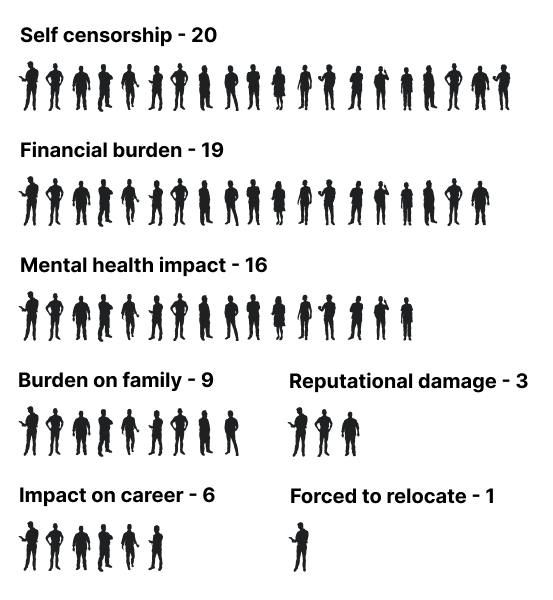
Drawn from the interviews and in-depth analysis of corresponding records related to the cases of the thirty journalists, this section of the report illuminates the individual and systemic effects that investigations and criminal proceedings under the DSA had on the lives of journalists, their families and communities, and civil society more broadly. In particular, proceedings take an immense toll on the personal and professional wellbeing of individuals—including, for example, imposing financial and other burdens and creating obstacles to carrying out future journalistic work—while the broader pattern of charging journalists under the DSA has had a demonstrable chilling effect on freedom of expression. Journalists reported impacts to their personal and professional lives as depicted below. These stories make clear the stakes in striking the right balance in implementing the CSO going forward.
Wee People Copyright © 2018 ProPublica and Alberto Cairo CC BY-NC_ND 3.0 US
A. Impact on the Lives of Journalists
As discussed above, at the time of arrest, and in detention thereafter, many journalists suffered direct and immediate physical and mental consequences. At least 14 journalists interviewed stated that they were subjected to abuse and mistreatment during arrest or while in detention.
For instance, in the case of the journalists charged for allegedly misattributing a quote to a police officer, one of them, Ramjan Ali Pramanik, said that when he was arrested at home just before a meal, his family members cried and begged the police to release him, and were not even informed where he was being taken. The police reportedly took a circuitous route to the station, leaving the journalist afraid that he was being driven into the countryside to be executed. Despite being a diabetic and informing the police of his condition, he was given no medicine. Throughout this ordeal, he wasn’t even sure why he was being arrested; according to him, the FIR in his case was actually registered after his arrest.312
In Tanvir Hasan Tanu’s case (one of the journalists accused for reporting on reduced food in the COVID ward of a hospital), Tanu himself had COVID-19 at the time of his arrest, but he was kept at the police station for interrogation until 1 AM, before his health began to deteriorate and he was having trouble breathing. He was ultimately taken to the hospital in handcuffs, with a rope around his waist, accompanied by 15-20 officers, and he was denied the ability to remove the handcuffs to use the washroom.313
In a third case, that of Azharul Haque, the journalist states that he was aggressively questioned by five to six officers while blindfolded and according to him, they made use of electric shocks during questioning. He says the questioning revolved around whether he had anti-government sentiment or why his bosses at the publication for which he worked had made him write his report (according to him, this was an effort to establish a connection between him and his publisher who at that time stood for election as part of an opposition party).314
Ikhtiyar Uddin Azad’s Story: Ikhtiyar Uddin Azad states that he spent almost Taka 6 lakh in defending his case. He had to attend hearings almost three times a month. The case, including court visits and lawyer fees, “has totally broken his economic backbone.” He suffered and endured so much pain for so long, socially and economically degraded, all because of a false case that will still leave a black mark in his life and career.315
The way cases dragged on and/or were left hanging also had profound consequences, including requiring significant financial outlays. In the cases for which we had data, an average of nearly two years elapsed between registration of the FIR and disposition of the case. And nineteen of thirty journalists cited a financial impact of the case. For instance, in the case of the journalist who reported on alleged diversion of funds from a construction project, he said that the case cost him nearly Taka 5 lakhs.316 This is commensurate with the maximum fine possible under several of the DSA provisions, and is roughly 20 times the average monthly wage in the country.317
In other cases, the pendency of the case caused additional profound upheaval in journalists’ lives. For instance, in Afroza Sarkar’s case, she relocated without her two sons for seven months to avoid immediate unjustified arrest. She had to sell her gold pendant and earrings in order to sustain herself.318 Abu Taiyub Munshi’s Story: Abu Taiyub Munshi’s family and professional life suffered as a result of the case against him. ‘His family is still terrified.’ He is not allowed to post or share any news on Facebook. His employer asked him why he needed to get involved in this mess by generating this news.319
But the effects were not only physical or financial, DSA cases also created fear and anxiety among journalists, or affected their families. In MD Hedait Hossain Molla’s case, for instance, he said that he is reminded about the case wherever he goes and continues to be traumatized by what he experienced. ‘Now he has to think 3 times to write the truth. He is still in trauma.’320
In the case lodged for reporting about a powerful businessman who had allegedly disregarded COVID-related restrictions on bus operations, the journalist, Sirajul Islam Ratan, said that officers came to arrest him around 6am, while he was sleeping with his two children, one aged one year and another five years at that time. His two children kept crying while the police took away their father. He says that his family, especially his children, had to go through social torment and taunts for his case.321
B. Systemic Impacts
Mamunur Rashid Nomani’s Story: After the case, which involved allegedly taking photos of a mayor, Mamunur Rashid Nomani says that the city corporation in question blacklisted his newspaper—meaning that no advertisement appears in his newspaper now. Due to this he is facing a huge loss because the newspaper runs on advertisement, amounting to Taka 1 crore. He said that he will never leave journalism, but now he no longer reports on the city corporation.322
Twenty of the thirty journalists said they self-censored following their experience with one or more DSA cases, and three stopped working as journalists entirely. As one interviewee expressed, the DSA functioned as a “red signal to journalists, column writers and cartoonists and it created a terror among them.”323 In Sabur Rana’s case, he had just reposted an article and also faced charges. He said ‘the journalists he knew were terrified. They are terrified of writing investigative reports. They are hesitant to share or even like anything on Facebook.’324 Likewise, in Azharul Haque’s case, he said that ‘he has been robbed of his right to speak and he dare not to take any work involving risk thinking of the suffering his family went through.’325
Abu Zafar’s Story: Abu Zafar spent his 37 days of jail time in complete terror and uncertainty about whether he would ever be free or not. The thought of ending his profession also crossed his scared mind after being punished for writing up against a corrupt government official. The case has forced him to self-censor his news for fear of getting accused again and going through the same horrifying process.326
In some cases, journalists are denied work, even if they might seek it. For instance, in Abdul Kaium’s case, pictures of him in handcuffs were circulated in the community, and he can no longer work because news organizations see him as a liability who might cause their organizations harm.327
As a result, the space for investigative reporting shrinks, with consequences for democratic accountability.
Notes
- Interview, K M Belal Hossen Swapon. 91 ↩
- Interview, Ramjan Ali Pramanik. ↩
- Interview, Tanvir Hasan Tanu. 92 ↩
- Interview, Azharul Haque. ↩
- Interview, Ikhtiyar Uddin Azad. ↩
- Interview. ↩
- One recent report placed the average monthly entry-level salary in Bangladesh at between BDT 20,000 and 30,000. Faisal Bin Iqbal & Aaqib Hasib. Entry Salaries for Fresh Graduates: A Bleak Picture, Daily Star, Aug. 25, 2022, available at https://www.thedailystar.net/campus/career/news/entry-salaries-fresh-graduates-bleakpicture-3102016. ↩
- Interview, Afroza Sarkar. 93 ↩
- Interview, Abu Taiyub Munshi. ↩
- Interview, MD Hedait Hossain Molla. ↩
- Interview, Sirajul Islam Ratan. ↩
- Interview, Mamunur Rashid Nomani. 94 ↩
- Interview, K. M. Belal Hossen Swapon. ↩
- Interview, Sabur Rana. ↩
- Interview, Azharul Haque. ↩
- Interview, Abu Zafar. ↩
- Interview, Abdul Kaium. 95 ↩