
Overview: The Use of the DSA Against Journalists
As the Media Reform Commission recently found, a “major obstacle to objective and independent journalism is the abuse of power. Those in power often misuse laws and policies to silence dissent and favour political, financial, or social loyalists. Over the past 15 years, repressive laws and government regulations have been used to crush criticism and nurture favouritism.”62 The Digital Security Act was among such laws.
The DSA has been criticized in particular for its vague and expansive provisions, which led to the “criminalis[ation of] various legitimate forms of expression[,]with overly harsh sentences.”63 As noted by the OHCHR, these provisions were “not sufficiently precise to allow the public, and those executing the law, to understand what kind of expression under the law [wa]s restricted,” leading to arbitrary application and the stifling of speech.64
Further, many DSA offenses were non-bailable, which coupled with the police’s “unfettered” powers to arrest, raised concerns of “automatic pretrial detention” for those charged under the DSA.65
Combined, these factors led to the DSA serving as a convenient tool for the authorities to press criminal charges against government critics.66 Previous data gathered by CGS shows that of the over 1,500 individuals charged under the DSA between October 2018 and September 2023 whose professions were known, close to 30 percent were journalists and more than 30 percent were politicians.67 And out of the 859 cases where the filer of the complaint was identified by CGS, 22 percent of cases were filed by law enforcement agencies and almost 40 percent were filed by individuals affiliated with political parties, with the vast majority of these individuals affiliated with the ruling Awami League.68
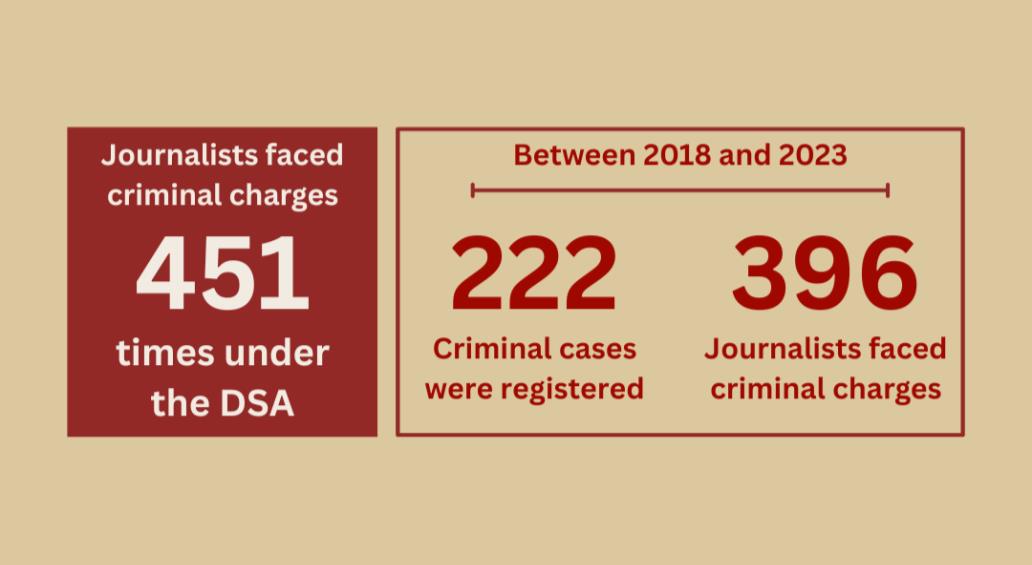
The sections below do a deep dive into these trends, specifically on the use of this law against journalists, based on the dataset of 222 DSA cases against 396 journalists as well as the 30 case studies.
A. Temporal and Geographical Distribution of Cases
A majority of the DSA cases against journalists in our dataset were filed in 2020 and 2021. Indeed, this corroborates reports of an uptick in DSA
cases for allegedly spreading misinformation about COVID-19 or criticizing the Government’s response to the pandemic.69
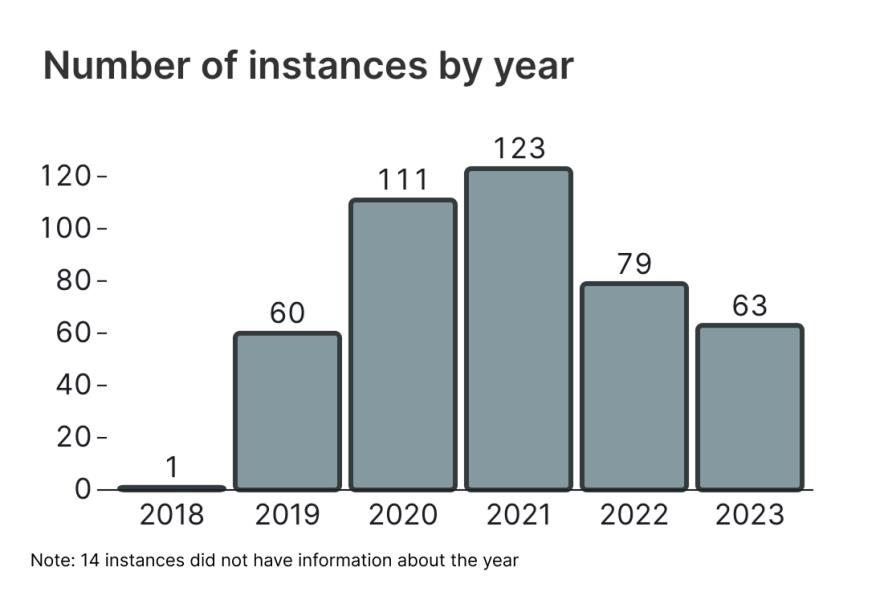
For instance, Ikhtiyar Uddin Azad faced charges under multiple provisions of the DSA for a Facebook post that criticized food shortages during the pandemic, allegedly suggesting that the situation had driven someone to commit suicide.70 The FIR in his case said that through his post, the journalist had published false information, and in doing so, “discredit[ed] the image of the state and the government, creat[ed] fear and panic among the public, attempt[ed] and aid[ed] the deterioration of law and order.”71 The FIR itself did not provide any other details.
In another case concerning the response to the pandemic, three journalists were criminalized for a report on the availability of food in a hospital ward.72 They had reported that though the daily allocation for food was supposed to be Taka 300, COVID-19 patients were only being given Taka 70 worth of food, and patients were resorting to having food brought from home, which in turn created a greater risk of infection.73 In that case, the complaint was filed by a hospital superintendent, but the chargesheet even admits that in fact “we can find out that in the month of June/2021, due to the lock down situation in Thakurgaon district, due to insufficient supply in the market, there was a slight disruption in the supply of food for 2/1 days.”74 At the same time, one of the three journalists, Tanvir Hasan Tanu, said that while at the police station, the police were consulting an MP, suggesting a political valence to the case, too.75
With respect to the geographical distribution: a majority of the incidents occurred in the following divisions:76 Chattogram (115); Dhaka (102); Rangpur (54); Sylhet (49) and Barishal (41).77 This broadly tracks the population of these divisions, with Dhaka, Chattogram, and Rangpur three
| 76 | As of 2024, there were eight divisions of | Bangladesh | , each named after the major | ||
|---|---|---|---|---|---|
| city within its jurisdiction that also serves as the administrative seat of that division. | |||||
| Each division is divided into several | |||||
| into | upazilas | (sub-districts). |
of the four most populous divisions. That is, this suggests that the DSA was widely used across Bangladesh, and its invocation against journalists was not confined simply to the capital.
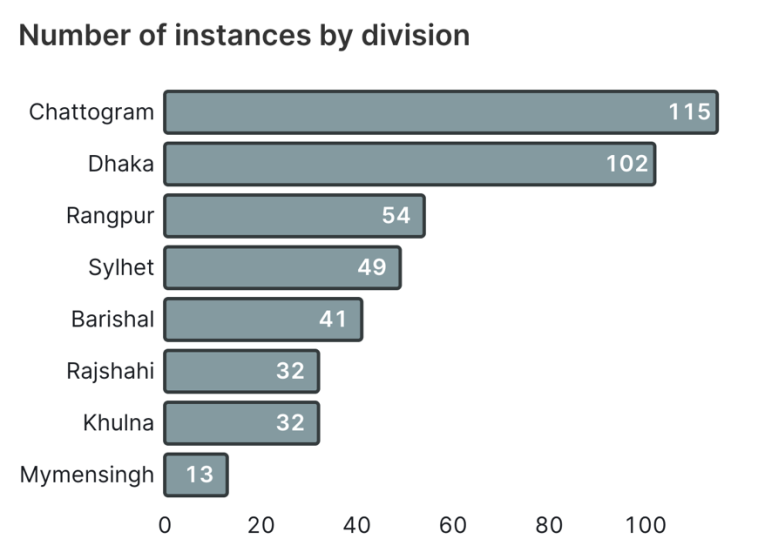
Taken together, these trends paint a picture of a widely-used tool, responsive to the political issues of the day (such as COVID-19).
B. Profiles of Complainants
The DSA has been criticized for being used as an instrument of harassment by the then ruling party and its affiliates to stifle dissent.78 This is borne out by our data: the largest number of the cases in our dataset were filed by politicians (73 of 222). Close to 70% of these politicians were affiliated with the then ruling party, the Awami League, at least according to public sources.79 The second largest category of complainants in our dataset were government employees (34 cases).80
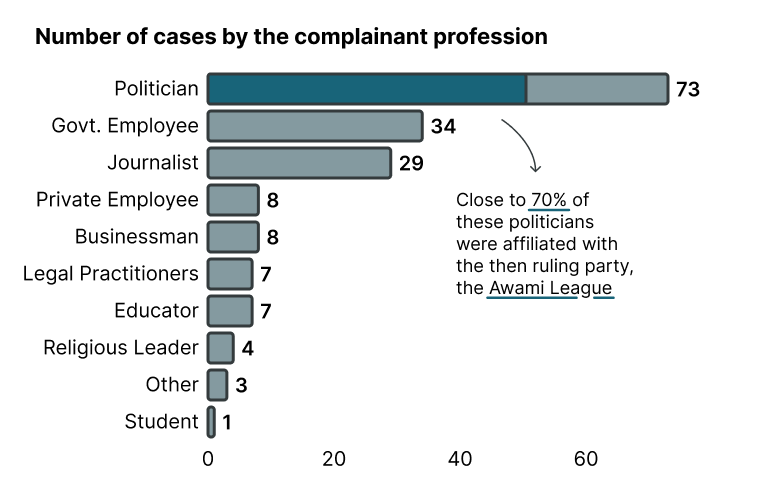
Among the 30 case studies analysed, almost 50% of the cases were filed by politicians or family members of politicians.
Among these cases, 20 of 30 cases concerned core journalistic work— the journalists faced cases for reporting on issues such as police abuse, public service delivery failures, and allegations of corruption. Among these 20, more than 50% were likewise filed by politicians/family of politicians.
In one case a member of the Bangladesh Awami Swechasebak League, the volunteer wing of the Awami League, filed a complaint against a journalist reporting on alleged corruption regarding the distribution of rice.81 The complaint specifically stated that “giving the above false and baseless information, my political party, the Bangladesh Awami League is defamed, is for the malicious purpose of degrading law and order and spreading social provocation by degrading the image of my political party Bangladesh Awami League.”82 In another case, a journalist posted online about concerns regarding the alleged diversion of funds from a construction project. In response, a councillor in the district filed a complaint alleging that the social media posts in question were “false propaganda” and because the “posts of the defendant are viewed by thousands of people and various comments are made . . . . the honour of the Honourable Mayor and other councillors along with me is extremely damaged.”83
In a third case, journalist MD Hedait Hossain Molla was charged with violating the DSA for reporting on alleged voting irregularities.84 Molla was stationed at the District Commissioner’s officer to hear the results of the 2018 parliamentary elections. For one of the seats a first set of results showed the opposition party and the Awami League as close, but when the final results were announced, the number of votes for the opposition party had gone down, and the total number of votes received appeared to be more than the total number of voters. The District Commissioner did not respond to a question regarding these discrepancies, but amended results were later announced. The next day the District Commissioner called Molla and demanded an apology, which the journalist declined to give.85 The complaint alleged that Molla had called the “fair” election into question in an “evil” attempt to affect the law and order situation.86 This case was filed by an officer from the upazila (sub-district).87 Ultimately, Molla was acquitted in the case.88
Digital Security Act. I and my political party are not involved in the incident in any way.”). This same journalist was among the three facing charges for the reporting on food irregularities in the COVID ward of a hospital. See supra.
The same holds true for cases brought for social media activity89—21 of the 30 cases in our case studies were brought for social media activity. Out of these, the majority were brought by politicians and government employees.
For instance, in one case a journalist, Lutfur Rahman Shawon, allegedly posted a picture on Facebook of the then Prime Minister Sheikh Hasina with the caption “[a]ll the courts are now under Hasina’s skirt (petticoat)”90 (although it was unclear whether in fact Shawon had even made this post).91 In response a leader of the Awami league student wing filed a complaint alleging that the post in question caused “the dignity of the head of state and the people in the country and abroad [to be] constantly being undermined. Because of this, as a good citizen of the state and a member of Bangladesh Chhatra League, my image or reputation is also getting damaged.”92
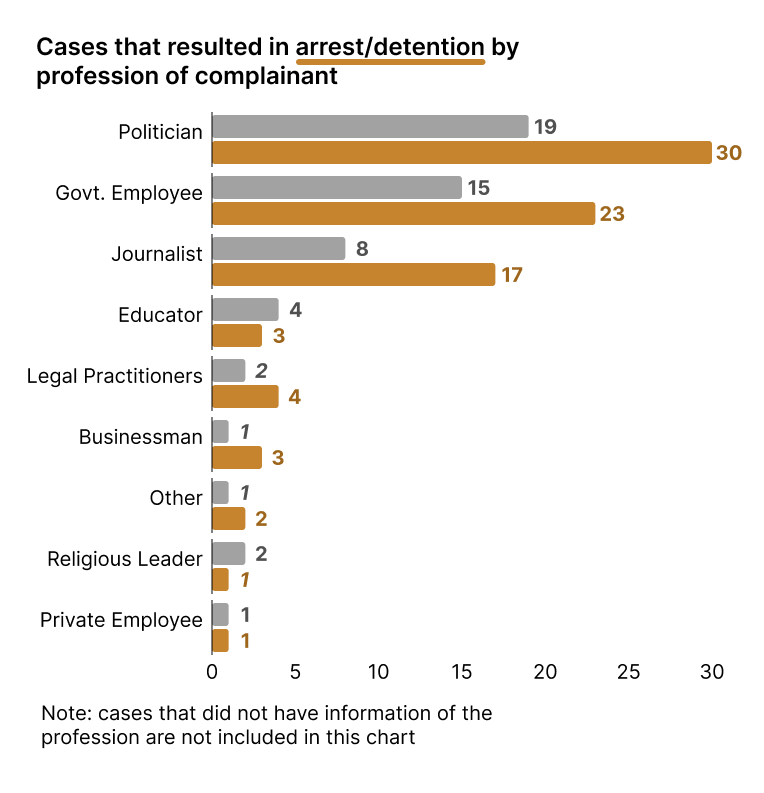
Our data also revealed that journalists were most likely to be arrested/detained in the cases filed by politicians and government employees.
In one case, Azharul Haque reported on alleged police corruption. According to Haque, he was arrested and then aggressively questioned by five to six officers while blindfolded and the police officers made use of electric shocks during questioning. He also said that the questioning revolved around whether he had anti-government sentiment.93
Our data also revealed that many cases appear to have been filed to intimidate and harass journalists for personal rivalries. Indeed, journalists themselves were the complainants in 28 cases in our dataset. As the recent Media Reform Commission report notes, “political division and conflicts of interest have become prominent among journalists. . . . [and] [p]ress clubs, intended as recreational and social gatherings for journalists, have similarly become a cause of disunity.”94
For instance, in one case a fight broke out at the Rangpur Press Club.95 One of the journalists who had been attacked, Afroza Sarkar, said that ‘she never imagined her colleagues would torment and assault her, let alone raise their hands against her and strike her in the back with an iron chair.’ Sarkar reported that three of her fingers on her left hand were fractured. She then went on a Facebook Live during which she identified the alleged attackers, one of whom was a former member of the Press Club who had previously been expelled.96 For this Facebook Live upload, Sarkar faced three complaints—from at least one of the alleged attackers and one of their former wives.97
Likewise, in Shawon’s case (involving the alleged remark suggesting that the courts were beholden to Prime Minister Hasina), Shawon explained in an interview that in addition the case’s political valence, he suspected it had been filed due to the complainant’s affiliation with a rival press club.98
A significant minority of cases were filed by private employees, educators, lawyers and businessmen (30 of the 222 in total). A case was lodged for reporting about a powerful businessman who had allegedly disregarded COVID-related restrictions on bus operations. According to reporting at that time, “police had seized the buses of [the businessman] while they were transporting people from Gaibandha to Dhaka during the lockdown,”99 and the journalist had reported on these dynamics.100
In another case, a journalist faced charges under the DSA after publishing a report alleging corruption/preferential treatment given to a restaurant owned by the daughter of a former Member of Parliament (MP). The case was filed by the owner of the restaurant.101
And in a third case, a journalist and several others were charged with violating the DSA for criticism of magistrates. The journalist had been fined for a driving infraction, and then allegedly broadcast criticism on Facebook Live.102 While the chargesheet does not specify what was said—alleging vaguely that that the defendant said “various insults about the mobile court, various bad comments about the District Commissioner . . . , various malicious and false/defamatory statements about the learned magistrates, raising questions about the jurisdiction of the mobile court and deliberately defaming the mobile court by making various falsehoods”103—the journalist alleges that he was targeted for failing to refer to the magistrate as ‘sir.’104
Four cases were also filed by religious figures—in one case, journalist Henry Swapon faced a case brought by a local religious leader for posts critical of the Catholic church in the area.105 Swapon said he thought the case was retaliation for his reporting on alleged corruption within the church.106
This pattern reinforces broader concerns about the DSA being used as a tool to shield public officials from scrutiny and stifle dissent, particularly in the context of social media expression, but also a vessel for settling scores.
C. Profiles of the Accused Journalists
In 209 incidents, the accused journalists had a national reach, and in 197 incidents the journalists had a local reach.
National and local level journalists could be further categorised by the medium they worked for: at the national-level, print media accounted for 65%; broadcast/TV for 25%; and online media publications for 10% of the incidents.
At the local-level, online media formed the majority—close to 60%; print media accounted for 40%; and broadcast/TV comprised only 1% of the incidents. In 45 incidents, data was not available.
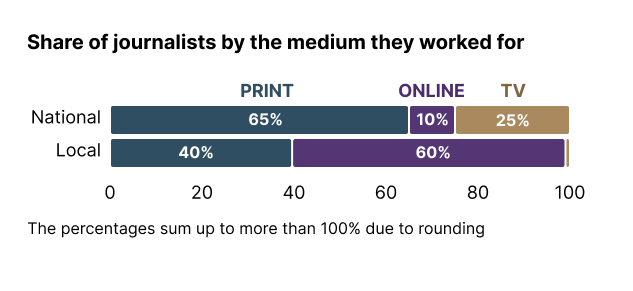
Overall, journalists working in print faced a higher proportion of criminal cases—48% of the total in the dataset; online media journalists comprised 29% of the dataset; and broadcast journalists 12%.
This may indicate the surge in growth in print publications in recent years. According to the 21st Annual South Asia Press Freedom Report, as of 2022, “Bangladesh has 3,176 registered newspapers and magazines of which 1,279 are dailies.”107 The recent Media Reform Commission report noted that “in 1982, only a dozen dailies were published in Dhaka, and the total number of newspapers and magazines across the country stood at 604. Today, the number stands at 3,270, including 1,371 in Dhaka.”108
At the same time, according to Freedom House, “[t]he increased use of social media platforms for sharing news and the emergence of blogs and independent online media outlets have brought new voices to the fore. The ability to access localized information and create content in Bengali has contributed to the popularity of local blog-hosting and online news services, as well as Bengali-language YouTube content.”109 Perhaps these trends—along with the relatively smaller number of currentlyoperational private TV stations110—explain the relative proportion of cases against print and digital outlets.
In 70% of the incidents, journalists facing criminal cases were in the age range of 30-50 (where information was available). And while the journalists in the dataset were predominantly male, at least 12 journalists facing DSA charges were women.
Notes
- The Report of the Media Reform Commission, Mar. 22, 2025, pg. 20 [hereinafter the “Media Reform Commission Report”]. ↩
- OHCHR Technical Note. ↩
- Id. ↩
- Section 43 of the DSA granted wide discretion to the police to conduct warrantless searches, seizures and arrests, while Section 53 of the law made several offences, namely Sections 17, 19, 21, 22, 23, 24, 26, 27, 28, 30, 31, 32, 33 and 34, non-bailable. See id. This is discussed further infra. ↩
- See, e.g., Ali Riaz, How Bangladesh’s Digital Security Act Is Creating a Culture of Fear, Carnegie Endowment for International Peace, Dec. 9, 2021, available at https://carnegieendowment.org/2021/12/09/how-bangladesh-s-digital-security-act-iscreating-culture-offear-pub-85951; Zillur Rahman, The New CSA: A Draconian Law Made More ‘Efficient,’ The Daily Star, Aug. 24, 2023, available at https://www.thedailystar.net/opinion/views/news/the-new-csa-draconian-law-mademore-efficient-3401151; Bilal Hussain, Advocates Question Whether Reforms Will Offer Bangladesh Media Greater Protection, VOA News, Aug. 18, 2023, available at 25 ↩
- Centre for Governance Studies, The Ordeal: Five Years of the Digital Security Act, 2018-2023, Apr. 2024, pg. 10, https://cgs-bd.com/cms/media/documents/e7678484-19ac-4716-8224-be3f706bfa66.pdf. ↩
- See id. pg. 18. 26 ↩
- See OHCHR Technical Note; Committee to Protect Journalists, Bangladeshi Journalists Face Physical Attacks, Legal Cases, and Detention Amid COVID-19 Pandemic, July 23, 2020, available at https://cpj.org/2020/07/bangladeshi-journalistsface-physical-attacks-legal-cases-and-detention-amid-covid-19-pandemic/. ↩
- FIR 20/194, Patnitala Police Station, May 13, 2020, Ikhtiyar Uddin Azad. According to the journalist, his post was corroborated by news accounts in several other publications. See Interview, Ikhtiyar Uddin Azad. He also indicated that he believed the case had been filed because he had exposed “corruptions and irregularities of various government officials and the local leaders and activists of the ruling Awami League and the Bangladesh Chhatra League.” See New Age, Journalist’s Acquittal Comes After 8-Month Detention, 3yr Legal Battle, Feb. 8, 2023, available at https://www.newagebd.net/article/193875/journalists-acquittal-comes-after-8-monthdetention-3yr-legal-battle. 27 ↩
- FIR 20/194, Patnitala Police Station, May 13, 2020, Ikhtiyar Uddin Azad. ↩
- FIR 7/206, Thakurgaon City Police Station, July 9, 2021, Tanvir Hasan Tanu, Rahim Shuvo, and Abdul Latif Litu. ↩
- Chargesheet No. 141, June 23, 2022, Tanvir Hasan Tanu, Rahim Shuvo, and Abdul Latif Litu. One of the journalists had apparently sought treatment at the hospital and had observed irregularities giving rising to the reporting. See Interview, Rahim Shuvo (indicating that one of his fellow journalists had sought treatment at the hospital). ↩
- Chargesheet No. 141, June 23, 2022, Tanvir Hasan Tanu, Rahim Shuvo, and Abdul Latif Litu. ↩
- Interview, Tanvir Hasan Tanu. One of the other two journalists offered a similar explanation, indicating that a local MP was the president of the hospital committee. Interview, Rahim Shuvo. ↩
- In the chart below, the numbers do not add up to 451 instances because this information was not available for all cases. 28 ↩
- This is also consistent with findings by the Media Reform Commission, which noted data to the effect that “influential ruling party figures filed 47 percent of the cases” under the DSA. Media Reform Commission Report, pg. 69. ↩
- Anyone holding a position within the official Awami League or its associated groups (such as the student wing, youth wing, labour wing, etc.) was categorized as a “politician affiliated with the Awami League.” ↩
- In the chart below, the numbers do not add up to 222 cases because this information was not available for all cases. 29 ↩
- FIR 12/59, Baliadangi Police Station, April 17, 2020, Rahim Shuvo. The journalist had allegedly characterized the complainant as a ‘rice thief.’ ↩
- Complaint as the basis for FIR 12/59, Baliadangi Police Station, April 17, 2020, Rahim Shuvo. In this case, sacks of rice were discovered, and the journalist published an article entitled “630 bags of rice found in the godown of the brother of the President of the Volunteer League.” See also id. (“[B]ecause it publishes news and information with purpose, it is read by many people and many indecent and inexcusable comments are made about Bangladesh Awami League and me, which is an offence under the 30 ↩
- Complaint. ↩
- Interview, MD Hedait Hossain Molla; FIR 06/221, Batiaghata Police Station, December 31, 2018, MD Hedait Hossain Molla. ↩
- Interview, MD Hedait Hossain Molla. ↩
- Complaint as the basis for FIR 06/221, Batiaghata Police Station, December 31, 2018, MD Hedait Hossain Molla. ↩
- Complaint as the basis for FIR 06/221, Batiaghata Police Station, December 31, 2018, MD Hedait Hossain Molla. ↩
- Cyber Tribunal Verdict, October 7, 2020. 31 ↩
- Cases where the complaint/FIR concerned a post/article on social media – this included those that related to core journalistic work as well as others. In some cases the journalists denied making the said posts—hence the cases were categorised as per the allegations in the complaint. ↩
- FIR 20/355, Chhatak Police Station, December 25, 2021, Lutfur Rahman Shawon. ↩
- Forensic Report on Facebook Activity of Lutfor Shawon, Issued By IT Forensic Branch, CID Bangladesh, April 20, 2022. ↩
- Interview, Lutfur Rahman Shawon; Complaint as the basis for FIR 20/355, Chhatak Police Station, December 25, 2021, Lutfur Rahman Shawon. 32 ↩
- Interview, Azharul Haque. 33 ↩
- Media Reform Commission Report, p. 140. ↩
- See generally Dhaka Tribune, ARTICLE 19 Concerned over Violence Against Female Journo in Rangpur, Sept. 26, 2021, available at https://www.dhakatribune.com/bangladesh/nation/259696/article-19-concerned-overviolence-against-female. ↩
- FIR 126/22, Rangpur Kotwali Police Station, February 13, 2022, Afroza Sarkar; Interview, Afroza Sarkar. ↩
- Interview, Afroza Sarkar. ↩
- Interview, Lutfur Rahman Shawon. 34 ↩
- Rummana Foisal Nafiu, Gaibandha Journalist Arrested Under Digital Security Act, Dhaka Tribune, May 26, 2020, available at https://www.dhakatribune.com/bangladesh/nation/210945/gaibandha-journalistarrested-under-digital. ↩
- Interview, Sirajul Islam Ratan. ↩
- Interview, Fazle Elahi. ↩
- Interview. ↩
- Chargesheet. ↩
- Interview. ↩
- See Dhaka Tribune, Poet Henry Swapon Jailed in Digital Security Act Case, May 14, 2019, available at https://www.dhakatribune.com/bangladesh/nation/176883/poethenry-sawpon-jailed-in-digital-security-act. 35 ↩
- Interview, Henry Swapon. 36 ↩
- South Asia Press Freedom Report 2022-2023, available at https://samsn.ifj.org/SAPFR22-23/bangladesh/. ↩
- Media Reform Commission Report, p. 18. ↩
- Freedom House, Bangladesh: Key Developments, June 1, 2023 – May 31, 2024, available at https://freedomhouse.org/country/bangladesh/freedom-net/2024. ↩
- The Media Reform Commission report states that “34 are operational,” Media Reform Commission Report p. 51. 37 ↩