
The Plights of the Accused
Numerous legal proceedings have been initiated against a multitude of individuals under the Digital Security Act. These cases had and continue to have far-reaching and deleterious consequences. A comprehensive examination of this legal framework reveals that individuals have not only encountered severe harassment but also faced instances of abduction, torture, and, tragically, loss of life. These instances stand as stark testimony to the inhumane dimensions of the law.
Among the myriad cases, there exist glaring examples that underscore the egregious nature of the allegations. For instance, a case was filed against a minor, a mere two years of age at the time (RTV News 2023). In another case, Md Emon, a 14-year-old student in the ninth grade, found himself accused of posting a critical status against Prime Minister Sheikh Hasina on a social media platform. The socioeconomic backdrop of Emon’s family, characterized by financial hardship, further exacerbates the challenges they face in navigating the legal complexities of the case (Daily Manab Zamin 2023). There has been a case against a farmer named Abu Zaman, an illiterate farmer in Gazaria village, Kishoreganj. This farmer doesn’t even have a smartphone and internet access, let alone a Facebook account. Yet he has been accused under the Digital Security Act for a social media post (The Daily Star 2021). There is another case where a student was arrested under the Digital Security Act on charges of hurting religious sentiment through her posts on Facebook. Interestingly, the case was filed against her after the arrest. She was released from jail after two years and seven months after confessing her crime and seeking mercy mentioning she is a mother of a breastfeeding child (The Daily Star 2023). Regrettably, these are not aberrations, as hundreds of similar cases have been filed. The injustices perpetrated under the Digital Security Act are poignantly exemplified by the plight of Mushtaq Ahmed, who succumbed to the harsh conditions of incarceration.
Md Emon, a 14-year-old student in the ninth grade, found himself accused of posting a critical status against Prime Minister Sheikh Hasina on a social media platform. The socioeconomic backdrop of Emon’s family, characterized by financial hardship, further exacerbates the challenges they face in navigating the legal complexities of the case (Daily Manab Zamin 2023).
In this context, a focused inquiry has been conducted, scrutinizing twelve specific cases involving 10 individuals selected from the vast pool of victims. These cases include, cases against Didarul Islam Bhuiyan, the coordinator of the organization “Rashtrachinta”; Jhumon Das Apon, a private sector employee; Khadijatul Kubra, a student at a public university; Lutfur Rahman Shawon, a journalist; Mamunur Rashid Nomani, a journalist; Md. Abdul Kaium, a human rights defender and journalist; Pritom Das, a businessman and a politician; Shanto Banik, a journalist; Ruhul Amin, a businessman and politician; and Imitiaz Ahmed Kajol, a social worker. Through careful examination of these cases, the manifold implications of the Digital Security Act on the lives of the accused become palpably evident.
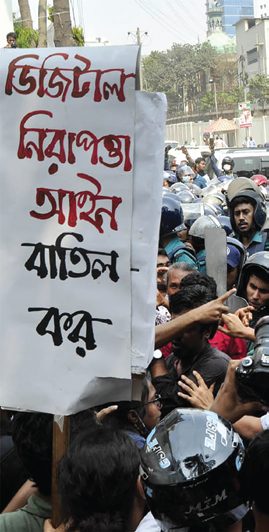
The selected cases became widely known nationwide and got a lot of attention because the victims went through devastating experiences. News and social media covered these cases, and they drew attention of the members of the civil society. However, hundreds of people accused under the DSA are facing similar or even worse predicaments. The victims suffer not just for a short time but for many years, facing both mental and physical torment. Their torment has no end in sight.
Selecting the cases was challenging because complete info wasn’t available in the public domain. Secondary sources like newspapers and social media protests were used as a point of departure but followed up with verifications through other sources including conversations with the victims and their lawyers. Their statements were meticulously recorded and are utilized only with their explicit consent. This method ensures a comprehensive understanding of the circumstances surrounding each case, fostering a nuanced and ethical approach to the investigative process. While our report focuses on the legal measures the accused have faced, we should not ignore the fact that the sufferings were not theirs alone. Financial hardships notwithstanding, families of these accused have experienced and continue to face agonies.
The following section presents a detailed examination of twelve specific cases, accompanied by a visual depiction of the timeline encompassing the entire procedural journey—from the day of the victims’ arrest to the present. This visual representation offers a chronological overview, delineating the trajectory of each case.