
Case study 7
Md Abdul Kaium
Case Summary
Md. Abdul Kaium, a journalist was accused under the Digital Security Act in May 2019. Kaium spent 53 days in jail before being granted bail on 3 July 2019 by the District Judges court. The proceeding of the case is now stayed through an order issued in June 2022 by the High Court. Md. Abdul Kaium was accused of being involved in circulating defamatory content on social media against one Idris Khan. Kaium faced a complex legal journey, marked by bail denials, jail custody and a charge sheet with accusation of false information dissemination and threats.
Case Details
In 12 May 2019, Md. Idris Khan, Principal of Momenshahi DS Kamil Madrasha, initiated legal proceedings against Md. Abdul Kaium in Trishal Police Station, bearing case no 15/142, accusing him for disseminating misinformation against him. The FIR filed under the Digital Security Act, resulted him spending 53 days in jail custody. The allegations pertained to defamatory news circulating on social media platforms such as Facebook and online news portals like “Ajker Bangladesh,” “Bhinnokhabar,” and “Primekhabor.” Subsequently, Kaium obtained bail and got release on 3 July 2019. At present, the case is halted by an order of Stay passed by a Division Bench of the High Court comprising of Mr. Justice S. M. Kuddus Zaman and Mr. Justice Md. Riaz Uddin Khan.
Background
Md Abdul Kaium, a 31 years old young journalist, human rights activist, and online freelancer, navigated a maze of legal pathways shaped by the complexity of the Digital Security Act (DSA). His experience underscores the intricate interplay of events, legal procedures, and personal repercussions within the framework of the DSA. The ordeal began on the evening of 11 May 2019.
Kaium went to the Momenshahi DS Kamil Madrasah to receive payment for a website he had developed for the principal of the Madrasah. Kaium’s routine visit to the Madrasah unfolded a series of fateful events. When the principal offered payment in US Dollars, Kaium, wary of potential irregularities, insisted on paying in Bangladeshi Taka. Upon leaving the premises, he was apprehended by plainclothed officers of the Law enforcing agencies on the charge of carrying USD 200 for alleged illicit activities. Notably, the purported 100-dollar notes were not found with him at the time of apprehension. Despite this, he was transported to the nearest police Special Branch (SB) office. During the initial 24 hours, Kaium’s family remained unaware of his location. The arresting officers neither disclosed their identities nor clarified the reason for his apprehension.
Remand
No Remand.
Bail
On 14 May 2019, Kaium had his first hearing where his plea for bail was denied. On 16 June 2019, the court conducted an unscheduled second hearing, summoning a Prosecution Witness (PW), during which the judge once again rejected the bail prayer. Unfortunately, this hearing was not communicated to Md. Abdul Kaium’s legal representative, leading to his absence in court. In the interim between these two hearings, Kaium’s lawyer endeavored to secure bail on two occasions, encountering denial both times.
Subsequently, on 26 June 2019, during another hearing, Kaium’s lawyer sought bail again but faced further denial. On 2 July 2019, a fresh bail application was submitted by Kaium’s lawyer, resulting in the District Judge Court finally granting the bail prayer. Consequently, Md. Abdul Kaium was released from jail custody on 3 July 2019, culminating in a total period of 53 days spent in jail custody.
Charge sheet
Superintendent Debasish Saha acted as the Investigating Officer of the case and submitted the Charge Sheet bearing no. 252 on 1 August 2020. In the Charge Sheet it was alleged that Kaium, deemed a proficient digital offender, disseminated misleading and baseless information through various devices, names, and links, causing harm to the reputation of the Informant, Idris Khan. Mr. Kaium was accused for using multiple mobile phone SIM numbers to spread false and malicious information about Khan on Facebook, resulting in reputational damage.
Kaium allegedly uploaded defamatory posts on platforms such as Protidiner Kotha, Ajker Bangladesh, and Bhinnokhobor, with titles implying grave accusations against Khan. Additionally, he is accused of creating a defamatory online page, ‘bdfactfinding.com.’ The charge sheet outlines incidents where Kaium allegedly sent threatening messages and made calls to intimidate Khan. Specific dates, such as 30 January 2019, and 16 February 2019, are mentioned, detailing the use of various phone numbers to spread false information and threats.
The charge sheet further accuses Kaium of spreading unauthorized pictures of Khan on YouTube, opening the defamatory page ‘bdfactfinding.com,’ and uploading offensive posts, subsequently deleted. The document details various news articles uploaded by Kaium on 31 January 2019, containing serious allegations against Khan, including financial misconduct and association with illegal activities.
The informant of the case claims that Kaium demanded money, and transactions occurred under duress, involving payments of Tk 50,000, Tk 25,000, and Tk 23,000. The accused allegedly continued threats and extortion, using a fake online page to menace Khan. The case was filed against him under Sections 23/23(2)/23(3)/25/29/29(2) of DSA. It is pertinent to note that the court accepted the charge sheet on 21 October 2020.
Chronology of Legal Proceeding
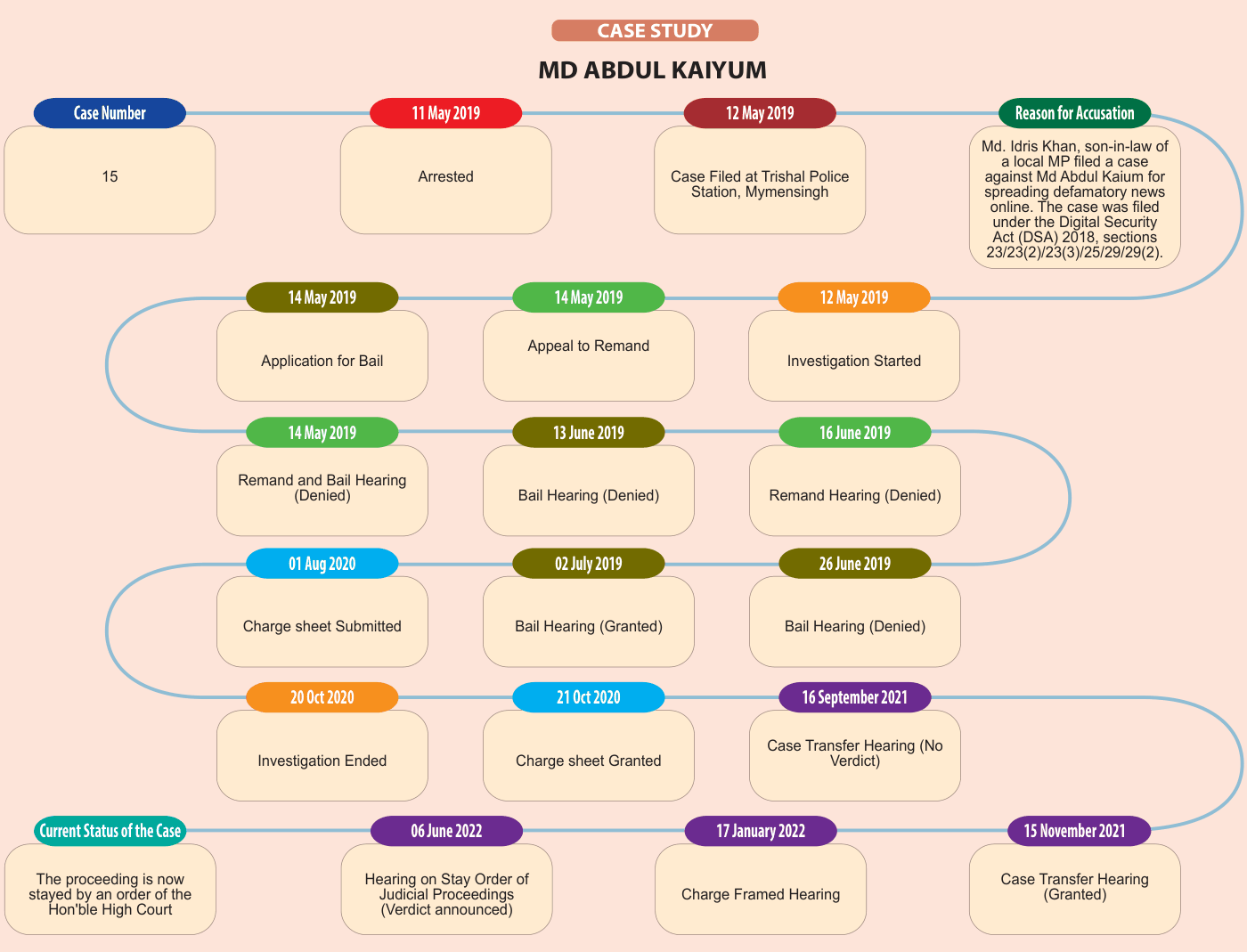
1st Hearing : 14 May 2019. Remand and Bail Hearing. The Remand and Bail were denied.2nd Hearing : 16 June 2019. Remand Hearing. The remand was denied.3rd Hearing : 26 June 2019. Bail Hearing. The bail was denied.
4th Hearing : 2 July 2019. Bail Hearing. The bail was granted.5th Hearing : 16 September 2021. Case Transfer Hearing. 6th Hearing : 15 November 2021. According to the Case Transfer Hearing.7th Hearing : 17 January 2022. Charge Framed Hearing, 8th Hearing : 6 June 2022. Hearing on Stay Order of Judicial Proceedings. The order of stay was passed.
Accused’s Statement
“I’ve had to endure significant financial and emotional burdens, constantly navigating the courtrooms just to prove my innocence,” expressed Md. Abdul Kaium in an interview. He went on to share a distressing aspect of his incarceration, revealing, “During my time in prison, I was denied medical attention for my asthma, and images of me in handcuffs were exploited to tarnish my reputation within the community.” This difficult journey has not only impacted his professional life but has left lasting scars on his personal well-being, he insisted.
Kaium lamented the collateral damage to his journalistic career, stating, “Now, I can no longer work as a journalist as news organizations perceive me as a liability that may bring harm to their reputation.” The ordeal extends beyond him, with his family continuing to face harassment from accusers and their supporters. Despite settlement offers from the accusing side after he got out of prison, Kaium is resolute about fighting the case in court, firmly asserting his innocence.
He perceives the entire episode as a concerted conspiracy to obstruct his work as a journalist and human rights defender. Kaium recounted four years of physical and mental trauma, with profound financial repercussions affecting both him and his family. Although did not go to Jail Custody again, the persistent fear of reprisals hampers his reporting on human rights violations, leading him to abandon personal writing. Kaium believes that the Digital Security Act has been used as a tool against him, hindering his journalistic pursuits. His narrative emphasizes the profound personal and professional toll borne by individuals trapped in legal complexities.
The hearings, remand, bail, case transfer, and charge framing, portrayed a challenging legal battle for Md. Kaium. Kaium’s interview highlighted the financial and personal toll, impacting his journalism career and family. He deemed the case a conspiracy to hinder his work as a journalist and human rights defender, expressing ongoing fear and threats.
Current Status of the Accused
The proceeding of the case is currently stayed through an order of the High Court issued on the 6 June 2022 passed by a Bench comprising of Mr. Justice S M Kuddus Zaman and Mr. Justice Md. Riaz Uddin Khan.