
Introduction
During a parliamentary session on 5 June 2023, Law Minister, Anisul Huq, informed the assembly that between 8 October 2018, the day of its adoption, and 31 January 2023, over 7,001 cases have been filed under the Digital Security Act (DSA) (The Daily Star 2023). This was the first acknowledgment from the government of the total number of cases filed under the law which has been an issue of intense debate at home and abroad. The statement, however, fell short of providing details of the extensive use of the law. The minister did not reveal as to how many people have been accused and arrested, how many of the cases have undergone the trial process, how many people have been convicted, how many are languishing in jail as pre-trial detainees and how many have been convicted. The law, when introduced in 2018, was claimed to have been enacted to provide security to the citizens in the digital arena. But over the past years, various academic studies, reports of international and national human rights organizations, and organizations which track freedom of media have documented that the law has been used wantonly by the government and supporters of the ruling party to silence the critics. These studies and reports have shown that the law has been used as a tool to suppress freedom of expression, stifle voices of dissent, and serve the interests of the government and the ruling party activists in Bangladesh. It is well recorded that the law’s vague provisions infringe upon fundamental rights enshrined in the country’s Constitution and international agreements. It is against this backdrop, human rights activists, editors, and politicians have been demanding the repeal of the law.
Recent developments can be traced back to the amendment of the Information and Communication Technology (ICT) law in 2013 and the introduction of the Digital Security Act (DSA) law in 2018. The DSA has caused distress and anguish to the general populace and has been subjected to intense criticism by various human rights organizations and press freedom groups since it was drafted in early 2018.
The minister’s statement came almost three months after UN High Commissioner for Human Rights, Volker Türk urged the Bangladesh government to immediately suspend the enforcement of the law (OHCHR 2023). Türk’s comment was a follow-up to the Office of the United Nations High Commissioner for Human Rights (OHCHR)’s Technical Note to the Government of Bangladesh on review of the Digital Security Act (OHCHR 2022). The note, shared with the Bangladesh Government in June 2022, was prepared after years of consultations between the OHCHR and the Bangladesh government (Ahmed 2023).
On 7 August 2023, the government announced that the Digital Security Act would be repealed and will be replaced with a new law called the Cyber Security Act (CSA) (Mahmud, 2023). This decision was met with considerable apprehension and anxiety among the general public. The government also announced that although the DSA will be replaced with the CSA, cases filed under the DSA will be continued. Law Minister told, ‘there is no scope for quashing the cases filed under the Digital Security Act and there is no question of giving compensation in this regard’ (The Business Standard 2023). This statement clearly showed that the government is oblivious to the anguish and distress caused by the law to a large number of people. The primary concern with the CSA is that it has almost copied all the provisions of the much-criticized DSA. On 13 September 2023, the act was passed by the parliament and subsequently, the CSA became a law with the ascent of the President Mohammad Shahabuddin. The potential ramifications of this change will no doubt be a topic of discussion in the coming months and years as the new legislation is implemented. But the lingering impacts of the DSA, which has become an unending nightmare for thousands of people, is beyond doubt. Those who have been accused and being tried, in many instances wrongfully, will have to endure the agony of going through the criminal justice system.
This statement clearly showed that the government is oblivious to the anguish and distress caused by the law to a large number of people. The primary concern with the CSA is that it has almost copied all the provisions of the much-criticized DSA. On 18 September 2023, the Cyber Security Act (CSA) was gazetted and on 13 September 2023, the act was passed by the National Parliament, subsequently the CSA became a law with the ascent of the President Mohammad Shahabuddin.
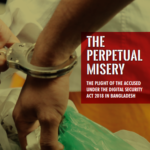
It is against this background that this report is prepared under the project conducted by the Centre for Governance Studies (CGS). The CGS has been tracking the extent of the use of the DSA. The project, initiated in early 2020, has previously published three reports documenting how the law has been implemented and who has become the victims of the cases. They are ‘Digital Security Act, 2018: How Is It Being Enforced’ (April 2021); ‘The Unending Nightmare: Impacts of Bangladesh’s Digital Security Act 2018’ (April 2022); ‘What’s Happening: Trends and patterns of the use of the Digital Security Act 2018 in Bangladesh’ (January 2023). The project continues to gather information about the use of the DSA since its introduction in October 2018 and a dedicated website continues to update as we receive and verify the information. In continuation of the work, this report presents 12 case studies involving 10 individuals who have been accused under the DSA over the past years and facing legal proceedings. Individuals whose cases are examined are: Didarul Islam Bhuiyan, Lutfur Rahman Shawon, Mamunur Rashid Nomani, Md. Abdul Kaium, Pritom Das, Shanto Banik, Ruhul Amin, and Imitiaz Ahmed Kajol. Two individuals – Jhumon Das Apon and Khadijatul Kubra – had two cases filed against each of them. Jhumon Das Apon, was arrested and detained on two occasions, while Khadijatul Kubra was detained for both cases simultaneously.
This report contextualizes these cases within the broader picture of the use of the law. This report presents an analysis of the Digital Security Act (DSA) trends from 8 October 2018 to 30 September 2023. The data draws upon information from approved media sources, the accused, their networks, lawyers, and relevant authorities. All data is available at https://freedominfo.net/.