
India’s BRICS Presidency and the Management of Disagreement

Roman Uddin
Senior Research Associate,Centre for Governance Studies (CGS)
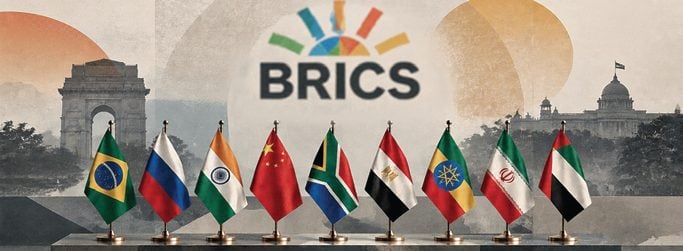
Abstract: India’s BRICS presidency demonstrates how states with divergent strategic interests can sustain cooperation within a flexible diplomatic framework. The analysis examines BRICS as a platform for managing disagreements over security, trade and regional order, while highlighting India’s multi-alignment strategy and its relationships with the United States, China and Russia.
The eighteenth BRICS Summit in New Delhi was important less because it produced a unified geopolitical position than because it showed how states with different interests can work inside the same diplomatic framework. Under India’s presidency, the expanded grouping brought together countries with contrasting relationships with the United States, China, Russia and one another. The New Delhi Declaration reaffirmed consensus, institutional reform, economic cooperation and a greater role for developing countries in global governance.1 What deserves closer attention is how governments that disagree on security, trade and regional order manage to preserve cooperation without first settling those disagreements. Part of the answer lies in the design of the grouping. BRICS rests on no treaty, maintains no permanent secretariat and places no binding obligations on its members. Scholars describe an arrangement of this kind as an informal intergovernmental organization, and its principal advantage is that states can organize themselves without surrendering independence.2 Because membership costs little, governments that distrust one another can still take part. India’s own conduct follows a related pattern, which the literature calls multi-alignment.3 A country following this approach builds several partnerships at the same time, gives each a particular purpose, and allows none of them to close off the others.4 Read together, these two features explain the New Delhi outcome. BRICS is not built to settle the quarrels of its members. It is built to manage them, and the summit showed how much diplomatic work that modest function can carry. India’s relationship with the United States shows the method in practice. The two countries work mainly on Indo-Pacific balance, maritime security, technology and supply chains, and the Quad has also taken up critical minerals and new communication standards.5 That relationship came under heavy strain during 2025. In February 2026, Washington lowered its tariff on Indian goods from 25 to 18 per cent. It also removed an extra duty imposed because India was buying Russian oil. In return, India made large commitments to purchase American products.6 The repair was real, but confidence was not fully restored. One assessment concluded that the episode made hedging more important to Indian foreign policy, not less.7 Relations with Russia follow a separate logic, built on a long defense relationship and on energy. Vladimir Putin met Narendra Modi in New Delhi on the eve of the summit, and their talks covered civil nuclear energy, defense, fertilizers and critical minerals. By July 2026, Russia supplied a record 51 per cent of India’s crude oil imports, because supplies from the Middle East had been disrupted.8 A commitment made in one negotiation was therefore overtaken by conditions created in another. That is the ordinary difficulty faced by a large energy importer. Engagement with China runs alongside open competition. Xi Jinping travelled to New Delhi for the summit, his first visit to India since 2019. He and Modi agreed on the need to respect existing understandings on the border, and to address the trade imbalance and questions of market access.9 Direct flights have resumed and some investment rules have been relaxed. Yet the boundary remains unsettled, large deployments stay in place, and New Delhi remains concerned about Chinese export controls on rare earths and about Chinese defense ties with Pakistan.10 The Gulf shows a similar picture. India keeps energy and investment links with Saudi Arabia and the United Arab Emirates, and diplomatic ties with Iran, although these states stand on opposite sides of a regional war.
“The economic passages worked in the same way. Russia, China and Iran pressed for stronger language on sanctions and on reducing dependence on the dollar, while India resisted an openly anti-Western position.”
BRICS holds all of these tensions at once. India and China compete for influence in Asia. Iran and the Gulf states are regional rivals. Russia is in open confrontation with Western governments, while India deepens its economic links with them. The contrast with an alliance is instructive. An alliance requires its members to align their positions and to act together against a third party. This grouping asks only those members continue to attend, and that they accept wording each can live with. The value of it is not that such differences were settled. It is that a method exists for working despite them. In May 2026, a meeting of BRICS foreign ministers ended without a joint statement because of the war involving Iran.11 Four months later, agreement was reached in New Delhi.The method was careful wording. Talks on the hardest passages continued into the early hours. India avoided deciding who was at fault, and the text recorded the national positions of members while calling for maximum restraint.12 The declaration expressed concern about attacks on civilian infrastructure and on nuclear facilities under international safeguards, without naming any party.13 Language of this kind is often dismissed as vague. In practice it performs a precise function, because it allows each government to report a result at home without endorsing the position of its rival. The summit also gave the Iranian and Emirati leaderships a place to meet. A framework of this kind cannot deliver justice or stop a war, but it keeps channels open when bilateral relations are closed. The economic passages worked in the same way. Russia, China and Iran pressed for stronger language on sanctions and on reducing dependence on the dollar, while India resisted an openly anti-Western position.14 The final text criticized unilateral tariffs and sanctions but named no country, which allowed governments with very different exposure to Western markets to accept the same sentence.15 Financial cooperation followed a similar path. Discussion centered on settlement in local currencies and on linking payment systems, and Indian officials confirmed that no common currency is under consideration.16 The aim is to add options rather than to replace the existing order. Scholars of contested multilateralism have shown how dissatisfied states use one institution to press for change in another.17 BRICS fits that description only in part, because its members disagree about how far such pressure should go. China tends to treat the grouping as a way to widen non-Western influence. Russia values it as diplomatic and economic space during a period of isolation. India treats it as an instrument of strategic autonomy and of Global South representation. Other members bring their own priorities, and these asymmetries continue to limit the cohesion of the group.18 What results is a diplomatic ecosystem in which different visions of order meet, not a single geopolitical project.A framework of this kind can do only so much. It preserves dialogue, lowers the cost of disagreement and protects institutional relationships that bilateral friction might otherwise break. It does not assign responsibility, and it rarely produces collective action when the interests of members collide. Yet in a period when few states are willing to choose one camp, that modest function has become valuable. For middle and smaller powers, including those of South Asia, the practical lesson is that access to such frameworks now matters as much as the strength of any single bilateral partnership. The future of diplomacy may depend less on removing rivalry than on maintaining places where rivalry and cooperation can exist together. India’s presidency of BRICS shows how emerging powers are adapting to a world in which no single alignment defines a country’s place in international politics.
Endnotes
1 Prime Minister’s Office, Government of India. (2026, September 12). BRICS New Delhi Declaration: Building for resilience, innovation, cooperation and sustainability. Government of India. https://www.pmindia.gov.in/en/news_updates/brics-new-delhi-declaration-building-for-resilience-innovation-cooperationand-sustainability-september-12-2026/2 Vabulas, F., & Snidal, D. (2013). Organization without delegation: Informal intergovernmental organizations (IIGOs) and the spectrum of intergovernmental arrangements. The Review of International Organizations, 8(2), 193-220. https://doi.org/10.1007/s11558-012-9161-x3 Hall, I. (2016). Multialignment and Indian foreign policy under Narendra Modi. The Round Table, 105(3), 271-286. https://doi.org/10.1080/00358533.2016.1180760https://www.aljazeera.com/news/2026/9/12/chinas-xi-headsto-india-for-brics-summit-overshadowed-by-wars 10 Business Today. (2026, September 11). Xi-Modi meeting: India-China thaw faces hurdles over border, trade and Pakistan. Living Media India. https://www.businesstoday.in/india/story/xi-modi-meeting-india-china-thaw-faces-hurdles-over-border-trade-and-pakistan -554914-2026-09-11 11 Al Jazeera. (2026, May 15). BRICS talks end without joint statement as divisions over Iran war deepen. Al Jazeera Media Network. https://www.aljazeera.com/news/2026/5/15/brics-talks-endwithout-joint-statement-as-divisions-over-iran-war-deepen 12 Outlook India. (2026, September 13). BRICS Delhi Declaration explained: How India got Iran, UAE, Russia and China on the same page. Outlook Publishing. https://www.outlookindia.com/national/brics-delhi-declaration -explained-how-india-got-iran-uae-russia-and-china-on-thesame-page 13 The Statesman. (2026, September 13). BRICS Summit 2026: Here is what the New Delhi Declaration says. The Statesman. https://www.thestatesman.com/india/brics-summit-2026-here-is-what-the-new-delhi-declaration-says-1503637754.html 14 Outlook India. (2026, September 12). Behind the Delhi Declaration: How BRICS navigated the Iran war to find
Notes
- O’Donnell, F., & Papa, M. (2021). India’s multi-alignment management and the Russia-India-China (RIC) triangle. International Affairs, 97(3), 801-822. https://doi.org/10.1093/ia/iiab036 ↩
- Asia Society Policy Institute. (2026, June 24). Trump, Modi, and “final touches” on the U.S.-India trade deal. Asia Society. https://asiapolicy.asiasociety.org/p/trump-modi-and-finaltouches-on-the ↩
- The White House. (2026, February 10). Fact sheet: The United States and India announce historic trade deal. Executive Office of the President. https://www.whitehouse.gov/fact-sheets/2026/02/fact-sheetthe-united-states-and-india-announce-historic-trade-deal/ ↩
- Bajpaee, C. (2026, February 17). Despite reset in India-US relations, New Delhi retains commitment to strategic hedging. Chatham House, The Royal Institute of International Affairs. https://www.chathamhouse.org/2026/02/despite-reset-indiaus-relations-new-delhi-retains-commitment-strategic-hedging ↩
- Reuters. (2026, September 11). Modi, Putin hold talks in New Delhi on trade, defence. Business Recorder. https://www.brecorder.com/news/40439046/modi-putin-holdtalks-in-new-delhi-on-trade-defence ↩
- Al Jazeera. (2026, September 12). Modi and Xi seek to reset India-China ties on BRICS sidelines. Al Jazeera Media Network. 04 consensus. Outlook Publishing. https://www.outlookindia.com/international/behind-the-delhideclaration-how-brics-navigated-the-iran-war-to-findconsensus ↩
- Al Jazeera. (2026, September 13). BRICS summit 2026: What are the key takeaways? Al Jazeera Media Network. https://www.aljazeera.com/news/2026/9/13/brics-summit- 2026-what-are-the-key-takeaways ↩
- Outlook Business. (2026, September 12). BRICS’ local-currency settlement plan is a push towards de-dollarisation. Outlook Publishing. https://www.outlookbusiness.com/economy-and-policy/bricslocal-currency-trade-settlement-plan-cbdc-framework-dedollarisation-push-benefits-for-india ↩
- Morse, J. C., & Keohane, R. O. (2014). Contested multilateralism. The Review of International Organizations, 9(4), 385-412. https://doi.org/10.1007/s11558-014-9188-2 ↩
- East Asia Forum. (2025, October 25). BRICS’ multipolar aspirations navigate asymmetries of power. Australian National University. https://eastasiaforum.org/2025/10/25/brics-multipolaraspirations-navigate-asymmetries-of-power/ ↩