
25 Years After 9/11: The Wars, Divisions and Unintended Consequences

Depanjali Roy
Senior Research Associate, Centre for Governance Studies (CGS)
Abstract: The twenty-five-year legacy of 9/11 reveals profound consequences for international security, foreign policy and social relations. The analysis examines the subsequent war on terror, military interventions in Afghanistan and other countries, and their wider effects on Muslims, Arabs and South Asians, highlighting the divisions and unintended consequences of post-9/11 policies.
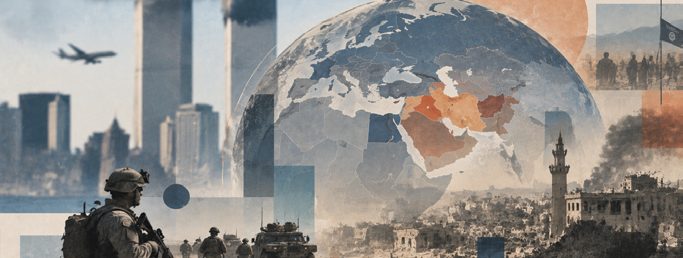
“Never forget”: The most widely repeated phrase used on anniversary stickers, signs, and memorials to honor the victims of the 9/11 attack.On that fateful day, the whole world was glued to the news channels to get the latest updates. Some turned off their TV sets to avoid the fear and anxiety. After that, the USA declared war on terror. At the time, the situation was so intense that little attention was given to the long-term impact it could eventually have. U.S. foreign and security policies increasingly affected Muslims, Arabs, and South Asians. Organizations, institutions, and universities kept surveillance on people in certain communities. Reports of hate crimes and attacks were made in different places. Muslims were arrested on suspicion of involvement in the attack. The relationship with the Middle East also changed significantly. Questions later emerged over whether U.S.-led efforts to restore or promote democracy in certain countries in the region achieved their intended outcomes. Now, twenty-five years later, the question is what the world has become in response to it. It goes without saying that this attack affected Americans to the core, as three weeks after 9/11, 87 percent said they felt angry about the attacks on the World Trade Center and Pentagon. A sense of patriotism was seen inside, as the majority of them said that even after one year of the attack. In that context, then-President George W. Bush declared the “war on terror” after Congress passed the 2001 AUMF, authorizing military force against those who were engaged in the 9/11 attacks. However, eventually it was not limited to Afghanistan; the USA and its allied forces entered Afghanistan on October 7, 2001, and later conducted military operations in Iraq (2003), Pakistan (2004), Libya (2011), Syria, and Yemen (2014 onwards). It cannot be denied that the war on terror was started to eliminate al-Qaeda in Afghanistan, and the USA justified it as a “just war.” However, the consequences were severe and generated continuing debate over proportionality and long-term outcomes. The objective of the USA and its allies also shifted to stabilizing Afghanistan by establishing democracy and institutions to run the country. After two decades of war, the Taliban returned to power following the U.S. withdrawal, leaving the outcome of that effort widely debated.
“In an interconnected world, the shockwaves of a crisis anywhere can become the reality of everyone.”
The invasion of Iraq in 2003 was a debatable decision, as per many scholars and experts. After the 9/11 attack, the wounds on U.S. soil were still fresh, and the decision to go to war was made in an atmosphere of intense pressure and uncertainty. The United States proceeded without a further UN Security Council resolution explicitly authorizing the invasion; in February 2003, then-U.S. Secretary of State Colin Powell asked the UN Security Council to support action against Iraq, arguing that Saddam Hussein was continuing to stockpile and manufacture weapons of mass destruction (WMD), in violation of UN Resolution 687.1 Another stated objective was to overthrow Saddam Hussein and establish democracy for the Iraqi people. Later, it was found that the USA and UK relied on the information of two Iraqi defectors, an engineer called Rafid Ahmed Alwan al-Janabi and an intelligence officer called Maj Muhammad Harith, who claimed that they had first-hand knowledge of Iraq’s WMD program. Both men later said they had fabricated their evidence because they wanted the allies to invade and oust Saddam.2 Post-invasion investigations found neither active WMD stockpiles nor a connection between Saddam Hussein’s regime and the 9/11 attack. The failure of pre-war intelligence raised questions about its credibility, while an estimate placed war-related deaths between 2003 and 2011 at 461,000.3 The war was also estimated to have cost the U.S. $3 trillion.4 After everything, the world cannot forget the descriptions and pictures of human rights violations in Abu Ghraib Prison in Iraq and Guantanamo Bay in Cuba. Since 2002, 780 Muslim men and boys from more than 47 countries have been sent to Guantanamo Bay.5 At Abu Ghraib, the Red Cross reported that 70% to 90% of detainees had been arrested by mistake or had no links to armed insurgencies and were labeled as “security threats.”6 Because of months of inhuman treatment, including mental, physical, and sexual violence, prisoners still suffer from Post-Traumatic Stress Disorder (PTSD), severe depression and despair, and chronic anxiety and paranoia. This made it difficult for some prisoners to adapt to society after they were released. After bearing humiliation, some also struggled to get a stable job to lead their lives. Constant judgment, suspicion, and racism made recovery more difficult. Some eventually recovered and rebuilt their lives, while others were drawn toward extremist networks. The relationship between detention and later radicalization is complex, but the prisons became important spaces for contact among militants and later featured prominently in extremist narratives. The effects of detention also reached beyond individual prisoners. Leaders of ISIS, including Abu Bakr al-Baghdadi, spent time in U.S. detention facilities in Iraq, where they networked and organized.7 For some detainees, experiences of detention became part of later grievance and radicalization. Terrorist organizations also used torture stories and photos of detention in propaganda and recruitment, including for foreign fighters. These dynamics were among several factors associated with post-9/11 radicalization; they should not be treated as a single explanation for extremism. At the same time, Islamophobia and suspicion toward Muslims increased after 9/11. Muslims, Arabs, Asians, and South Asians often faced longer airport inspections, racial profiling, and surveillance. The attack on September 11, 2001, produced a chain reaction that included prolonged military campaigns, governance challenges, human rights violations in detention, radicalization, and the rise of Islamophobia. In Iraq, the absence of the WMD stockpiles cited before the invasion intensified debate over the basis for the war. After 25 years since the unforgettable attack, many scholars still debate whether the invasions of Afghanistan and Iraq achieved their intended objectives. U.S. forces removed the Taliban government in 2001 but were unable to prevent the group from returning to power after the withdrawal. The wars also carried major financial and human costs. With the U.S. out of Afghanistan and the Taliban in control, 69% of Americans say the U.S. failed to achieve its goals there, and 53% said the same about Iraq.8 The regional effects did not remain confined to Iraq and Afghanistan, but shaped security calculations across the Middle East and Europe. The course of action from 2001 also altered the regional balance of power after the removal of Saddam Hussein and the growing influence of Shia-led political actors across Iraq and the wider region. The democratic stability promised by Western countries was only partly realized, while instability and anti-Western grievances contributed to conditions in which brutal transnational insurgencies could grow, including the evolution of Al-Qaeda in Iraq into ISIS, which later carried out and inspired attacks beyond the region. In the long term, these conflicts triggered a humanitarian crisis, as millions of refugees fled toward Europe, contributing to political polarization. Later, the withdrawal of Western forces created additional strategic space for rivals such as China and Russia to expand their influence. The post-9/11 period therefore transformed the Middle East from a region of extensive Western influence toward a more multipolar strategic environment, while also changing how particular communities were viewed in security and public discourse.
Endnotes
1 United Nations Office of the High Commissioner for Human Rights. (2003, February 5). Briefing Security Council, US Secretary of State Powell presents evidence of Iraq’s failure to disarm. https://www.ohchr.org/en/press-releases/2009/10/briefingsecurity-council-us-secretary-state-powell-presents-evidenceiraqs 2 BBC News. (2023, March 20). Why did the US and allies invade Iraq, 20 years ago? https://www.bbc.com/news/world-64980565 3 Medical Xpress. (2013, October 15). New estimates give updated count of Iraq war deaths between 2003 and 2011. https://medicalxpress.com/news/2013-10-iraq-war-deaths. html 4 Stiglitz, J. E., & Bilmes, L. J. (2010, September 5). The true cost of the Iraq War: $3 trillion and beyond. The Washington Post. https://www.hks.harvard.edu/publications/true-cost-iraq-war-3-trillion-and-beyond 5 Center for Constitutional Rights. (2025, February 5). Guantánamo by the numbers. https://ccrjustice.org/home/get-involved/tools-resources/factsheets-and-faqs/guant-namo-numbers 6 NBC News. (2004, May 10). Red Cross: Iraq abuse ‘tantamount to torture’. https://www.nbcnews.com/id/wbna4944094 7 The Guardian. (2014, December 11). ISIS: The inside story. https://www.theguardian.com/world/2014/dec/11/-sp-isis-theinside-story 8 Pew Research Center. (2021, September 2). Two decades later, the enduring legacy of 9/11. https://www.pewresearch.org/politics/2021/09/02/twodecades-later-the-enduring-legacy-of-9-11/