
From September Promises to Present Crisis: Understanding the Failure of Camp David and Oslo

Fawzia Afrin
Research Intern, Centre for Governance Studies (CGS)
Abstract: The Camp David Accords and Oslo Declaration created historic diplomatic openings, but neither resolved the deeper disputes surrounding territory, sovereignty, security and national identity. Their limitations remain visible in the continuing Gaza crisis, instability in the West Bank and weakening prospects for a two-state solution. Sustainable peace requires addressing unresolved political realities, not agreements alone.
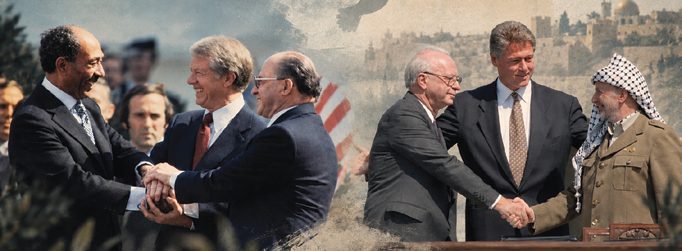
In the history of Middle Eastern diplomacy, September has repeatedly marked as crucial turning point. On 17 September 1978, Egyptian President Anwar Sadat and Israeli Prime Minister Menachem Begin signed the Camp David Accords under the mediation of U.S. President Jimmy Carter.1 Fifteen years from this event, on 13 September 1993, Israeli Prime Minister Yitzhak Rabin and Palestine Liberation Organization (PLO) Chairman Yasser Arafat signed the Oslo Declaration of Principles, creating the first official recognition between Israel and the Palestinian leadership. Though both agreements created international optimism, decades later, the region remains defined by unresolved questions of territory, sovereignty, security, and national identity. The ongoing Gaza crisis, instability in the West Bank, and the weakening prospects of a two-state solution demonstrate the limitations of these earlier peace frameworks.2 The Camp David Accords emerged from decades of conflict between Egypt and Israel. Following the 1967 Six-Day War, Israel occupied the Sinai Peninsula, which became the central territorial dispute between the two countries. From a realist international relations perspective, Camp David succeeded because both states had clear strategic interests. Egypt regained occupied territory and strengthened its international position, while Israel achieved security by removing the threat of war with its largest Arab neighbor.3 The agreement therefore solved one dimension of the Arab-Israeli conflict but left the Palestinian question unresolved. The Oslo Accords attempted to address this unresolved issue. Signed in 1993, Oslo represented the first direct political agreement between Israel and the PLO. Israel recognized the PLO as the representative of the Palestinian people, while the PLO recognized Israel’s right to exist. However, Oslo was designed as an interim arrangement. It postponed the most difficult issues, including final borders, Jerusalem, Israeli settlements, Palestinian refugees, and sovereignty. The agreement created a process for negotiations but did not define the final political outcome.4
“Recognition between governments can open the way for peace, but it cannot by itself resolve deeper disputes over territory, sovereignty and national identity.”
Both agreements focused more on reducing immediate confrontation than resolving the deeper causes of conflict. Camp David managed the Egypt-Israel conflict, while Oslo created limited political cooperation between Israel and the PLO. However, neither agreement fully addressed questions of sovereignty, identity, and territorial rights. The central challenge of Israeli Palestinian conflict has been territory. Oslo postponed decisions on borders, Jerusalem, settlements, and refugees. The expansion of Israeli settlements and changing realities in the West Bank have repeatedly raised concerns about the viability of a two-state solution. United Nations Security Council Resolution 2334 emphasized that settlements in occupied Palestinian territory constitute a major obstacle to peace.5 Another challenge was the unequal position of the negotiating parties. Israel participated as an established state with international recognition, while Palestinians entered negotiations without full sovereignty. The Oslo framework created Palestinian administrative institutions but did not establish an independent Palestinian state. Peace agreements also faced opposition within both societies. The Oslo process suffered from growing mistrust and violence, including the assassination of Israeli Prime Minister Yitzhak Rabin in 1995. Among Palestinians, opposition emerged from groups that viewed Oslo as insufficient because it did not guarantee independence and statehood.6 The history of Camp David and Oslo offers a significant message about the limits of peace agreements. Recognition between governments can open the way for peace, but it cannot by itself resolve deeper disputes over territory, sovereignty, and national identity. The current Middle Eastern crisis demonstrates the consequences of unresolved issues from the Oslo period. The Gaza war after October 2023 represents the most serious breakdown of Israeli Palestinian relations in decades. The conflict has produced massive humanitarian consequences, destroyed infrastructure, and further reduced trust between Israelis and Palestinians. Even after ceasefire efforts, Gaza continues to face questions regarding governance, reconstruction, security, and political authority.7 One of the most difficult questions today is who will govern Gaza after the conflict. Israel has argued that Hamas cannot remain a governing and military force, while Palestinians and regional actors have raised concerns about replacing one form of political uncertainty with another. Without a legitimate political framework, reconstruction alone cannot create long-term stability. Recent UN assessments have warned that rising violence and territorial fragmentation threaten the possibility of establishing a viable and sovereign Palestinian state.8 Beyond Palestine, the contemporary regional order is shaped by Iran-Israel rivalry, proxy conflicts involving actors in Lebanon, Iraq, Syria, and Yemen, and the growing role of non-state actors in regional politics. These developments show a shift from traditional state-to-state conflicts toward a more complex security environment where local conflicts are connected to broader geopolitical competition.9
“A durable resolution requires confronting the underlying political realities surrounding sovereignty, security, equality, and competing national identities.”
At the same time, Gulf states such as Saudi Arabia, the United Arab Emirates, and Qatar have adopted more independent foreign policies by balancing relations with global and regional powers. While normalization agreements such as the Abraham Accords changed diplomatic relations between Israel and several Arab states, they did not resolve the Palestinian issue, which remains a major source of regional tension.10 Conflicts in Syria and Yemen, along with instability affecting Red Sea security and global trade routes, further demonstrate that Middle Eastern instability is no longer driven by a single conflict but by interconnected challenges involving weak states, regional rivalries, and competing security interests.11 Five decades of Middle Eastern diplomacy demonstrate that agreements between political leaders alone are insufficient to create sustainable peace. A durable resolution requires confronting the underlying political realities surrounding sovereignty, security, equality, and competing national identities.
Endnotes
4 Said, E. W. (2001). The end of the peace process: Oslo and after. Vintage Books.5 United Nations Security Council. (2016). Resolution 2334 (2016): Israeli settlements in the occupied Palestinian territory. United Nations 6 BBC News. (2020). Oslo Accords: What were they and why did they fail? 7 United Nations Security Council. (2026). From Gaza to Gulf, peace in Middle East hinges on resolving Israel-Palestinian conflict, Security Council speakers stress, amid calls for political progress. United Nations Meetings Coverage and Press Releases.8 United Nations. (2026). With West Bank settler violence at new high, Security Council speakers demand accountability, full implementation of Resolution 2803 (2025). United Nations Question of Palestine.9 Armed Conflict Location & Event Data (ACLED). (2026). Middle East overview: Regional conflict updates.10 Observer Research Foundation. (2026). Shifting sands: A Middle East in conflict and transition.11 Associated Press. (2026). Middle East developments: Gaza, Iran, Lebanon and regional security updates. Associated Press.
Now Available
Notes
- Office of the Historian, U.S. Department of State. (2018). Foreign Relations of the United States, 1977–1980, Volume IX: Arab Israeli dispute. ↩
- Office of the Historian, U.S. Department of State. (2000). The Oslo Accords and the Arab Israeli Peace Process. ↩
- Council on Foreign Relations. (n.d.). What are the Oslo Accords? 45/1 New Eskaton (2nd Floor), Dhaka 1000, Bangladesh Tel +880 2 58310217, +880 2 222223109, Website: www.cgs-bd.com ↩