
Methodology
This study employed a mixed-methods research design, integrating both quantitative and qualitative approaches to explore the perceptions, lived experiences, and expectations of minority communities in Bangladesh ahead of the upcoming national election. This chapter outlines the systematic framework employed to investigate the political engagement, perceptions, and systemic barriers faced by the minority and marginalized communities in Bangladesh. By utilizing a mixed-methods approach, the study ensures that broad quantitative trends are grounded in the nuanced, lived experiences of minority groups, providing a comprehensive analysis of the electoral landscape.
Research Design: A Mixed-Methods Approach
This study adopted a mixed-methods research design, integrating quantitative and qualitative methodologies to capture a holistic view of the electoral environment for minority communities. The quantitative component was designed to identify large-scale patterns, trends, and statistical correlations across various demographic groups. Conversely, the qualitative component provided the necessary depth to interpret these trends, exploring the “why” behind voter hesitation, institutional distrust, and social silence.
To ensure the study was grounded in national realities, secondary data analysis was incorporated into the design. This involved a thorough review of the BBS census. These national statistics informed the sampling logic and site selection, ensuring that the study focused on areas with high concentrations of religious, ethnic, and socio-economic minorities.
Rationale for Methodological Triangulation
The complexity of minority participation in a transitional political climate necessitates a multi-layered approach. While a nationwide survey can quantify the scale of a problem, such as the fact that only 23.4% of respondents feel completely safe during elections; it cannot fully capture the emotional or historical weight of that fear.
By combining the Survey, Key Informant Interviews (KIIs), and Roundtable discussions, the study achieved “methodological triangulation.” This allowed the study to cross-verify findings: The survey provided the measurable data, the KIIs offered expert structural analysis of human rights and democratic gaps, and the multi-party dialogues provided a real-time assessment of how political promises align with community expectations.
Survey Methodology and Sampling Strategy
Conducting a survey of minority populations in Bangladesh presents a unique methodological challenge: demographic dispersion. While groups like the Chakma or Garo have geographic concentrations, others, such as urban Dalits or Christians, are dispersed or hidden within larger majority populations. Consequently, a Simple Random Sampling (SRS) method would be statistically inefficient; It would likely yield a sample dominated by the Bengali Muslim majority, failing to capture enough minority respondents to run meaningful regression analyses or comparative studies.
To overcome the above constraints, the study adopts a Stratified Purposive Sampling design. This approach deliberately selects specific geographic “clusters” (districts and divisions) where minority populations are historically and demographically concentrated. Within these purposely selected sites, a Snowball Sampling technique is employed to access “hard-to-reach” respondents such as those living in tea garden enclaves or urban slums or who might have been absent from official voter lists.
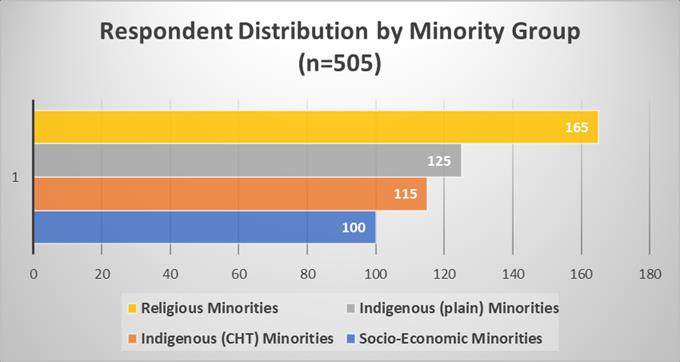
The total sample of 505 respondents is stratified into four distinct categories:
- Socio-Economic Minorities (n=100)
- Indigenous Communities: Chittagong Hill Tracts (n=115)
- Indigenous Communities: Plains (n=125)
- Religious Minorities (n=165)
Why Stratified Purposive Sampling?
Stratification was applied to reflect differences in political context across regions and communities. Indigenous communities in the Chittagong Hill Tracts operate under a distinct administrative and historical framework compared to plains indigenous groups. Similarly, the political experiences of religious minorities vary between urban centers and rural districts, and socio-economic minorities often face constraints linked to employment conditions and residential segregation.
By structuring the sample around these distinctions, the study aimed to capture variation in electoral experiences without assuming uniformity within or across minority groups.
The Role of Snowball Sampling
Many of the target populations in this study are socially marginalized or geographically isolated.
- The Problem: There are no reliable, publicly available lists of “Dalit voters” or “Tea Garden laborers” or “trans population” that can serve as a sampling frame. Furthermore, marginalized groups often fear persecution and may be suspicious of strangers asking about political affiliations.
- The Solution: Snowball sampling (chain-referral) solves this by using community insiders. The research team identifies initial “seeds” such as a community elder, a church leader, or a labor union representative. These seeds then refer the researchers to other members of their community. This method is the gold standard for accessing “hidden” populations, ensuring we reach the most vulnerable individuals (e.g., a female tea picker) rather than just the vocal elite.
Rationale for Target Distribution
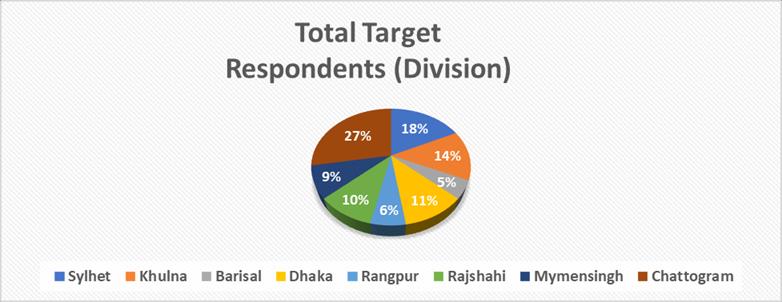
The following sections provide the justification for each stratum, explaining why specific districts were chosen and how the sample size reflects both demographic reality and research importance.
Stratum A: Socio-Economic Minorities (Target: 100)
Definition: This category encompasses groups whose political marginalization is primarily defined by their occupation, caste, and class status. It focuses on the “labor colonies” of the tea and betel leaf industries and the marginalized Hindu castes.
- Sylhet Division (n=90): The Plantation Economy
- Moulvibazar (n=35): This district is the epicenter of Bangladesh’s tea industry, hosting 91 of the country’s ~160 tea gardens. We have allocated the highest number of socio-economic respondents here to study the “Tea Garden Vote Bank” phenomenon. Tea workers, approximately 440,743, live in isolated lines (colonies) provided by management.10 Their voting behavior is often collective, decided by panchayat leaders or influenced by garden owners (Al-Amin et al., 2017; Zaman & Abir, 2017). A large sample here allows us to test hypotheses about voting and political illiteracy.
- Sylhet Sadar (n=30): This site focuses on workers in peri-urban gardens and the Hindu minority living in close proximity to tea estates. It provides a comparative context: do tea workers closer to the city (Sylhet) have higher political agency than those in remote Moulvibazar?
- Sunamganj (n=25): This district targets the Khasi and Betel Leaf Workers. Unlike tea workers, the Khasia people live in punjis (clustered hill villages) and are engaged in betel leaf cultivation. With an estimated 20 million people involved in the broader betel leaf sector, this subgroup faces unique political battles regarding forest land rights and crop price syndicates. Their inclusion ensures the study covers agro-labor politics beyond just tea.
- Khulna Division (n=10): Caste-Based Exclusion
- Jessore (n=10): Including respondents here diversifies the socio-economic sample, ensuring it is not entirely Sylhet-centric. It allows the study to explore how caste associations function as political pressure groups in the southwest.
Stratum B: Indigenous Communities – CHT (Target: 115)
Definition: The Chittagong Hill Tracts (CHT) is the only region in Bangladesh with a dedicated administrative system (Regional Council) It also has a history of armed conflict. Political participation here is often revolving around the implementation of the 1997 Peace Accord.11
- Chattogram Division – The Hill Tracts
- Rangamati (n=45): As the administrative headquarters of the CHT, Rangamati is the center of indigenous politics. It is home to 98.38% of the nation’s Chakma population (483,726 total). The Chakma are the most politically dominant indigenous group, and high sampling here is mandatory to understand the mainstream indigenous political narrative.
- Bandarban (n=40): This district is ethnically distinct, home to the Marma (202,974) and smaller, more marginalized tribes like the Mro, Bawm, and Tanchangya. The Mro and Bawm often feel excluded by both the Bengali state and the Chakma-dominated regional parties.12 Allocating 40 respondents here allows us to capture these “minorities within minorities,” ensuring the study reflects the internal diversity of the CHT (Uddin, 2010).
- Khagrachhari (n=30): This district has a highly mixed population of Tripura, Chakma, and Bengali settlers. It is a hotspot for land disputes.13 Surveying here provides data on how direct competition with settlers influences indigenous voting behavior and political trust.
Stratum C: Indigenous Communities – Plains (Target: 125)
Definition: Plains indigenous groups (Adivasis) are dispersed across the northwest and north-central regions. Unlike the CHT, they lack a peace treaty or reserved governance seats, making their political struggle one of survival and recognition.
- Rajshahi Division (n=50): The Barind Tract Context
- Rajshahi (n=25) & Naogaon (n=25): These districts are the ancestral heartland of the Santal (129,049) and Munda (64,869) communities. 44.16% of all Santals live in Rajshahi Division. The region has a history of peasant uprisings (e.g., Tebhaga) but currently faces severe land alienation. The sample here is evenly split to capture a broad cross-section of the Santal community, examining whether their historical legacy of resistance translates into modern voting power.
- Mymensingh Division (n=45): The Matrilineal Context
- Mymensingh (n=45): This division is home to 87.77% of the country’s Garo population (100,223). The Garo are unique due to their matrilineal social structure. This site is critical for the study’s gender dimension: the impact of matrilineal culture results in political participation for indigenous women compared to the patriarchal societies of the Gaaro.
- Rangpur Division (n=30): The Northwest Frontier
- Dinajpur (n=30): This district hosts significant Oraon (85,858) and Santal populations. It serves as a geographic counterbalance to Rajshahi, ensuring that the Plains sample covers the entire northwestern belt.
Stratum D: Religious Minorities (Target: 165)
Definition: This stratum investigates the “religious minority vote.” While often assumed to be a monolith (e.g., “Hindus vote for Party X”), this study seeks to unpack the nuances of regionalism, security, and representation.
- Dhaka Division (n=55): The Urban & Dalit Nexus
- Dhaka City (n=55): This is the most complex and strategically vital site. It targets three distinct groups:
- Urban Dalits: An estimated 35,000–40,000 Dalits live in Dhaka’s colonies (e.g., Ganaktuli, Hazaribagh). They are often invisible in national politics.
- Christians: Only 0.30% of the national population, 25.46% of Christians live in Dhaka. They represent an educated, urban minority voice.
- Buddhists: Middle-class professionals who differ significantly from the rural Buddhists of the CHT.
This mix allows the researcher to analyze the effect of urbanization on political agency. Do urban minorities feel more empowered than their rural counterparts?
- Khulna Division (n=60): The Hindu Heartland
- Gopalganj (n=30): Famous as a political stronghold, this district has a massive Hindu population. Surveying here tests the “Safe Seat Hypothesis”: Do minorities in areas where their party is guaranteed to win actually receive better public services, or are they taken for granted?
- Khulna (n=30): With 15.27% of the division being Hindu, Khulna allows for a study of minority politics in a major industrial and port region. It serves as a control variable for the rural-centric data from other divisions.
- Barishal Division (n=25): The Southern Coast
- Barishal (n=25): This area has a notable concentration of both Hindus (5.71%) and Christians (0.49%). The political dynamics here are influenced by local patronage networks, offering a distinct context from the north.
- Chattogram Division (n=25): The Buddhist Center
- Chattogram (n=25): While CHT has indigenous inhabitants, the plains of Chattogram are the religious center for Bengali Buddhists (Barua community). Since 96.77% of all Buddhists live in Chattogram Division, this site is highly noted to represent the religious interests of the Buddhist community separate from the ethnic interests of the hill tribes.
Analytical Dimensions and Weighting
The distribution of the 505 respondents is not merely a reflection of population census numbers; it is a strategic allocation designed to maximize analytical power.
- Identity Intersectionality: By separating “Indigenous CHT” from “Indigenous Plains,” the study acknowledges that ethnicity is not enough to define political reality- geography and legal status matter. By separating “Religious Minorities” from “Socio-Economic Minorities” (like tea workers, who are often also Hindu), we can isolate the variable of poverty from religion.
- Regional Balance: The survey covers 6 Divisions (Dhaka, Chattogram, Rajshahi, Rangpur, Khulna, Sylhet). This ensures that the findings are not biased toward one specific region (e.g., only Dhaka-centric views).
- The “Critical Mass” Theory: If the survey followed the BBS Population and Housing Census 2022, where Christians account for about 0.3 percent of the population, the sample would include only one or two Christian respondents, making meaningful analysis impossible. Therefore, the study set a minimum sample threshold for the Christian community to ensure a sufficient critical mass for statistically valid and analytically useful findings.
Thematic Focus of the Survey
The survey instrument was structured around four pillars essential to democratic health:
- Electoral Behavior: Tracking historical turnout (found to be 86.7%) versus current interest levels (18.5% very interested) in the national parliament election.
- Political Awareness: Measuring the gap between general rights awareness (88.7%) and specific candidate knowledge.
- Representation: Evaluating the perceived sufficiency of minority candidates (where 67.7% reported an insufficiency).
- Access to Justice: Documenting experiences of discrimination and the “culture of silence” regarding reporting harassment to the police.
5. Key Informant Interviews (KIIs)
To gain a structural perspective on the findings, the study conducted in-depth KIIs with 10 experts. This cohort included human rights defenders, senior academics, civil society members, representatives from minorities and investigative journalists.
These interviews were instrumental in identifying the institutional “bottlenecks” that prevent minority inclusion. Informants provided critical commentary on the efficacy of the Election Commission, the impact of exclusionary nationalist narratives, and the historical lack of sincere representation in the National Parliament. Their insights helped transform the survey’s raw numbers into a narrative of systemic reform needs.
6. Dialogues and Roundtable Discussions
Recognizing that political participation is a two-way process, Thus the study organized several interactive platforms:
- Regional Roundtables: Four roundtables were conducted in Dhaka, Sylhet, and Rangpur. These sessions served as safe spaces for community members to voice region-specific grievances—such as land rights in the CHT or labor rights in Sylhet’s tea gardens—directly to civil society and political actors.
7. Data Collection and Quality Control
The field operation was managed by a team of 50 trained enumerators.
- Training: Enumerators underwent specialized training to handle sensitive topics with empathy and neutrality.
- Data Analysis: Quantitative data was processed using statistical software to identify correlations between variables (e.g., the relationship between education levels and political awareness). Qualitative data from KIIs and dialogues was analyzed through thematic coding, identifying recurring issues such as “fear of violence” and “institutional distrust.”
8. Ethical Considerations and Participant Protection
The study adhered to the highest ethical standards, prioritizing the “Do No Harm” principle.
- Informed Consent: Every respondent was briefed on the purpose of the study and participated voluntarily.
- Confidentiality: Given that 55.8% of respondents fear physical or psychological harm if they speak out, strict anonymity was maintained. Content Fetch Id-linked data was encrypted to ensure that no individual respondent could be identified by external parties.
- Sensitivity: Research sites were selected and interviews were conducted in a manner that minimized the risk of retaliation or social stigma for the participants.
Notes
- Al-Amin, M., Hossain, M. I., & Parveen, S. S. (2017). Social exclusion and poverty among tea garden workers in Bangladesh. The Indian Journal of Industrial Relations, 53(1), 21–36. ↩
- The Daily Star. (2025, December 1). 28 years of CHT accord: Disappointment, frustration keep growing. The Daily Star. Retrieved from https://www.thedailystar.net/news/bangladesh/news/28yrs-cht-accord-disappointment-frustration-keep-growing-4048496 ↩
- Uddin, N. (2010). Politics of cultural difference: Identity and marginality in the Chittagong Hill Tracts of Bangladesh. South Asian Survey, 17(2), 283–294. ↩
- Partha, R. S. (2016). The consequences of the Chittagong Hill Tracts (CHT) Peace Accord at the village level: A case study of Khagrachari Hill District in Bangladesh. Journal of International Development and Cooperation, 22(1), 1–14. Retrieved from: 222955767.pdf ↩