
The way forward
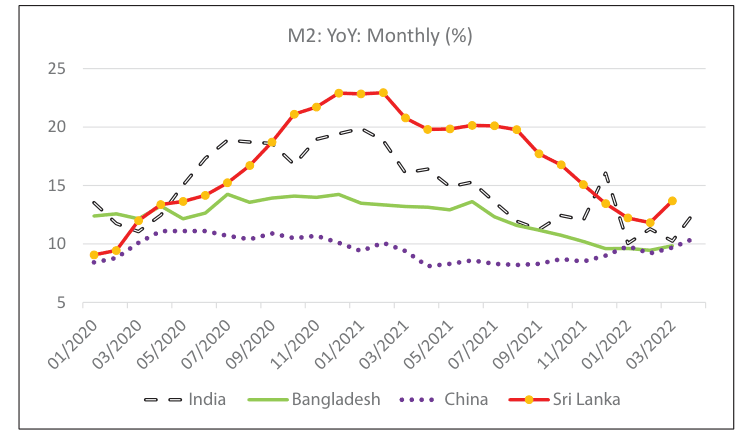
High inflation matters- it is often associated with lower growth, price distortion, financial crises, and political unrest. In its latest world economic outlook IMF cautioned, “as advanced economies lift policy rates, risks to financial stability and EMDEs’ capital flows, currencies, and fiscal positions– especially with debt levels having increased significantly in the past two years– may emerge.”38 Policymakers in Bangladesh now face extraordinary challenges to tame inflation. The scope of policy response is constrained by two key reasons. First: the drivers of ongoing inflation- the pandemic, the war, supply chain disruption, sanctions, geopolitical factors, etc.- are to large extent beyond the control of the country. Second: There are adverse developments in key macro variables, notably large “twin deficits” in the past few months: the consolidated fiscal balance (% of GDP) registered a large deficit of 5.2% in December 2021.39 The external sector of the country also faces significant challenges owing to big gaps in export earnings and import payments and the slowdown in inward remittances. Bangladesh’s current account deficit is projected to be 3.1% of its GDP in 2022.40 That being said, to limit the adverse impacts of inflation, there are still some scopes for policy maneuver through monetary and fiscal policies aimed at limiting the impact of current inflation as well as anchoring medium- and longer-term expectations at moderate levels. The latter determines the effectiveness of fiscal and monetary policy and shapes realized inflation. Monetary policy response: Nobel laureate Milton Friedman famously observed that “inflation is always and everywhere a monetary phenomenon.” As such, monetary policy transmission through interest rate and exchange rate could play a crucial role in limiting inflation shock. In this regard, the central bank’s credibility holds the key. Studies suggest that inflation expectations are shaped by among others, the degree of credibility of the central bank.41 One of the constraints in this regard is that the interest rate is largely administered rather than market-determined in Bangladesh. As a result, there are marked anomalies between policy rate, deposit rate, and lending rate. Currently, depositors are punished for savings with a negative real interest rate. Clearly, with this interest rate policy, it is challenging to manage aggregate demand in line with BB’s inflation target. Tightening monetary conditions including credit growth in less productive sectors is advisable. Nevertheless, broad money (M2) growth in recent months has declined to below 10% (Figure 7) and the Bangladesh Bank has raised its policy rate to 5%.
Given the nature of the exchange rate regime that Bangladesh Bank pursues the central bank has to intervene in the foreign exchange market when the impact of inflation is persistent. Amid the steady depreciation of most currencies of EMDEs vis-à-vis the US dollar, maintaining an appropriate level exchange rate of Bangladesh Taka is imperative limiting the impact of imported inflation as well as sustaining export competitiveness. In recent weeks, there has been marked misalignment between the official and kerb (unofficial) market Taka-Dollar exchange rate, leading to volatilities in exchange rate markets. Since the pandemic, Bangladesh’s real effective exchange rate (REER) appreciated by about 7% while the nominal effective exchange rate (NEER) index remained the same, indicating inflation in Bangladesh is higher than its trading partners, indicating exports have been more expensive and imports cheaper (Figure 8).
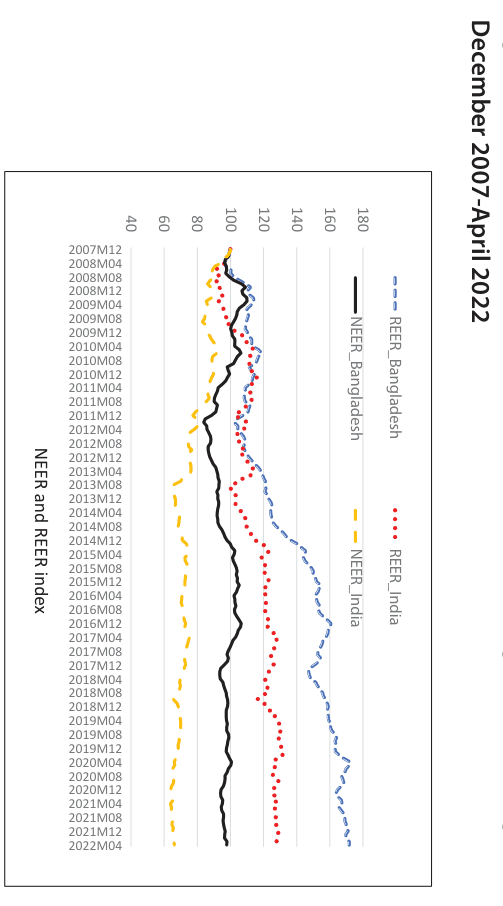
Source: Bruegel Datasets
In addition, a study shows that “there is a risk of policy missteps if the pass-through, the effect of exchange rate changes on domestic inflation, is not properly evaluated, notably in EMDEs, where large currency movements are more frequent”.42 As such, a correct assessment of the exchange rate pass-through ratio (ERPTR) to inflation, the percentage increase in consumer prices associated with a 1% depreciation of the effective exchange rate, is advisable.
Fiscal measures: The priority of fiscal authorities should be protecting those struggling with the double whammy of the commodity price hikes and the pandemic-induced economic crisis through targeted food subsidies and safety net measures. The provisions of food-support programs designed and implemented to mitigate the pandemic’s adverse impacts should be revisited amid the rising prices of essentials.43 The upward adjustment of energy prices should be delayed to suppress inflation and inflation expectations, although this could further increase the country’s fiscal deficit. The austerity measures that have been introduced should be maintained until inflation is eased to Bangladesh Bank’s targeted level. The forthcoming national budget is also critical to reduce tariff rates for essentials and elevate luxury items to control imports. The signal (supported by actions) that both monetary and fiscal authorities need to give to the market is that they are determined to ease inflationary pressure as much as they can, even if that cost some growth limiting current inflation and anchoring medium-term inflation expectations.
45/1 New Eskaton (2nd Floor), Dhaka 1000, Bangladesh Phone: +880258310217, +880248317902, +8802222223109 Email: [email protected] Website: www.cgs-bd.com
Notes
- Available at: https://www.business-standard.com/article/international/wef-summit-world-economy-has-buffer-against-recession-says-gopinath-122052400050_1.html
- Business Standard. World economy has ‘buffer’ against recession. May
- Financial Times. 2022. Is the global economy heading for recession?, 20 March. Available at: https://www.ft.com/content/35b31fb0-f8ad-4557-9d95-267e0ed958eb
- Op. cit. IMF 2022. ↩
- CEIC World Trend Plus database. ↩
- Ibid.10 ↩
- “A central bank is credible if people believe it will do what it says.” Also see, Blinder, A.S., 2000. Central-bank credibility: Why do we care? how do we build it?. American economic review, 90(5), pp.1421-1431, Issler, J.V. and Soares, A.F., 2019. Central Bank credibility and inflation expectations: a microfounded forecasting approach.11 ↩
- Ha, Jongrim, Stocker, M. Marc and Yilmazkuday, Hakan. 2020. Inflation and exchange rate pass-through, Journal of International Money and Finance, Volume 105, DOI: https://doi.org/10.1016/j.jimonfin.2020.102187.12 ↩
- Islam and Khayum.2022. Protecting the poor from food inflation. Financial Express. April 17. Available at: https://thefinancialexpress.com.bd/views/protecting-the-poor-from-food-inflation-1650210416.13 ↩