
The inflation outlook for 2022 and beyond
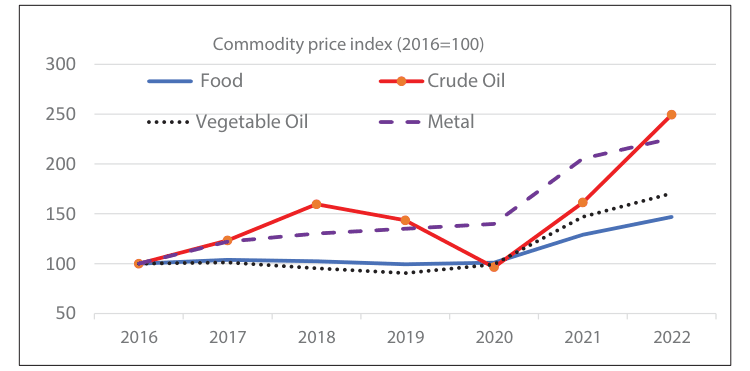
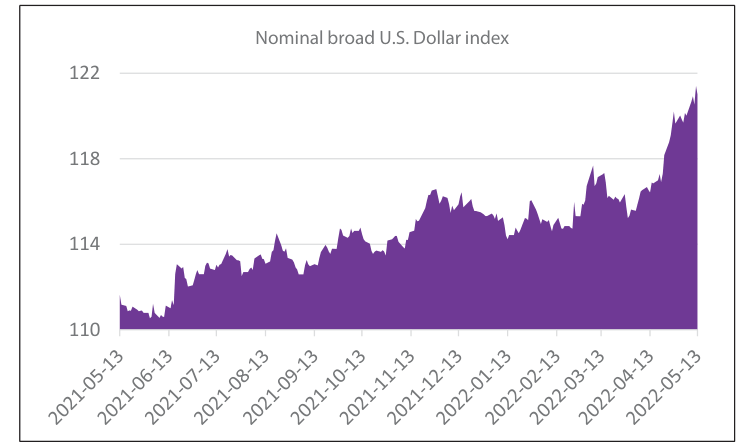
Now the big question is whether the current bout of inflation is transitory or elevated prices are here to stay. Amid the lockdown, Besides, China’s zero-Covid policy, the war in Ukraine and associated geopolitical risks, the export ban of commodities by several countries, and the strong US dollar are driving near and mid-term inflation expectations. Bull run of fuel and non-fuel commodity: A World Bank estimate shows that energy prices could rise more than 50% in 2022 before easing in 2023 and 2024.19 A senior executive of Singapore-based energy trading outfit Trafigura is of the view that “it would be nigh on impossible for the industry to supply enough oil in time to stop further inflation. There are plenty of scenarios where oil, come summer, is $150 per barrel.”20 Investment Bank JPMorgan predicts oil could reach $125 a barrel this year and $150 in 2023.21 Non-energy prices, including agriculture and metals, are projected to increase by almost 20% in 2022. Export ban on several commodities by numerous countries including India will only exacerbate price hikes. Ascent of US dollar and imported inflation: Amid Fed’s monetary tightening by raising interest rates to fight inflation, capital is flocking to the U.S. in search of higher yields. The US Dollar Index, which tracks the dollar against six other important currencies reached the highest level since 2002. Figure 5 captures the trends of the USD Index in recent months. There is a growing demand for safe-haven assets like the U.S. Treasury (10-year Treasury yields 3.1% return) which is more attractive compared to the bond issued by other central banks, including the Bundesbank of Germany (1.1%) and Bank of Japan (0.25%).22
19 Ibid.
Amidst a strong dollar, currencies in developing countries have weakened significantly. Most South Asian currencies, including the Bangladesh Taka, have lost significant value in recent weeks which could further fuel imported inflation, increase debt servicing costs, and rise in financial instability. The volatility in the exchange rate market could place Bangladesh’s hard-earned macroeconomic stability at stake. Nevertheless, compared to most South Asian economies, Bangladesh’s natural gas which comprised 69% of the country’s primary energy mix, takes some pressure off the dwindling foreign exchange reserves.
Source: CEIC World Trend Plus database.
Inflation expectations: Whether the current bout of inflation is transitory or is here to stay for a few years is to large extent determined by households’ inflation expectations. The current high inflation regime episode is largely manifested in the goods sector and a technical study interprets goods inflation as being predominantly transitory.23 However, as pandemic restrictions eased, the demand for services will rise keeping pressure on prices. In most South Asian economies, services account for over half of their GDP. Studies suggest that oil shocks are historically known to fuel inflation expectations and dis-anchor the expectations of both consumers and price setters.26 Figure 6 also indicates that there is a link between oil price and inflation expectations in the U.S., although a periodic variation in correlation is observed.
A study shows that in both advanced economies and EMDEs, long-term (five-year-ahead) inflation expectations fell during the past three decades.25 However, in recent times, among EMDEs, there has been a marked increase in inflation expectations, notably in Central Asia, Latin America, and South Asia, largely perpetuated by the effects of higher food and energy prices and currency depreciation.26
Source: Federal Reserve Bank of St. Louis
The Bangladesh Capital Market Sentiment Survey 2022 by Lanka Bangla Securities shows that inflation would be the biggest risk to the Bangladesh economy, with 83% of respondents seeing elevated inflation.27 Bangladesh Bank’s recent inflation expectation survey shows around 77% of the respondents expect one-year-ahead average inflation to be above 6% in 2022.28 Both in Europe and the U.S. inflation expectations have increased. The April 2022 Survey of Consumer Expectations in the U.S. shows that inflation expectations are 6.3% at the one-year horizon and 3.9% at the three-year horizon.29 The fear of inflation overshooting is gaining ground among top economists. Nobel laureate Paul Krugman discards his earlier stance that inflation would be transitory subscribing that “rising prices will get worse before they get better. There’s still a lot of inflation in the pipeline.”30 Risk of wage-price spiral: Both in advanced countries and EMDEs, households’ and firms’ near-term expectations of inflation have increased, while long-term expectations are at best mixed. An executive of the Bank for International Settlements observed that “while the message is more mixed regarding longer-term inflation expectations, it is not a source of much comfort. When inflation starts affecting the cost of living, it is more likely to take center stage in price- and wage-setting decisions, triggering a dangerous wage-price spiral.”31 A wage-price spiral- a consequential relationship between prices and wages- to large extent depends on the complex interplay of consumer psychology, the bargaining power of workers, the productivity of businesses, and the credibility of central banks.32 Although there is an optimism that the wage-price spiral of the 1970s is unlikely to be repeated as “wage inflation and other inflationary pressures will subside, once supply bottlenecks and labor market shortages ease.”33
Notes
- Financial Times. 2022. The new energy shock: Putin, Ukraine and the global economy. 28 February. ↩
- Reuters. 2022. As inflation breaks records, $100 oil is also looming. Available at: https://www.reuters.com/markets/europe/inflation-breaks-records-100-oil-is-also-looming-2022-01-19/ ↩
- Wall Street Journal. 2022. 10-year treasury yield hits 3% for first time since 2018. 02 May. 6 ↩
- A study shows that since the early-1990s, goods inflation has played a minimal role in fueling trend inflation, which is a contrast with the “great inflation” of the 1970s when goods inflation was a larger contributor to variation in overall inflation. See, Eo, Yunjong, Uzeda, Luis and Wong, Benjamin. 2022. Goods inflation is likely transitory, but upside risks to longer-term inflation remain. Voxeu, Available at: https://voxeu.org/ ↩
- Coibion, O, Y Gorodnichenko, and S Kumar (2018), “How do firms form their expectations? new survey evidence”, American Economic Review 108(9): 2671-2713.7
- Ha, Jongrim, Kose, M. Ayhan, Hideaki, Matsuoka, Panizza, Ugo and Vorisek, Dana. 2022. Anchoring inflation expectations in emerging and developing economies. Voxeu. Available at: https://voxeu.org/ ↩
- ibid ↩
- The Business Standard. 2021. Investors cautiously optimistic about 2022 market: LankaBangla Survey. 02 March. ↩
- Financial Express. 2022. Inflation in Bangladesh expected to exceed 6% by June. 02 March. ↩
- Federal Reserve Bank of New York. 2022. Inflation expectations mixed; credit access expectations deteriorate. 09 May. Available at: https://www.newyorkfed.org/newsevents/news/research/2022/20220509 8 ↩