
Introduction
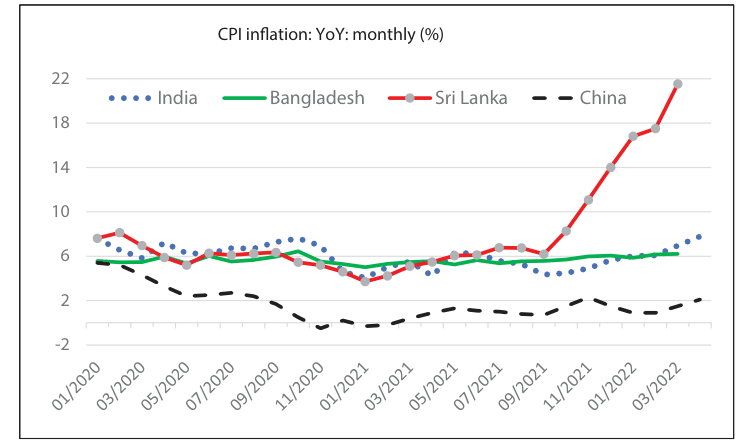
After decades of price stability, notably in advanced economies, prices of food and non-food commodities are on the rise globally. The annual inflation rate in the United States (U.S.) soared to a four-decade high of 8.5% in March, widely missing the Federal Reserve’s inflation target of 2%.1 Not far below the U.S. rate, the overall price level in the eurozone registered a 7.5% increase in the same period.2 The 10-year breakeven rate, derived from the difference between conventional and inflation-adjusted Treasury yields, is hovering around 3%,3 surpassing the previous high reached in 2005.In emerging markets and developing economies (EMDE) consumer prices are spiking fast. In almost all South Asian countries CPI (Consumer Price Index), which measures the total value of goods and services consumers buy over a specified period, inflation is rising steadily. In Bangladesh, year-on-year (YOY) consumer prices surpassed 6% in the first quarter of 2022, which is higher than the Bangladesh Bank’s inflation target set at 5.3% for the year.4 Although there are concerns that the official inflation figure of Bangladesh underestimates the actual consumer prices.5 In Sri Lanka and India, CPI inflation shoot up 21% and 8%, respectively in March (Figure 1).
* Dr. M Shahidul Islam is a Senior Research Fellow at the Centre for Governance Studies (CGS) and Distinguished Fellow at Yunnan Academy of Social Sciences (YASS), China. The author can be contacted at: [email protected]. Expressed views are personal.
Source: CEIC World Trend Plus database
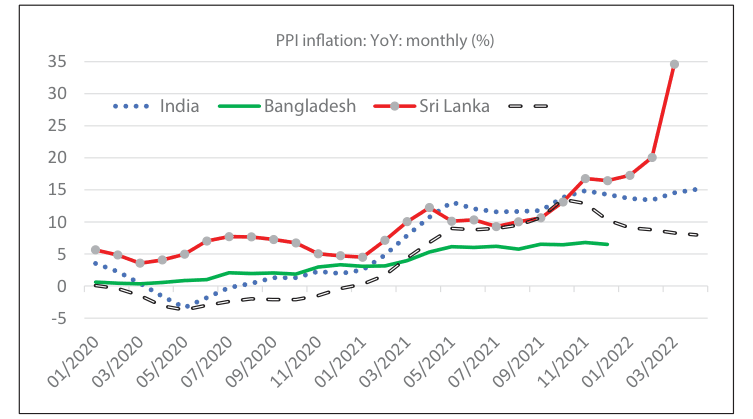
The Producer Price Index (PPI) measures price changes before goods reach consumers, it is seen as an earlier predictor of inflation than the CPI. The YOY growth of monthly PPI, which was close to zero for Bangladesh, low in Sri Lanka, and negative for both China and India at the beginning of the Covid-19 pandemic, increased sharply in recent months reaching 7%, 22%, 8%, and 15%, respectively (Figure 2). This relatively higher input inflation will initially be passed through to retailers and eventually to consumers. That said, the rising consumer and producer prices have several implications for Bangladesh and other South Asian economies, affecting the region’s macroeconomic and political stability.
Inflation, in particular, is a de facto regressive tax that hurts the poorest most and worsens income distribution. The rest of the paper is organized as follows. Section 2 briefly discusses theoretical issues pertaining to inflation. Section 3 outlines the current drivers of inflation. Section 4 focuses on the inflation outlook for 2022 and beyond. Amid the specter of stagflation, Section 5 briefly highlights the ongoing debate on whether the global economy is headed for recession. The final section provides policy suggestions.
Notes
- US Bureau of Labor Statistics. 2022. Consumer prices up 8.5 percent for year ended March 2022. Available at: https://www.bls.gov/opub/ted/2022/consumer-prices-up-8-5-percent-for-year-ended-march-2022.htm#:~:text=The%20Consumer%20Price%20Index%20increased,month%20advance%20since%20December%201981. ↩
- Eurostat. 2022. Euro area annual inflation up to 7.5%. Available at: https://ec.europa.eu/eurostat/documents/ 2995521/14497757/2-29042022-AP-EN.pdf/664dc8bd-4460-46f6-69ea-04c1763abd28#:~:text=Euro%20area%2 0annual%20inflation%20is,office%20of%20the%20European%20Union. ↩
- FRED. 2022. 10-year breakeven inflation rate. Fred Economic Data, St Luis Fed. Available at: https://fred.stlouisfed.org/series/T10YIE ↩
- Financial Express. 2021. Inflation target set at 5.3pc for FY22. Financial Express, 03 June 2021. ↩
- Daily Star. 2022. BBS inflation figures don’t reflect the reality: Sanem. 03 March. Available at: https://www.tbsnews.net/economy/bbs-inflation-figures-dont-reflect-reality-sanem-379219 1 ↩