
Recent drivers of inflation
Several factors drive the current global inflation. These are discussed in brief. Massive fiscal stimulus amid the pandemic: Governments notably in advanced countries allocated USD10 trillion for economic stimulus in just two months after World Health Organization declared the Covid-19 a pandemic in March 2020. According to McKinsey, the size of the stimulus is three times more than the response to the 2008-09 financial crisis.13 In Bangladesh, the stimulus package of TAKA 1.24 trillion might have contributed to inflationary pressure. Some economists, notably former U.S. Treasury Secretary and Harvard Professor Larry Summers cautioned as early as 2020 that “macroeconomic stimulus on a scale closer to World War II levels than normal recession will set off inflation pressures of a kind we have not seen in a generation.”14 He reasoned that “persuasion of fiscal and monetary policy on a transcendent scale to increase demand, at a time when Covid-19 was likely to curtail the supply of labor and goods, risked generating a huge overflow of demand.” He has been proven to be right. Disruption in the global supply chain: The initial large-scale lockdown measures and the prolonged pandemic owing to the Delta and Omicron variants have had damaging effects on supply chains and the labor market. The supply of numerous commodities and goods has been unresponsive to higher demand reflected in, among other factors, bottlenecks, rising shipping costs, delivery delays, and shortages of key production inputs such as computer chips. There was a dramatic rise in container freight rates between January 2019 and March 2022, reaching a record price of nearly $10400 in September 2021 from as low as $1446 in April 2020, a 600% increase (Figure 3).
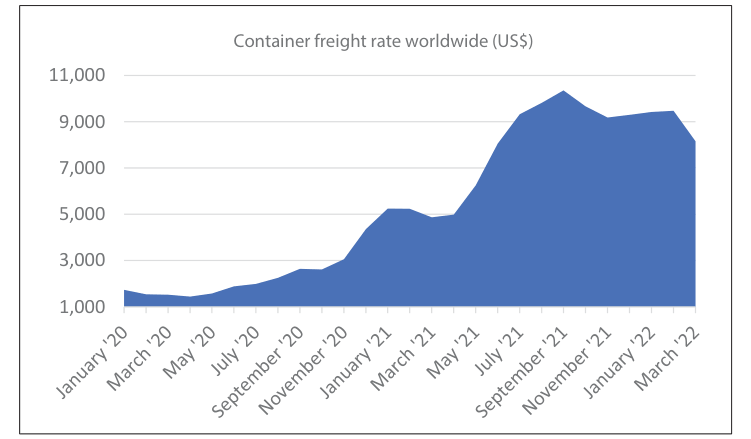
Source: World Container Index, MacroMicro, Drewry.
China’s zero covid policy: China’s status as the factory of the world and its critical role in the global supply chain markedly affected the prices of manufacturing goods owing to the country’s zero-Covid policy. The recent lockdown in Shanghai is likely to exacerbate global supply-chain problems and inflation concerns as the city accounts for around a fifth of China’s port volume.15 Relatively higher spending on goods than services: Before the pandemic, consumer spending on goods had been declining relative to services for several decades. However, given the travel ban and other restrictions put in place during the pandemic coupled with the rise in online platforms, the demand for goods outpaced services. War in Ukraine and elevated energy and commodity prices: According to World Bank, energy prices were more than four times higher in March 2022 than their April 2020 lows—the largest 23-month increase since the oil shock of 1973.16 Fertilizer prices rose by 220% during the same period.17 Similarly, prices of food of which Russia and Ukraine are large producers supplying over a quarter of global wheat exports rose by 84%.18 As a result, there has been a big jump in fuel and non-fuel commodity price indices in the past five quarters (Figure 4).
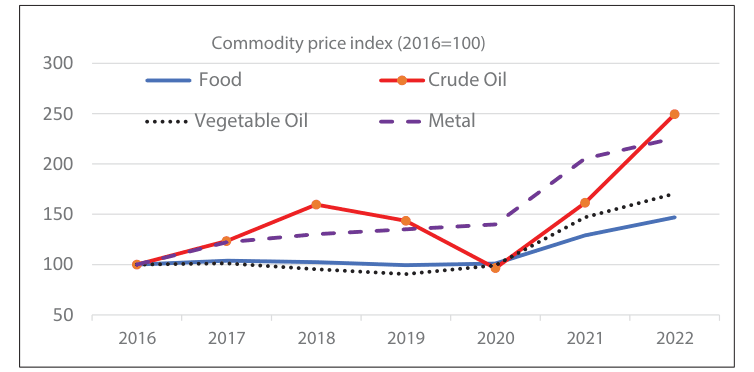
Source: CEIC World Trend Plus database.
Notes
- Bernanke, B (2007), “Inflation expectations and inflation forecasting”, Technical report, Board of Governors of the Federal Reserve System (US).
- Goodfriend, Marvin, and Robert G. King (1997), The New Neoclassical synthesis and the role of monetary policy, in B. S. Bernanke and J. J. Rotemberg, eds., NBER Macroeconomics Annual 1997, Cambridge, MA, MIT Press, 231-283
- McKinsey. 2020. The $10 trillion rescue: How governments can deliver impact. Available at: https://www.mckinsey.com/industries/public-and-social-sector/our-insights/the-10-trillion-dollar-rescue-how-governments-can-deliver-impact ↩
- Summers, H. Lawrence. 2022. On inflation, we can learn from the mistakes of the past – or repeat them. Washington Post, February 3. Available at: https://www.washingtonpost.com/opinions/2022/02/03/inflation-warning-history-lawrence-summers/ 4 ↩
- Financial Times. 2022. Shanghai lockdown exposes global supply chain strains. 14 May. ↩
- World Bank. 2022. Commodity markets outlook. Available at: https://openknowledge.worldbank.org/bitstream/handle/10986/37223/CMO-April-2022.pdf ↩
- Ibid. ↩
- Ibid.5 ↩