Research & publications Web edition
Introduction
October 8, 2022 marked the completion of four years of the Digital Security Act 2018 (DSA), a legislation claimed to be enacted to provide cybersecurity to citizens of Bangladesh. The government asserted during the enactment of this law and insists that this law is akin to cybersecurity laws of many other countries. Despite occasional acknowledgments of abuse of the law, government officials, cabinet ministers and ruling party leaders contend that the law has been effective in addressing cybercrimes. However, national and international human rights organizations, and organizations which track press freedom, have been critical of the nature and scope of the law since it was proposed in early 2018. In the past years, various organizations and independent analysts have demonstrated that the law has stifled freedom of expression and muffled critical voices. They argue that the law has become the weapon of choice of the government and activists of the ruling Bangladesh Awami League (BAL) to silence its opponents. The vagueness of various provisions of the law has engendered widespread usage. Many consider the law a flagrant violation of the fundamental rights enshrined in the Constitution of Bangladesh, and Bangladesh’s responsibility under the International Covenant on Civil and Political Rights (ICCPR).
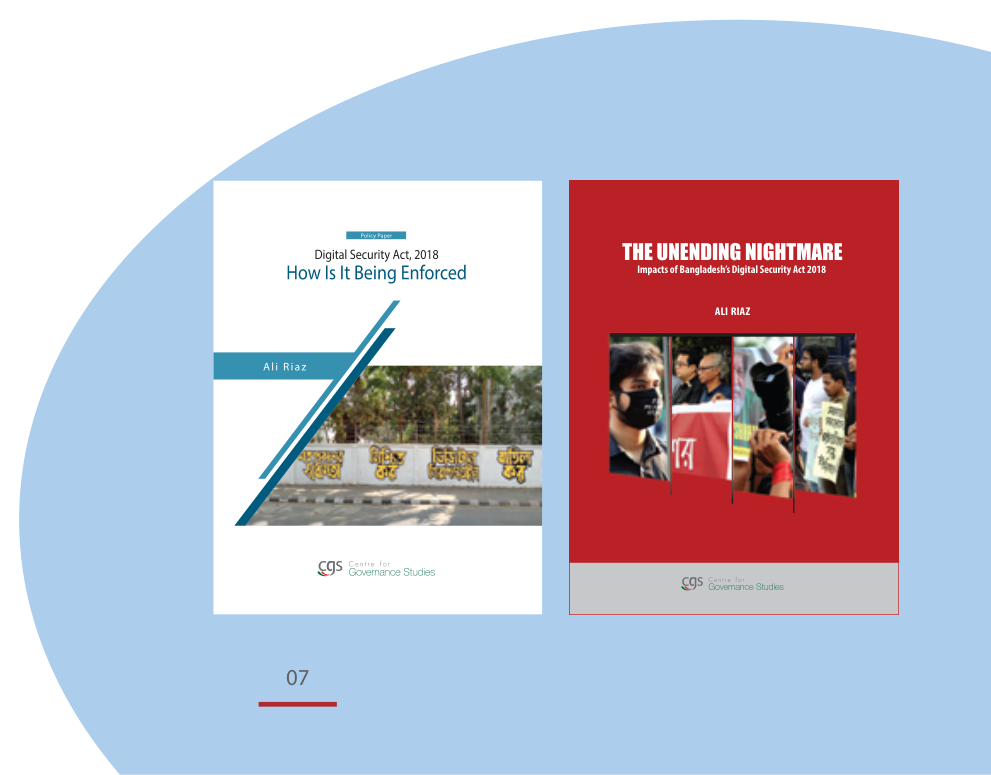
It is against this backdrop that this report focuses on the trends and patterns of the use of the DSA between October 8, 2018 and August 31, 2022. Data have been gathered under the project “DSA Tracker” of the Centre for Governance Studies (CGS). This report builds on and updates data of two previous reports of the project, published in April 2021 and April 2022. The former report, titled “Digital Security Act 2018: How Is It Being Enforced” analyzed data gathered between January 1, 2020 and March 25, 2021. The latter report titled “The Unending Nightmare: Impacts of Bangladesh’s Digital Security Act 2018” presented the analysis of data gathered between January 1, 2020 and February 28, 2022.
The CGS research project was initiated in early 2020 to gather information about various aspects of the Digital Security Act 2018, particularly the impact of the law. Under this project, information about cases, detentions, and legal proceedings under the Digital Security Act was gathered. These data were gathered from government-approved print and electronic media, the accused or their family and friends, the lawyer of the accused, and police stations and other concerned departments. The data are presented and regularly updated at the website: https://freedominfo.net/.
After the publication of two reports which compiled data from the inception of the project, we have taken a deep dive into the data about the DSA’s use from the day it came into effect on October 8, 2018. This allows us to provide a comprehensive picture of the use of the DSA and compare the pattern over the past 47 months. This report provides the comparisons of various years and data about various categories such as the numbers of cases, accused, detained, age of the accused and detained. It also delves into the professions of the accused and detained individuals. We have gathered and analyzed data regarding the workplace of journalists who have been accused and detained. As mentioned before, the law has become a weapon of the government and ruling party supporters; consequently, we have examined the identities of accusers. Broadly, there are two kinds of accusers: government agencies and individuals. In the case of individuals, their professions and political affiliations have been explored. Our report highlights a disturbing aspect: the use of the DSA against those who allegedly defamed the Prime Minister, cabinet ministers and politicians, particularly of the ruling Bangladesh Awami League (BAL). Additionally, the project examines various articles of the DSA which are widely used and focuses on who have been targeted through these provisions. In the context of the growing use of Facebook, the DSA has been used against Facebook users, the extent of which is documented in this report.