Research & publications Web edition
Facebook: Already Perilous, More to Come?
Like elsewhere around the world, social media, particularly Facebook, has become immensely popular in Bangladesh and the number of Facebook users has increased significantly. According to Statista.com, Bangladesh had 44.7 million users in 2022. Facebook has been used for inciting religious and ethnic violence on the one hand, while creating avenues for expressing grievances against the government and helping to organize social movements. There is palpable discomfort among the ruling party and the government about the increasing influence of Facebook. Consequently, on several instances, the government tried to restrict Facebook. For example, in March 2021, during demonstrations against Indian Prime Minister Narendra Modi’s visit to Bangladesh, services were restricted for three days (Netblocks 2021). Since 2013, there have been scores of incidents where postings on Facebook or comments on social media have ended in individuals being tried and convicted. The Digital Security Act and its predecessor, the ICT Act, were used by individuals and government agencies in this regard.
The Bangladesh government has not hidden its desire to have control over social media, especially Facebook. In 2019, Posts and Telecommunications Minister Mustafa Jabbar told that the government has “plans to require its citizens to obtain licenses to use social media platforms such as Facebook and YouTube and has already installed software giving it the ability to remove online content” (Khiam 2019). It was reported in the press in 2022, that the government has not backed down on its plan. The newly proposed law, called “Bangladesh Telecommunications Regulatory Commission Regulation for Digital, Social Media and OTT platforms”, is meant to do so. It will require Facebook and YouTube to inform all their users in Bangladesh that they should not “display”, “upload”, “publish” or “share” content which “threatens friendly relations with friendly states” or “is insulting to a foreign nation” (Bergman 2022). Forty-five human rights groups objected to the proposed law in May 2022 (The Express Tribune 2022).
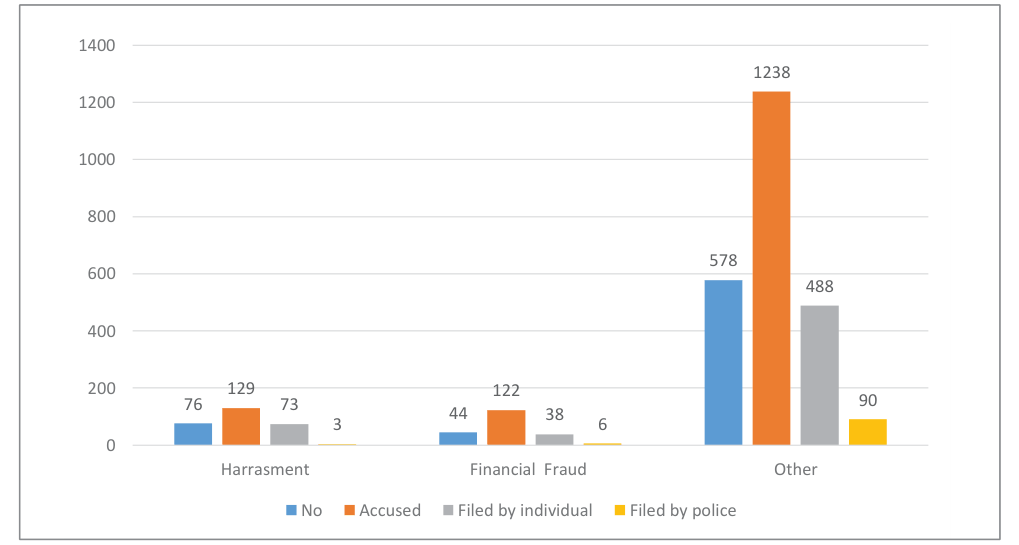
Even before harsher and more punitive measures are enacted, the use of Facebook has become perilous for Bangladeshis. During the period of our study, 698 cases have been filed against 1489 individuals for posts and comments on Facebook. We have divided these cases by the reasons cited in filing them into various categories and gathered data about the number of cases and the accused. Of these 698 cases, 76 cases have been filed for harassment (accused 129) and 44 cases for financial fraud via Facebook (accused 122). Of the remaining 578 cases, 115 cases have been filed for hurting religious sentiments, accusing 177 individuals (Figure 19). Further disaggregation of the cases involving hurting religious sentiments shows that 88 were for slandering and 27 were for provocation and spreading rumors through fake status or video, accusing 142 and 35 people, respectively.