
What Do We Know?
Who Is Being Accused, Who Is Being Detained?
Between January 2020 and February 2022, at least 2244 individuals have been accused under the law in 890 cases. We have been able to gather information about the occupations of 820 people. The breakdown of their professions is following (Table 1).
Table 1: Professions of the accused, Jan 2020-Feb 2022
| Professions | No |
|---|---|
| Journalist | 207 |
| Educator | 41 |
| NGO & Activist | 10 |
| Politician | 254 |
| Student | 79 |
| Govt. Employee | 32 |
| Private Employee | 53 |
| Businessman | 79 |
| Legal Practitioners | 21 |
| Religious Leaders | 8 |
| Other Profession | 36 |
| Profession Not Found | 1424 |
According to this information, of those whose professions are known, 30.98 percent are politicians, and more than a quarter are journalists. Of the total accused, they constitute 11.32 percent and 9.22 percent, respectively (Figure 1).
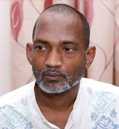
| Ahmed Kabir Kishore, a cartoonist and social activist, spent ten months in jail and was denied bail six times until March 2021. He alleged of being tortured in custody. He along with six others have been indicted in February 2022. Ahmed Kabir Kishore |
|---|
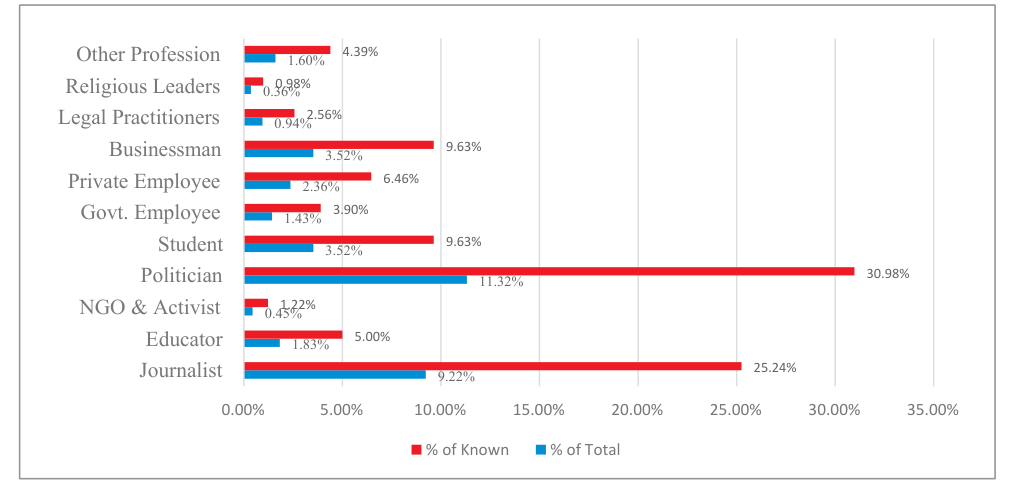
Note: ‘Other profession’ refers to the professions that are not listed under the specified professions above; ‘profession not found’ consists of the people those were unnamed, and their professions are not available.
In our previous report in April 2021 the data showed that the share of politicians and journalists were on top of the list, with 14.1 percent and 13.2 percent of accused whose professions were known to us. The pattern has held, but the share of individuals of both professions has increased significantly.
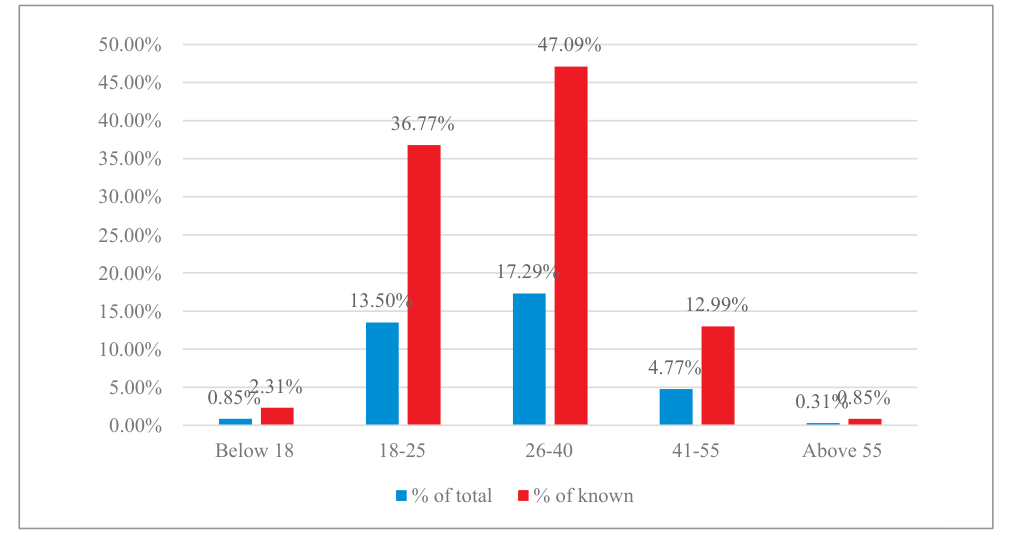
We have been able to gather information about the age of 824 accused. Of these 19 are below the age of 18. This number has doubled since our last report in April 2021. This is a disturbing development because it clearly shows that children have continued to remain vulnerable to the unrestrained use of the law. Overall, almost 84 percent of the accused belonged to the age group of 18-40. In terms of the number, accused within the age group 18-25 and 26-40 are close, 303 and 388, respectively (Table 2). Their share are respectively 36.77 percent and 47.09 percent, (Figure 2).
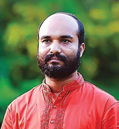
| Mamunar Rashid Nomani, an editor of a newspaper of Barisal, has been in jail for weeks after a local Ward councilor filed a case against him and his friends in September 2020 under the DSA. He was granted interim bail on September 29, 2020. He is yet to be indicted or granted permanent bail, thus requiring him to appear Mamunar Rashid Nomani before the court regularly. |
|---|
| Age group | No |
|---|---|
| Below 18 | 19 |
| 18-25 | 303 |
| 26-40 | 388 |
| 41-55 | 107 |
| Above 55 | 7 |
| Age Not Found | 1420 |
Table 2 – Age of the accused, Jan 2020- Feb 2022
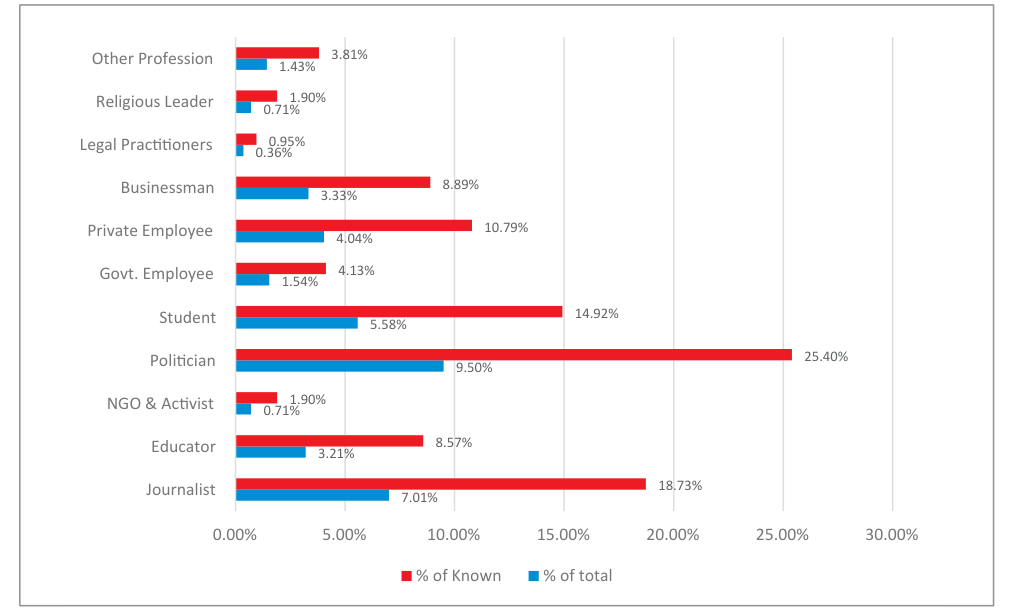
Our database has the record of 842 individuals who have been arrested under the law over the period between January 2020 and February 2022. From various sources, we gathered occupational information of 315 people. Of them 80 were politicians, 59 were journalists and 47 were students (Table 3), that is 25.40 percent, 18.73 percent, and 14.92 percent, respectively (Figure 3)). The share of politicians among the arrestees have increased compared to our pervious study period (January 2020- March 25, 2021). Previously, it was 11.3 percent.
Table 3: Professions of the arrestees, Jan 2020-Feb 2022
| Professions | No |
|---|---|
| Journalist | 59 |
| Educator | 27 |
| NGO & Activist | 6 |
| Politician | 80 |
| Student | 47 |
| Govt. Employee | 13 |
| Private Employee | 34 |
| Businessman | 28 |
| Legal Practitioners | 3 |
| Religious Leader | 6 |
| Other Profession | 12 |
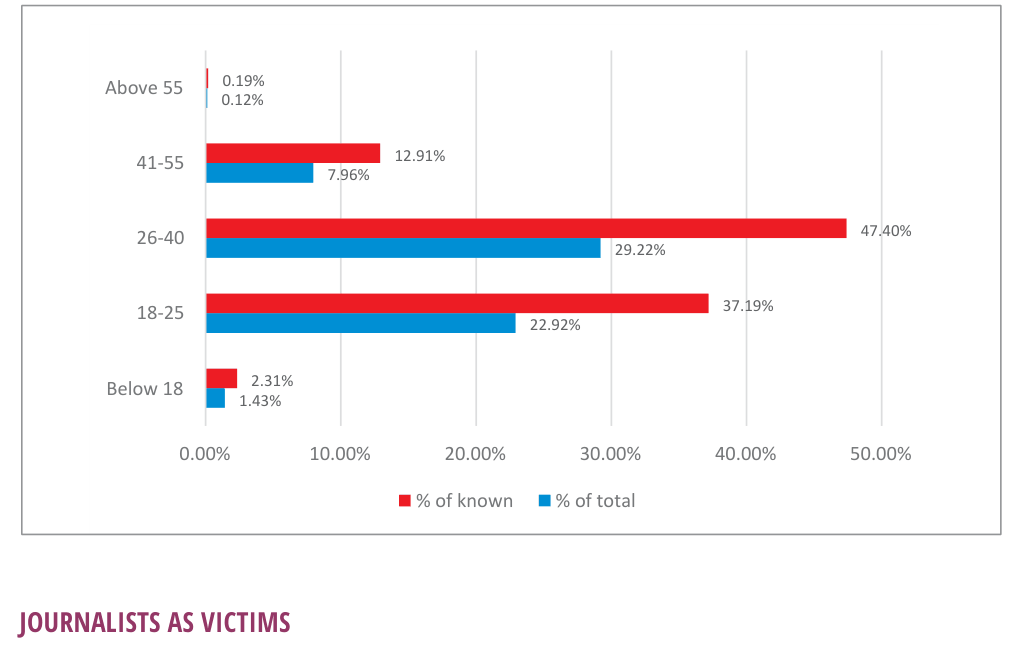
Among those who have been arrested (842 individuals), we succeeded in confirming the age of 519 persons. Among them 12 were underaged. The number was four when we analyzed the data in April 2021, covering information gathered between January 2020 and March 25, 2020. As we mentioned regarding the underaged being accused, it is deeply disconcerting. The largest number of people arrested belonged to the 26-40 age group (246), followed by the 18-25 (193) age group. The third largest age group is 41-55 (67). Percentage wise, 47.40% of the known arrestees are within the 26-40 group, and 37.19% are in the 18-25 age group (Figure 4).
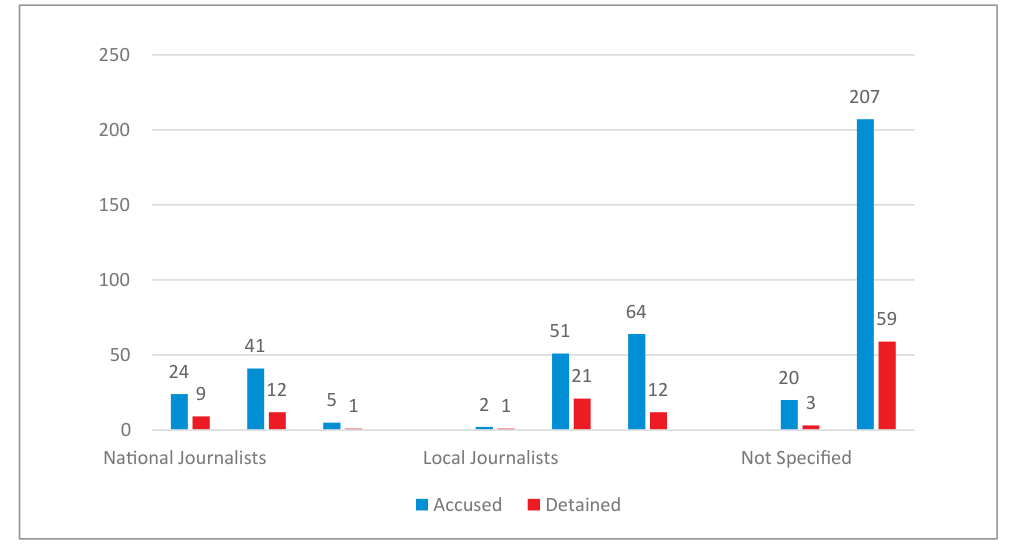
In a 26-month period, 207 journalists have been accused. Among them, we have details about 187 journalists’ media affiliation – 70 are associated with national level media, and 117 are local journalists. Of the 207 journalists, a majority of them are associated with the print media – a total of 92, almost half of the journalists whose workplace has been identified. The second highest number of journalists are associated with online media – a total of 69. Online media journalists from outside Dhaka have been the largest number of victims – 64 individuals. It is not only that the journalists working outside the capital are being accused of violating the law, but they are also the victims of being detained. Of the 59 journalists who have been detained, 34 of them were local journalists. It is the print media journalists who were detained the most – 33, this is more than half of the total arrested journalists (Figure 5).
These 207 journalists have been accused in 108 cases, filed by 96 people. Among these 96 accusers, 66 are aggrieved parties, while 30 individuals who haven’t been directly affected by the news or any other actions of these journalists filed cases. We have explored the political identities of these accusers and found that 24 of them belong to the ruling party and its affiliates. Of them, 12 belong to the Bangladesh Awami League, eight of them belong to the Student League, three of them are members of the youth front, and one of the Swechasebak (Volunteer) League. In many instances these journalists are alleged to have violated more than one section of the DSA. However, 46 journalists are accused of a breach of Section 25, and 48 are alleged to have violated Section 29. Section 25 deals with publishing, sending of offensive, false or fear inducing data-information, etc. It says 25(1),” If any person in any website or through any digital medium – a) Intentionally or knowingly sends such information which is offensive or fear inducing, or which despite knowing it as false is sent, published or propagated with the intention to annoy, insult, humiliate or denigrate a person or b) Publishes or propagates or assists in publishing or propagating any information with the intention of tarnishing the image of the nation or spread confusion or despite knowing it as false, publishes or propagates or assists in publishing or propagates information in its full or in a distorted form for the same intentions, then, the activity of that person will be an offense under the Act. (2) If any person commits any offense mentioned within sub section (1), the person will be penalized with imprisonment for a term not exceeding 3 (three) years of or fines not exceeding 3(three) lacs taka or with both. (3) If any person commits the offense mentioned in sub-section (1) for the second time or recurrently commits it, then he will be punished with imprisonment for a term not exceeding 5(five) years or with fine not exceeding 10 (ten) lacs taka or with both.” Section 29 deals with publishing, broadcasting & disseminating defamatory information. It says 29(1),” If a person commits an offence of publication or broadcast defamatory information as described in section 499 of the Penal Code (Act XLV of 1860) in any website or in any other electronic format then he will be sentenced to a term of imprisonment not exceeding 3(three) years or fine not exceeding Tk.5 (five) lac or both.” 29(2) says,” If any person commits the offence mentioned in sub-section (1) second time or repeatedly, he will be sentenced to a term of imprisonment not exceeding 5(five) years or fine not exceeding Tk.10 (ten) lac or both.” Two other sections of the law have been used against the journalists – section 31 (12 cases, 17 accused); and section 26 (5 cases, 16 accused).
Educators as Victims
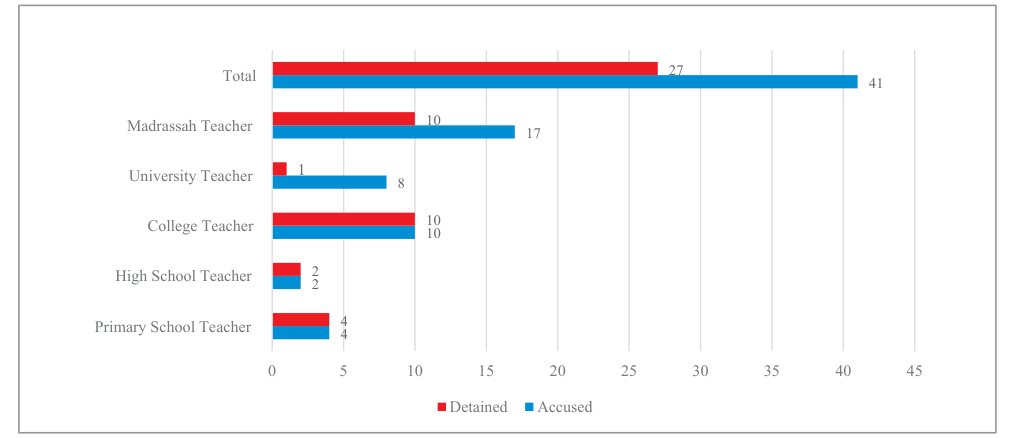
Our overall data showed that 41 educators have been accused; we gathered that 27 of them were arrested. Among the accused, Madrassah teachers constitute the largest numbers – 17, and they along with the college teachers – 10, each – have been the highest number being detained. Altogether eight university teachers have been accused while one of them had been arrested (Figure 6). It is notable that of the accused 41.46 percent were madrassah teachers; in the previous report we mentioned that the share was 22.72 percent. In the case of detention, the share of the madrassah teachers and college teachers is – 37.03 percent. Our data show that the rate of arrests of educators is far greater than in any other profession – 65.85 percent of accused educators have been arrested during this period, in case of school and college teachers the rate is 100 percent.
Accused Government Employees
Interestingly, government employees are continuing to being accused. A total of 32 government employees were accused; nine of them were members of the police (Table 4).
Table 4: Workplace of the accused government officials, Jan 2020 – Feb 2022
| Categories of Government Employees | Number |
|---|---|
| Assistant Surgeon of a Upazila [sub-district] Health Complex | 1 |
| Office Assistant of a Upazila Cooperative Office | 1 |
| Bangladesh Police | 9 |
| Work Assistant in the Office of a Project Implementation Officer (PIO) | 1 |
| Working as ‘Auditor’ in a District Accounts and Finance Office | 1 |
| Working in the Position of ‘Cash Government’ at a Medical College Hospital | 1 |
| Upazila Election Officer | 5 |
| Office Assistant/ Computer Typist of a Upazila Election Office | |
| Banker | 6 |
| Unknown | 7 |
| Total | 32 |
Who Are the Accusers?
Of the 890 cases in our database, identities of accusers of 508 cases have been identified. The breakdown shows that 111 cases have been filed by law enforcement agencies, and 43 cases have been filed by government officials. Considering that all of these have the government’s explicit and implicit approval, a total of 154 cases have the blessing of the authorities. After excluding the five cases filed by NGOs, cases filed by individuals stand at 349. While there are instances of victims of wrongdoings, including sexual harassments, bullying, invasion of privacy, have lodged complaints under the law, a significant number of complaints have been filed by individuals alleging defamation of other individuals (Table 5). The share of law enforcement agencies filing cases is 21.85 percent; this has increased from 12.6 percent of cases reported in April of 2021. Altogether the share of cases filed between January 2020 and February 2022 with the blessing of authorities is 30.31 percent. Among the cases filed by individuals, 206 cases have been filed by individuals with affiliations with political parties – a staggering 40.55 percent. This has doubled compared to our last report, when it was 20.7 percent.
| Accuser | No |
|---|---|
| RAB | 19 |
| Police | 87 |
| Other Law Enforcement Agencies | 5 |
| Private employee | 30 |
| NGO and activists | 5 |
| Party Affiliated | 206 |
| Government Officials | 43 |
| Businessman | 14 |
| Educator | 18 |
| Journalist | 25 |
| Legal Practitioners | 22 |
| Other | 21 |
| Student | 13 |
| Identity could not be ascertained | 382 |
| Total | 890 |
Table 5: Identities of accusers, Jan 2020-Feb 2022
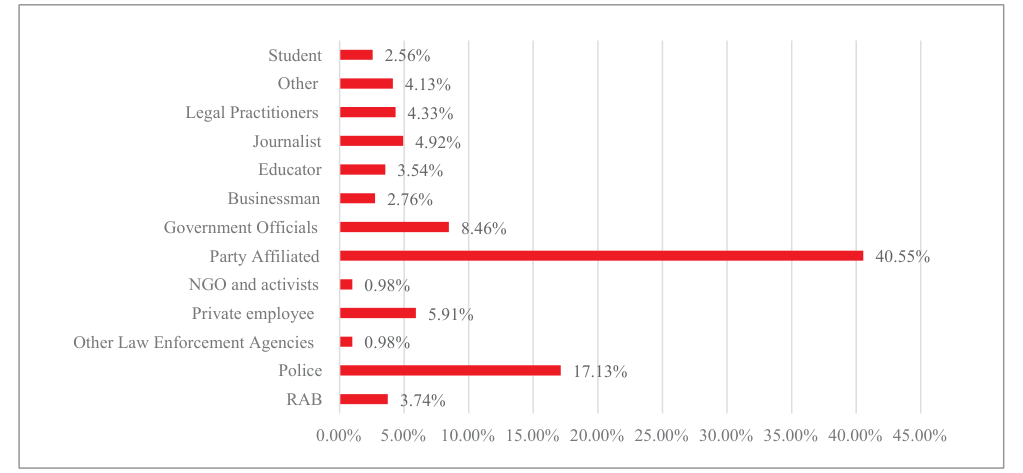
Of those who are affiliated with the political parties, 167 of them or 81 percent are directly involved with the ruling Bangladesh Awami League (BAL); this is the same share from April 2021. As such the ruling party activists have not been deterred by public criticisms that have been in the press about this phenomenon.
Table 6: Political Identities of individual accusers, Jan 2020-Feb 2022
| Political Identities of individual accusers | No |
|---|---|
| Bangladesh Awami League | 66 |
| Bangladesh Awami Jubo League (Youth front) | 28 |
| Bangladesh Awami Swechasebak League (Volunteers front) | 13 |
| Bangladesh Student League | 60 |
| Bangladesh Nationalist Party (BNP) | 2 |
| Others | 37 |
| Total | 206 |
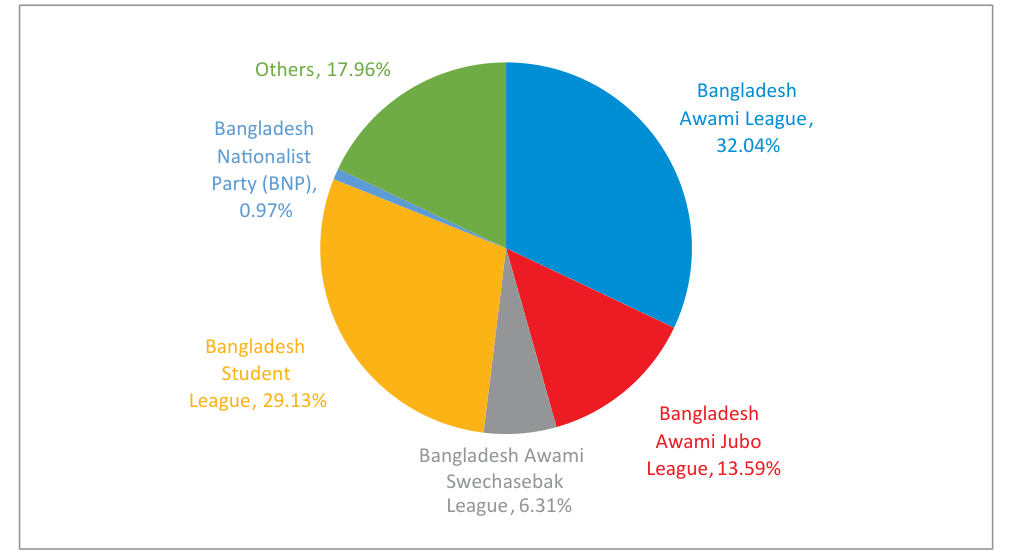
Among the accusers, we have been able to identify 37 individuals who hold elected positions at various national and local levels, which include five members of the parliament (Table 7).
Table 7: Elected Representatives as accusers, Jan 2020-Feb 2022
| Categories of Elected Representatives | Number |
|---|---|
| MP | 5 |
| City Mayor | 6 |
| Municipality Panel Mayor | 1 |
| Ward Councilor | 11 |
| Chairman of Union Parisahd | 8 |
| Chairman of Upazila Parishad | 4 |
| Vice Chairman of Upazila Parishad | 2 |
| Total | 37 |
| WHAT ARE THE ACCUSATIONS, WHO ARE THE ACCUSED, WH | O ARE THE ACCUSERS? |
There are 22 sections in the Digital Security Act 2018 which deal with offenses and penalties; but the details of the cases show that 16 sections have been used. In some instances, cases have been filed against the same person under multiple sections (Figure 9).
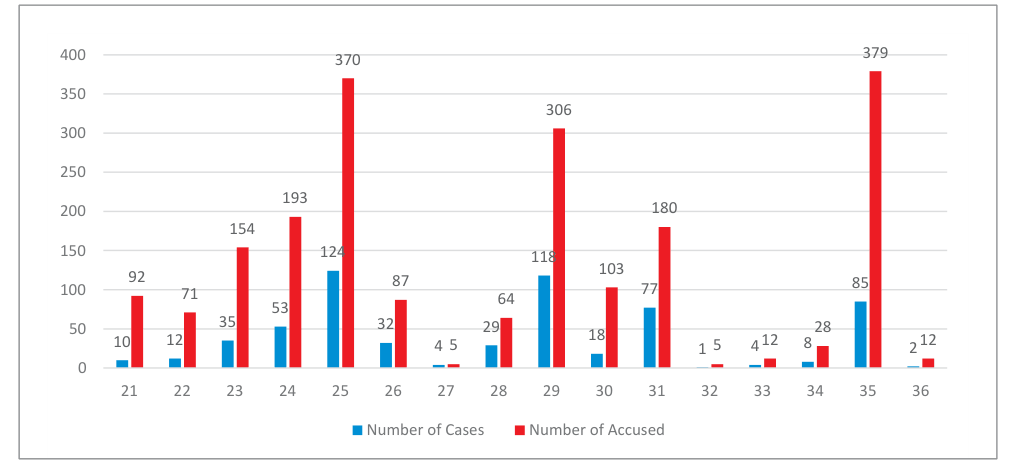
Section 25 has been used in the most instances (124), followed by Section 29 (118). However more people have been accused under Section 29 (379). Section 25 deals with publishing, sending of offensive, false or fear inducing data-information, etc, and Section 29 deals with publishing, broadcasting & disseminating defamatory information.
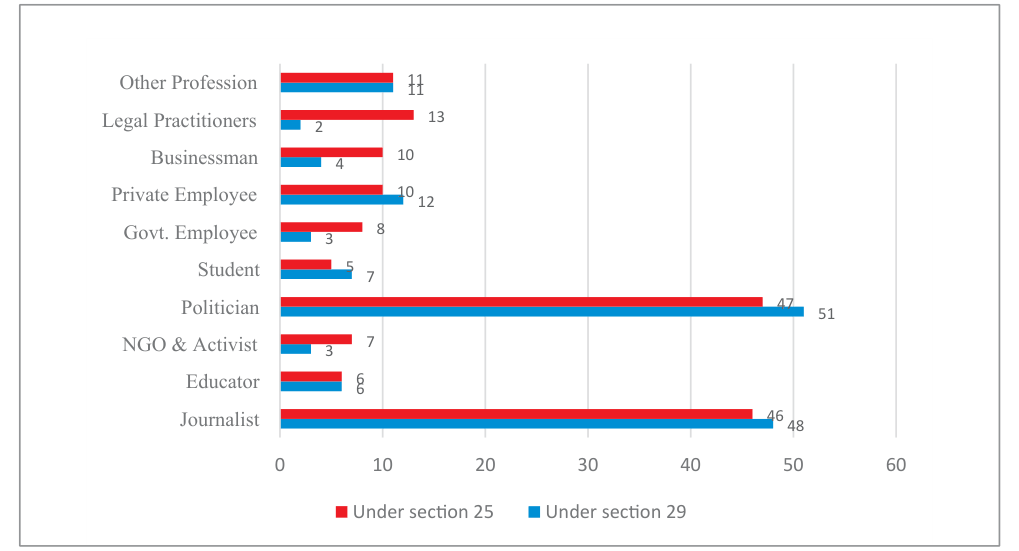
We have explored the professional identities of the accused under these two sections. Of the 306 accused in 118 cases under Section 29, 147 individuals have been identified by their professions. Most of them are politicians – 51; followed by the journalists – 48 people. Regarding Section 25, of 370 accused in 124 cases, 163 have been identified; the same pattern exists – politicians (47) are followed by journalists (46). (Figure 10).
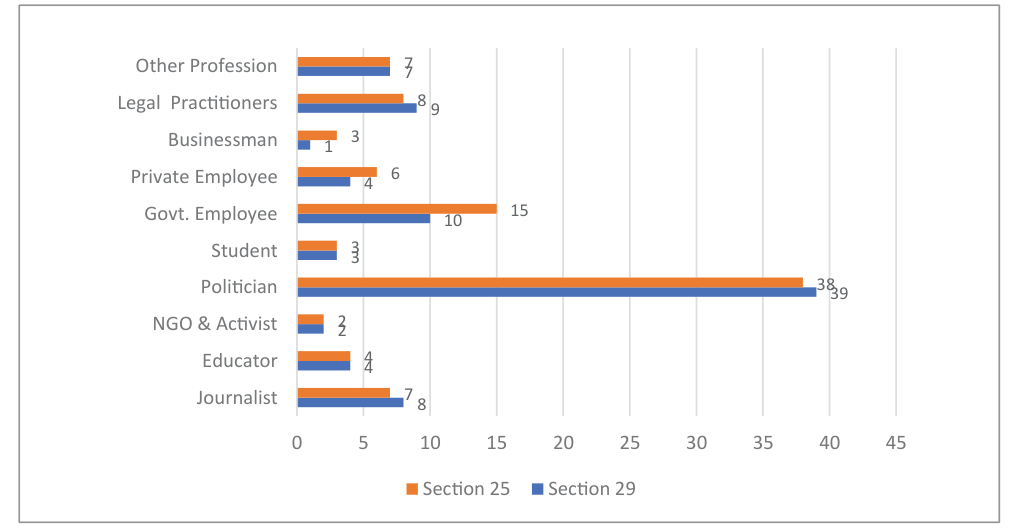
As for the accusers under these two sections, we identified the professional identities of 87 and 93, for Section 29 and Section 25, respectively. The accusers are overwhelmingly politicians in both instances (Figure 11)
Allegations of Defaming the Prime Minister, Ministers, and Politicians
Since the introduction of the law in October 2018, hundreds of cases have been filed by law enforcement agencies and individuals. There have been instances of being accused, charged and convicted for allegedly defaming Prime Minister Sheikh Hasina under the ICT Act, the precursor of the DSA. For example, in 2013, a lecturer of the Bangladesh University of Engineering and Technology (BUET) Hafizur Rahman Rana was tried in absentia and sentenced to seven years of imprisonment under the Information and Communication Technology Act (Hindustan Times 2013). In 2021, a cyber tribunal in Rajshahi sentenced Bangladesh Nationalist Party leader of Natore to seven-year imprisonment on charges of sharing distorted pictures of Prime Minister Sheikh Hasina and former Indian Prime Minister Manmohan Singh on social media. The case was filed under Section 57 of the ICT Act in 2015. In March 2021, a 17-year-old boy was arrested for making comments in a video posted online against Prime Minister Sheikh Hasina, Indian Prime Minister Narendra Modi and Bangladeshi Foreign Minister M A Momen (Sakib 2021). These were far from exceptions, instead similar instances have been reported in the press over the past nine years. Punitive actions have taken against individuals by their employers including universities on several occasions. We examined the allegations filed under the DSA between January 2020 and February 2022. We found that 98 cases have been filed during this period alleging that the accused have defamed Prime Minister Sheikh Hasina. Thirteen of these cases were filed by law enforcing agencies, while 85 were filed by individuals. Fifty of these individuals belong to the ruling BAL and its affiliates. Among these organizations, the student wing of the party has been the most active, its members filed 20 cases, followed by the members of the BAL with 19 cases, youth league members with nine cases and the volunteer wing with one. Our database records that 58 accused had been arrested.
We found that 51 cases have been filed for allegedly defaming ministers. The law enforcing agencies filed three cases, and the aggrieved minister or his/her family members filed four cases; the remaining 44 cases were filed by other individuals. Twenty-eight of these individuals have direct affiliation with the ruling party and its various wings. The members and leaders of the student wing of the party filed 13 cases. The BAL activists filed seven cases, while the youth league filed six. These cases resulted in arrests of 23 individuals.
At least 75 cases have been filed alleging defamation of political leaders, primarily of the ruling party. In 32 instances, it was the aggrieved parties who went to the police and/or court while three were filed by law enforcement agencies. His/her supporters filed 40 cases. All but one case of these were supporters of the Bangladesh Awami League (BAL); the lone exception was a Jatiya Party supporter. Fifty-five individuals were arrested because of these cases.
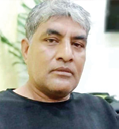
| Shafiqul Islam Kajol, a photojournalist, was abducted after ruling party leaders filed cases under the DSA in March 2020. He was found near the Benapole border after 54 days. He was arrested under the DSA and was detained for eight months. Kajol was granted bail on December 25, 2020. He has been indicted in three Shafiqul Islam Kajol cases. |
|---|
Dipti Rani Das, a tenth grader, was charged under the
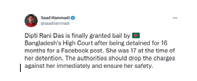
DSA in October 2020. She spent 18 months in a Juvenile Correctional Center until she was released on a bail on February 17, 2022. Local courts denied her bail thrice, and a bail granted by the High court in May 2021 was suspended by the Appellate Division due to Government’s appeal.