
Defining Features of the DSA
The DSA provided the government absolute
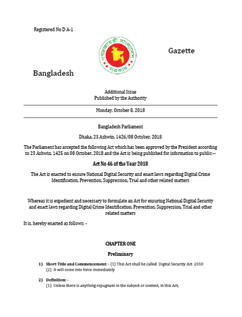
power to initiate investigations into anyone whose activities are considered a ‘threat’ by the government. The Act provides law enforcement agencies power to arrest without a warrant, simply on suspicion that a crime has been committed using social media. It provides police the power to search and seize without any warrant and oversight. Also, the Act allows the government to order the removal and blocking of any information or data on the internet it deems necessary, thereby providing broad scope to silence those critical of its policies or who share information on human rights violations in the country. Objections have been raised about nine sections of the law, which have been described as detrimental to freedom of speech; these Sections are 8, 21, 25, 28, 29, 31, 32, 43 and 53. It has been argued that these sections are unclear and many of its terms are not defined properly. Out of the 20 provisions of the law that deal with offences and punishments, 14 are non-bailable. Five are bail-able and one can be negotiated. The lowest punishment is one year in prison and the highest is a life-term, but most are in the range of between four and seven years. These have been viewed by editors and journalists as a recipe for creating a climate of fear. The non-bailable provisions of the law practically allow the accused to be detained for indefinite periods before the trial.