
How the Law Came Into Existence
The DSA was framed and enacted against two backgrounds. The first was the widespread criticism of the Information and Communication Technology Act 2006 (as amended in 2013), and the upcoming parliamentary election.
The ICT Act was passed in 2006 under the Bangladesh Nationalist Party (BNP) government led by Khaleda Zia. The stated objective of the law was to ‘provide legal recognition to and security of Information and Communication Technology and rules of relevant subjects.’ The principal argument of having the ICT Act was that the existing laws, particularly the Penal Code of 1860 and the Evidence Act 1872, were inadequate to address the growing number of cybercrimes and regulating emerging e-commerce.
In 2013, the Awami League government led by Sheikh Hasina made significant changes to the law, especially in section 57. A rough translation of Section 57 of the ICT Act, as amended said: “If any person deliberately publishes or transmits or causes to be published or transmitted in the website or in any other electronic form any material which is false and obscene and if anyone sees, hears or reads it having regard to all relevant circumstances, its effect is such as to influence the reader to become dishonest or corrupt, or causes to deteriorate or creates possibility to deteriorate law and order, prejudice the image of the state or person or causes to hurt or may hurt religious belief or instigate against any person or organization, then this activity will be regarded as an offence.” The amendments not only increased the maximum amount of punishment, but also made these offenses cognizable, which essentially provided the law enforcement agencies the power to arrest anyone without warrant. The offenses were made un-bailable. These changes came when the political situation was increasingly becoming restive on the issue of election-time government. The incumbent amended the constitution in 2011 and removed the caretaker government (CTG) provision. The CTG provision required that a non-partisan government is appointed to oversee the national election after the completion of the term of the elected government. Opposition political parties protested the removal of the provision and boycotted the 2014 election. Since the amendment in the ICT Act in 2013, the number of cases filed under the law, especially under section 57, began to rise.
Despite the presence of the law since 2006, there was very little use of it until the 2013 amendment was made. According to one account between 2006 and 2013, only 426 cases were filed and the number of people arrested or prosecuted was very low. In 2013, the number of cases filed was only three. But after 2013, the number began to rise. In 2014 the number rose to 33. The number continued to grow in the subsequent years: 2015 – 152; 2016
- 233; 2017 – 568; and 2018 – 676. There was only one cyber tribunal established under Article
68; consequently, the process of investigation was slow. In 2016, a newspaper report informed that “156 cases reached the Tribunal. Besides, 250 cases were under investigation. In other words, a total of 593 cases are pending and under investigation” (Asaduzzaman 2016). In 2015, eleven authors and academics filed a petition to the High Court against section 57 of the ICT Act saying that it goes against Article 39 of the Constitution that guarantees ‘freedom of thought and conscience.’ The court sought a response from the government on why the law did not violate constitutional protections, but the government did not respond.
By 2016, a few more things became clear. First, section 57 of this law is being used the most. The primary objective of this section was to limit the freedom of expression of the individual. In 2016 alone, of the cases filed under the ICT Act, 94 percent were filed under the controversial section 57. Between 2012 and June 2017, 1417 cases were filed under this law, and about 65 percent of these cases were under section 57. Until section 57 was repealed in 2018, at least 37 cases were filed under section 57.
Second, most of the accused in these cases were acquitted. “All the accused have been acquitted in 66 percent of the cases as the allegations have not been proven in court. That means only 34 percent of the cases have been proven. Thirteen percent of the cases have been proven false at the investigation stage.” It was also learnt that “the police had submitted final reports to the court on 46 cases in the last three years as the investigation did not find any truth of the incident.” (Asaduzzaman 2016).
Due to the extensive and indiscriminate use of the ICT Act, national and international organizations were calling for reform of the law, repealing the controversial section 57, and to stop abusing the law. For example, the Asian Forum for Human Rights and Development (FORUM-ASIA) in September 2016 urged the Government of Bangladesh “to repeal this Act and release people arbitrarily arrested so far” (Forum-Asia 2016). In early 2018, as the new Digital Security Act was being discussed apprehension was that the number of cases would increase if the Digital Security Act were introduced (Riaz, 2018). According to Article 19, a London-based organization that defends and promotes freedom of expression and freedom of information worldwide, a total of 71 cases were filed in 2018, 35 cases were under the Digital Security Act (New Age 2021).
The second context of the introduction of the DSA in 2018 was the contentious political environment in the country. Since the controversial election in 2014, boycotted by the opposition, the country saw further polarization and increasing trends toward use of restrictive measures by the government. There was increasing concern that the situation would further deteriorate leading up to the election scheduled in December 2018.
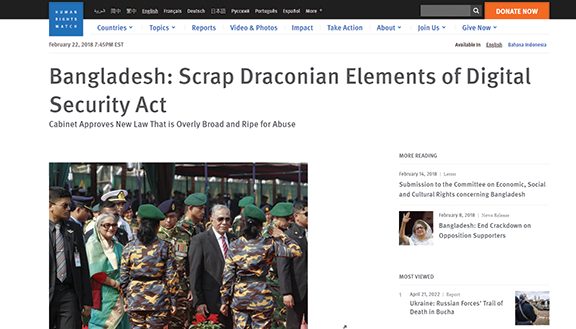
The process of legislating a new law began in mid-2017, and the cabinet approved the draft on January 29, 2018. As the new law was being drafted, the government announced that five articles of the existing ICT Act would be repealed, they were – 54, 55, 56, 57, and 66. The draft bill, however, revealed that the elements of these articles have been broken into pieces and incorporated in the proposed Digital Security Act (DSA). Immediately after the approval of the draft, serious concerns about the law’s reach and potentials for abuse were expressed. It was criticized as a means to curb freedom of expression. Reporters Without Borders (RSF) in a statement in January 2018, described the proposed law as “unacceptable” (RSF 2018). Human Rights Watch (HRW) said “with at least five different provisions criminalizing vaguely defined types of speech, the law is a license for wide-ranging suppression of critical voices” (HRW, 2018).
On May 22, 2018, owners of private television channels, the Editors’ Council, and the Bangladesh Federal Union of Journalists (BFUJ) met the parliamentary committee and raised concerns about the proposed law, particularly eight sections of the law. The meeting was attended by the telecommunication minister Mustafa Jabbar and the law minister Anisul Huq. According to a press report, “The journalists’ proposal was accepted positively by the parliamentary committee, said Post, Telecommunication and Information Technology Minister, Mustafa Jabbar, after the meeting ended. ‘We are in agreement with the journalists about amending the sections they have problems with,’ said Mustafa. ‘We are going to bring necessary amendments, so the freedom of press does not get hampered.’” (Dhaka Tribune 2018a). The eight sections the journalists expressed reservations about were: 8, 21, 25, 28, 29, 31, 32, and 43. In September 2018, the parliamentary committee submitted its report which ignored the suggestions of the journalists. In a statement on September 17, 2018, the editors’ council expressed “surprise and disappointment” (Dhaka Tribune 2018b). The Council rejected the draft law.
In two weeks, they once more drew attention to the flaws of various articles of the proposed laws and discussed the potential negative impacts of these articles on the media in a statement issued to the media (Prothom Alo English 2018). While the parliamentary committee completely ignored the objections of the journalist community, it recommended that in Section 43 regarding search, seizure, and arrests, the police should be required to seek permission from the Director General of the Digital Security Agency; but it was later removed at the objection of the police. Thus, the police have been given the power to search, seize and arrest without any warrant or permission (Prothom Alo 2021). In September, the parliament passed the bill and sent it to the President for ascent. On September 30, the Editors’ Council met the government representative and made a last-ditch effort to stop the enactment of the law which it insisted poses “serious threats to freedom of expression.”
Besides organizations within the country, various international organizations pointed to the potential adverse impacts of the new law on freedom of the press. HRW, for example, in May 2018 published a report on how the existing ICT Act has muzzled independent voices and how the proposed DSA would make it worse (HRW 2018). Committee to Protect Journalists (CPJ) urged the President to return the bill to the parliament (CPJ 2018). HRW further insisted in September that the DSA is ripe for abuse (HRW 2018).
Despite such national and international outcry, on October 8, 2018, the President signed the bill into law. The Editors’ Council, in an unprecedented move, staged a street protest and formed a human chain in front of the national press club on October 15, 2018. The government, on the other hand, continued to assure that the law would not harm freedom of expression nor journalists. Amnesty International pointed out in November that ‘the new Act is deeply problematic’ (Amnesty International 2018).
Since it came into existence, while the number of cases under the law grew exponentially, the government continued to claim that it has not been abused. In October 2018, Prime Minister Sheikh Hasina told in a press briefing that “journalists who do not publish false news need not worry” about the DSA (Aljazeera English 2018). The use of the law became so pervasive that The Editors’ Council said in May 2020 that their fears about the Digital Security Act have come to pass; “our fear is now a nightmare-reality for the mass media,” it said in a statement (The Daily Star 2020). In September 2020, two years after the law was enacted, the number of cases under the law had risen to more than 1,000 (Asaduzzaman 2020).

| Mushtaq Ahmed (54), an author and social activist, died in prison on February 25, 2021 after being detained for 10 months. He was arrested for criticizing the government and was denied bail six times. Mushtaq Ahmed |
|---|