Constitution
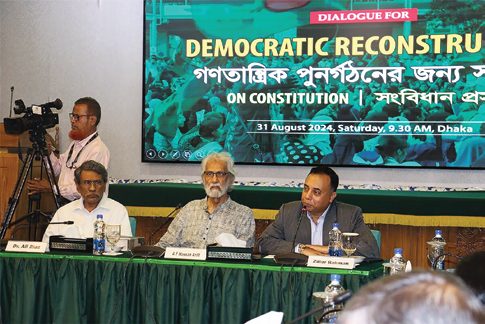
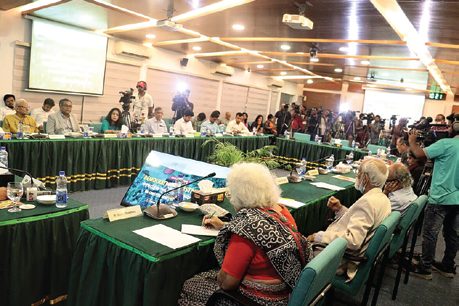
As part of a series of dialogues organized by the Centre for Governance Studies (CGS) on the priority areas of reform for the interim government, a discussion on the Constitution was held on August 31, 2024 (Saturday), at the Bangladesh Institute of International and Strategic Studies (BIISS) auditorium. This dialogue explored various aspects of the existing constitutional challenges, potential amendments, and the possibility of a complete constitutional rewrite. A summary of the key discussions is presented below.
Preventing Constitutional Autocracy and Decentralizing Power
Participants in the dialogue emphasized that, for the past 15 years, Bangladesh had witnessed a dangerous concentration of power, where the ruling party and the government became indistinguishable. They noted that this led to the establishment of a personalized autocracy that eroded democratic principles. According to the discussants, amendments to the constitution were made to serve individual and party interests rather than the collective good. With unchecked authority in the hands of the Prime Minister, a one-person dictatorship emerged across all levels of governance.
To prevent such constitutional autocracy in the future, participants suggested that the constitution must include provisions that separate the roles of the head of government, the head of the ruling party, and the leader of the parliamentary party, ensuring that no single person can hold all three positions simultaneously. Additionally, they stressed the need for a term limit, restricting any individual from serving as Prime Minister for more than two terms.
To further decentralize power, several participants proposed introducing proportional representation in parliamentary elections and establishing a bicameral legislature. They argued that the country’s constitution should reflect the collective aspirations of its people rather than the interests of a single party or individual.
Ensuring Judicial Independence and Transparency in Constitutional Appointments
Participants in the dialogue emphasized that judicial independence remains a constitutional promise that has never been fully realized in Bangladesh. They highlighted that, over the past fifteen years, political considerations have played a dominant role in the appointment of judges to higher courts, further eroding public trust. Some discussants pointed out that although efforts were made in 2007 to separate the judiciary from the executive branch, Article 116 of the Constitution prevents the full implementation of this principle. This provision, they noted, grants the President—who effectively operates under the Prime Minister’s control—authority over lower courts, thereby compromising judicial independence.
Participants also discussed how key constitutional positions, such as the appointment of the President and the selection of the Election Commission, have historically been filled solely at the discretion of the Prime Minister. To ensure greater transparency, several participants proposed introducing a public hearing process for constitutional appointments. They argued that future appointments to these crucial positions should involve parliamentary committees, with the public being informed in advance.
Guaranteeing Freedom of Expression
According to the participants, although the constitution formally guarantees freedom of speech, various restrictions—under the pretext of “reasonable limitations”—have been used to curtail this fundamental right. They cited controversial laws such as the Digital Security Act (DSA) 2018, the Cyber Security Act (CSA) 2023, and Section 57 of the ICT Act, all of which have been used to criminalize dissent.
To ensure genuine freedom of speech, participants proposed that the constitution must provide clear protections for differing opinions and prevent the misuse of legal provisions that suppress public discourse. Some participants argued that repealing or amending these repressive laws is essential to safeguarding democratic rights in Bangladesh.
Protecting Individual Liberties, Human Rights, and Indigenous Rights
Several participants raised concerns that the current constitution has, at times, facilitated the oppression of minority groups by allowing a ruling party with a two-thirds parliamentary majority to amend it at will. They argued that this has enabled a form of constitutional majoritarianism, where the ruling party can impose its will without adequate checks and balances. There was widespread agreement among discussants on the urgent need to establish safeguards that prevent such abuses of power.
While some participants acknowledged that the constitution contains provisions to protect human rights—such as Article 44, which allows citizens to seek legal recourse in court—they pointed out that there are no binding obligations on the state to actively uphold these rights. They suggested that ensuring human rights should not rest solely on the courts but must be a constitutional obligation of the state itself.
Additionally, the participants called for the constitution to adopt a more inclusive approach to marginalized communities. They stressed that the right to freedom does not only mean freedom of speech but must also guarantee personal liberty in all aspects of life. To align with modern human rights standards, some participants proposed abolishing the death penalty and ensuring equal rights for all citizens, including indigenous communities.
Discussants also emphasized that although Bangladesh was founded on Bengali nationalism, not all citizens identify as Bengalis. They recommended that the constitution officially recognize all ethnic groups, ensuring their representation in the state’s legal and political framework. This, they argued, should include providing equal representation for indigenous communities in both the hilly and plainland regions. A constitution based on equality, they asserted, would help foster an inclusive national identity.
Constitutional Reform or Rewriting?
Participants engaged in a robust debate over how to correct the flaws, inconsistencies, and undemocratic tendencies embedded in the current constitution. Two possible approaches were proposed: comprehensive amendments or a complete constitutional rewrite. Discussants emphasized that this is a subject requiring further national debate, ensuring that all segments of society have a voice in shaping the country’s constitutional future.
Many participants pointed out that the expectations of 1971 and 2024 are not the same. They argued that the failure to fully realize the aspirations of 1971 led to the mass uprising of 2024. While acknowledging the historical importance of the Liberation War, they contended that the current constitution has been manipulated to serve the interests of a single political party rather than reflecting the collective will of the people.
To determine the best path forward, some discussants suggested holding a constitutional convention or a national referendum. Legal experts among the participants noted that as long as Article 7(B) of the current constitution remains unchanged, constitutional amendments will remain legally impossible. In such a case, they proposed that a national referendum could be held to gain public approval for drafting a new constitution, with a constitutional assembly overseeing the process.
Other participants argued that if a new constitution is drafted, it must reflect the will of the people while maintaining continuity with the nation’s foundational principles from 1971. Another viewpoint expressed was that before rewriting the constitution, the first priority should be electing a truly representative parliament that can oversee the process democratically. Some discussants warned that if constitutional changes occur solely through legal procedures without public consultation, they risk being overturned by future parliaments. To prevent this, they stressed that any constitutional changes must be made through a broadly representative parliamentary process.
A New Constitution Does Not Mean Abandoning Everything
Several participants clarified that a full constitutional rewrite does not necessarily mean discarding the entire existing framework. They pointed out that the push for rewriting stems from the fact that the 15th Amendment made several provisions unchangeable, blocking future reforms. However, they noted that a new constitution could be drafted while preserving the fundamental structure of the state.
Legal experts among the participants suggested that if the 15th Amendment is annulled or a court issues a stay order, allowing Article 142 (which governs constitutional amendments) to be reinstated, a referendum could
resolve the issue. Many discussants agreed that a broad national consensus involving political parties, civil society, and citizens must be built to shape the future of the constitution. They emphasized that if a parliamentary framework is established to debate and refine constitutional changes, greater agreement and legitimacy can be achieved.
The dialogue was moderated by CGS’s Executive Director, Zillur Rahman, and featured several distinguished speakers. The speakers were;
- A. F. Hassan Arif, Advisor, Ministry of Civil Aviation and Tourism and Land Ministry.
- Dr. Ali Riaz, Distinguished Professor, Illinois State University, USA
- Munira Khan, Chair, Centre for Governance Studies (CGS)
- Dr. Badiul Alam Majumdar, Head of the Electoral System Reform Commission and Secretary of SHUJAN (Citizen for Good Governance)
- Ikteder Ahmed, Former Judge, Columnist and Legal Consultant
- Nurul Kabir, Editor, New Age
- Dr. Borhan Uddin Khan, Professor, Department of Law, University of Dhaka
- Barrister Sara Hossain, Executive Director, Bangladesh Legal Aid and Services Trust (BLAST)
- Dr. Manzoor Hasan OBE, Executive Director, Centre for Peace and Justice, BRAC University
- A.M. Mahbub Uddin Khokon, President, Bangladesh Supreme Court Bar Association
- Mahfuj Alam, Information and Broadcasting Adviser
- Habibur Rahman, Former Student, Department of Law, University of Dhaka.
- Advocate Z I Khan Panna, Chairperson, Ain o Salish Kendra
- Raja Devasish Roy, Barrister-at-Law, Chief of the Chakma Circle
- Dr. Dilara Chowdhury, Professor of Political Science, Jahangirnagar University
- Dilruba Shormin, Advocate, Supreme Court of Bangladesh