Law and Order
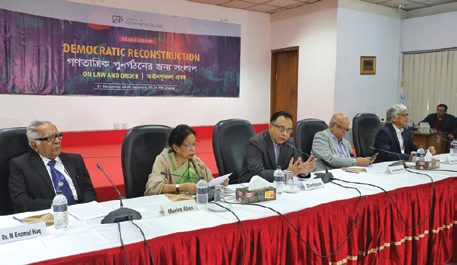
As part of the Centre for Governance Studies (CGS) series of dialogues on priority reform areas for the interim government, a discussion on law and order was held on December 21, 2024 (Saturday), at the Centre for Integrated Rural Development for Asia and the Pacific (CIRDAP) auditorium in Dhaka. This discussion addressed the deteriorating law enforcement situation, potential solutions, and the need for an independent police commission. A summary of the key discussions is presented below.
Independent Law Enforcement Commission and Depoliticization
Participants in the dialogue stressed that a stable law and order system is essential for a country’s national security and overall development. However, they argued that in Bangladesh, law enforcement agencies have become an extension of the ruling government rather than functioning as independent bodies.
Several participants pointed to the events of the July uprising, during which police and security forces carried out violent crackdowns on civilians, demonstrating their unquestioning loyalty to the regime rather than their duty to protect citizens. Over the past 15 years, discussants noted that opposition activists and critics of the government have faced systemic repression from law enforcement agencies, and even ordinary citizens have not been spared from these abuses.
Since law enforcement remains under direct political control, participants highlighted that public trust in these institutions has deteriorated. To rebuild confidence, they suggested adopting a community-based policing approach to create a citizen-friendly police force that serves the public rather than the ruling elite.
Additionally, participants emphasized that decentralization and depoliticization are essential to restructuring law enforcement agencies. They called for transparent recruitments, promotions, and transfers to prevent favoritism and political influence. To ensure effective oversight, several discussants proposed introducing a Code of Conduct enforced by Parliament, preventing future bureaucratic and political manipulation of law enforcement agencies.
Establishing a National Security Council
Participants proposed establishing a National Security Council (NSC) to oversee law enforcement agencies and ensure the decentralization of command structures. Many discussants argued that the lack of political will has resulted in security policies being designed to serve ruling elites rather than the public interest. They pointed out that due to poor coordination between law enforcement agencies, efforts to establish an NSC have repeatedly failed.
A well-structured NSC, participants suggested, would hold security forces accountable and ensure that they function in a lawful and transparent manner.
Additionally, participants raised concerns about corruption in law enforcement budgets, arguing that budget allocations must be restructured to prevent financial misconduct. Several discussants suggested that fair salaries and benefits should be provided to officers to eliminate incentives for bribery and illegal earnings. Furthermore, participants highlighted the need for physical and mental health programs to improve the well-being of officers.
Modernization of Law Enforcement
Many participants stressed the importance of modernizing law enforcement through policy reforms and the adoption of advanced technology. They emphasized that the investigation process must be restructured to ensure that suspects are treated humanely and their rights are protected.
Several discussants proposed using modern forensic tools to help law enforcement agencies conduct faster and more transparent investigations, leading to a fairer judicial process. Participants agreed that ensuring accountability and professionalism within the police force is necessary to prevent a repeat of past human rights violations.

Abolishing the Rapid Action Battalion (RAB)
Participants strongly condemned the Rapid Action Battalion (RAB) for its extensive history of extrajudicial killings, enforced disappearances, and severe human rights violations. They pointed out that international sanctions have been imposed on RAB due to its brutality and misconduct, severely damaging Bangladesh’s reputation on the global stage.
Given RAB’s deep-rooted role in human rights abuses, participants overwhelmingly recommended its complete abolition. Several discussants argued that all crimes committed by RAB officers must be thoroughly investigated, and those responsible should be prosecuted.
Participants further highlighted that RAB’s association with other security forces has led to the widespread normalization of violent tactics, eroding the integrity of law enforcement institutions. They warned that without comprehensive reform, RAB would remain a threat to human rights and democracy in Bangladesh.
Reforming the Police Act
Participants raised concerns about several controversial provisions in the Police Act, particularly Sections 167, 54, and the Code of Criminal Procedure (CrPC). They argued that these legal loopholes have been used to justify mass arrests, arbitrary detentions, and false charges against political opponents.
To end these oppressive practices, participants called for reforming outdated provisions of the Police Act. They emphasized that law enforcement agencies must be legally bound to uphold accountability so that the police do not become a weapon of political repression.
Several discussants proposed introducing a continuous evaluation and monitoring framework to ensure that law enforcement remains aligned with democratic principles. Additionally, they stressed the need to dismantle the deep-rooted political influence within the police force.
Addressing Human Rights Violations
Participants strongly condemned the unprecedented human rights violations committed by law enforcement agencies over the past decade. Many discussants highlighted those thousands of opposition activists have been arrested, detained, and tortured in secret detention centers. They argued that the government has used forced disappearances, arbitrary arrests, and excessive force to silence political dissent.
Extrajudicial killings, participants noted, have become a routine practice, with opposition figures being killed in staged “crossfire” incidents. Several discussants pointed out that in many cases, individuals were deliberately shot in the legs to permanently disable them, preventing them from engaging in political activities.
Since every law enforcement agency in Bangladesh has been implicated in these violations, participants emphasized the urgent need for justice and accountability. They proposed establishing a special judicial
process to investigate these crimes and ensure that perpetrators face legal consequences. Many discussants argued that holding law enforcement officers accountable would help restore the rule of law and rebuild public trust in law enforcement institutions.
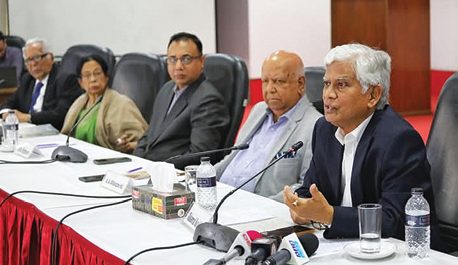
The dialogue was moderated by CGS’s Executive Director, Zillur Rahman, and featured several distinguished speakers. The speakers were;
- Maj. Gen. ANM Muniruzzaman (Retd.), Chairman, Bangladesh Institute of Peace and Security Studies
- Dr. M Enamul Huq, Former IGP and member of the Law Commission from 2004 to 2007
- Muhammad Nurul Huda, Former IGP
- Zahir Uddin Swapon, Adviser, BNP Chairperson
- Munira Khan, Chair, Centre for Governance Studies (CGS)
- Ikteder Ahmed, Former Judge, Columnist and Legal Consultant
- ASM Nasiruddin Elan, Rights Activist and Director of Odhikar
- Barrister Andaleeve Rahman (Partho), President of the Bangladesh Jatiya Party
- Rashna Imam, Advocate, Supreme Court of Bangladesh
- Barrister Asaduzzaman Fuaad, Joint Member Secretary, AB Party
- Sohrab Hassan, Joint Editor, Prothom Alo
- A K Azad, Publisher and Editor, Samakal
- Shafqat Munir, Senior Research Fellow, Bangladesh Institute of Peace and Security Studies
- Nurul Haq Nur, President, Gono Odhikar Parishad
- Advocate Hasnat Kaiyum, Chief Coordinator, Rashtra Sanskar Andolon
- Dr. Mahbubur Rahman, Professor of Political Science, North South University
- Psymhe Wadud, Lecturer, Department of Law, University of Dhaka
- Md. Zarif Rahman, Researcher and Student Representative, Member of Police Administration Reform Commission
- Kazi Rakib Hossain, Student Representative and Activist
- Rezwana Rashid, Student Representative and Activist
- Ushaton Talukder, Former Member of Parliament, Rangamati Hill District