

Research & publications Web edition
Introduction
In the past decade, Bangladesh has witnessed serious erosion of the human rights situation. According to Freedom House reports, the country’s political and civil rights have not only remained low but also decreased significantly (Figure 1). Reports of various international human rights organizations and of the United States Department of State have documented various aspects of the increasing instances of rights violations. Although incidents of human rights violations and the increasingly authoritarian tendency of the government have been discussed in various forums for almost a decade, the issue gained salience after the sanctions imposed by the United States on the Rapid Action Battalion (RAB) and seven of its former and current officials (U.S. Department of the Treasury 2021). Sanctions were imposed on RAB and selected officials for egregious violations of human rights. However, the Bangladesh government has repeatedly denied any human rights violations including extrajudicial killings and enforced disappearances in the country (The Daily Star 2021; The Daily Star 2021a).
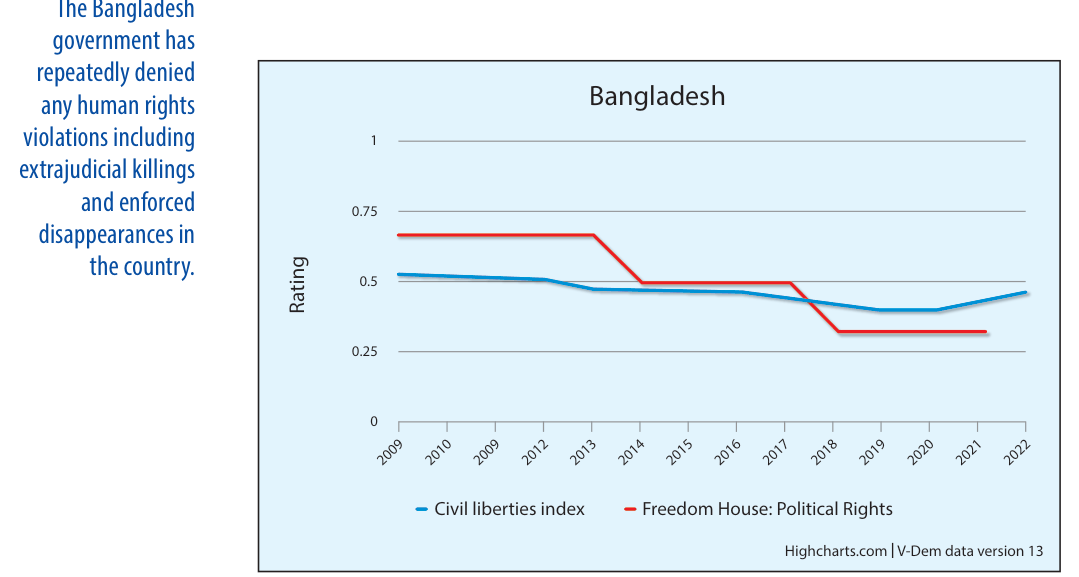
Source: V-Dem Database, version 13, 2023 As the overall human rights situation deteriorated in the country, national and international media have reported harassment, intimidation, and persecution of human rights defenders, that is those who gather and report human rights abuses, endeavor to stop such abuses and make sure that everyone has access to their universal rights (Amnesty International UK 2018). Besides individual human rights activists being persecuted, Human Rights organizations are also subjected to attacks. For example, in September 2022, a prominent Human Rights organization in the country, Odhikar, has been deregistered (Civicus 2022) after withholding its registration for eight years. These developments are contrary to Bangladesh’s commitment to protecting Human Rights defenders. During the Third Cycle of the Universal Periodic Review of the UN Human Rights Council in 2018 (UN Human Rights Council 2018), Bangladesh accepted 178 and noted 73 recommendations made by UN member states. Although many of these recommendations were a continuation of the first and second UPR cycles (2009 and 2013), most of these recommendations have not been implemented (For UPR, see OHCHR, nd) In the third cycle UPR, “Bangladesh accepted recommendations to repeal restrictive legislative provisions that limit the rights of human rights defenders and civil society organizations to freedom of expression and free speech, end all assaults on human rights defenders, and publicly commit to ensuring that human rights defenders and civil society organizations are able to carry out their activities without fear of surveillance, intimidation, harassment, arrest, prosecution, or retribution” (Solidarity Group for Bangladesh 2023).
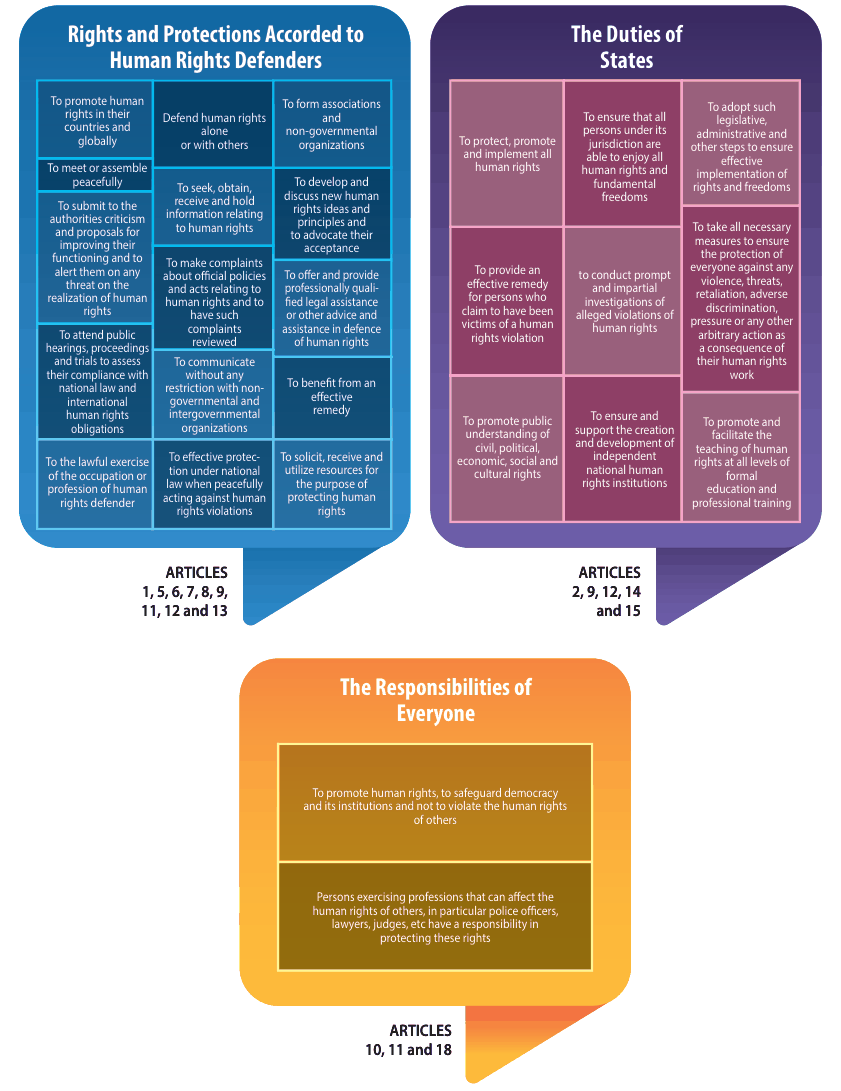
The United Nations General Assembly adopted a resolution to protect human rights defenders on 9 December 1998. The UN resolution entitled,
Individual human
“Declaration on the Right and Responsibility of Individuals, Groups, and
rights activists being
Organs of Society to Promote and Protect Universally Recognized Human
persecuted, Human
Rights and Fundamental Freedoms” laid out the rights and protections
Rights organizations
accorded to the HRDs, the duties of the member states, and the
are also subjected to
responsibilities of other citizens (Figure 2).
attacks.
Human Rights Defenders: ‘The people who, individually or with

others, act to promote or protect human rights in a
The Special Rapporteurs on human rights defenders defined Human
peaceful manner’.
Rights Defenders as ‘the people who, individually or with others, act to promote or protect human rights in a peaceful manner” (OHCHR, n.d.). Following the declaration many countries promulgated their specific law to protect defenders’ rights. However, there have been countries that were not providing adequate protection to the HRDs. Consequently, on 17 December 2015, UN General Assembly adopted a resolution (A/Res/70/161) which urged:
States to acknowledge through public statements, policies, or laws the important and legitimate role of individuals, groups, and organs of society, including human rights defenders, in the promotion of human rights, democracy, and the rule of law, as essential components of ensuring their recognition and protection, including by condemning publicly all cases of violence and discrimination against human rights defenders, including women human rights defenders, underlining that such practices can never be justified (United Nations General Assembly 2015).
The resolution strongly called upon all States:
To refrain from, and ensure adequate protection from, any act of intimidation or reprisal against human rights defenders who cooperate, have cooperated, or seek to cooperate with international institutions, including their family members and associates (United Nations General Assembly 2015).
While Bangladesh voted in favor of the resolution, the country is not only yet to take any concrete measures, but rather continued to violate the letter and spirit of the 1998 Declaration and the 2015 resolution.
In recent years, human rights reports of international and national human rights organizations have highlighted the increasing intimidation and persecution of human rights defenders (HRDs). According to these reports, it has become increasingly difficult for the HRDs to gather and report human rights abuse and raise awareness.
In 2021, the Frontline Defenders, a Dublin-based international organization reported that “Human rights defenders in Bangladesh face
While Bangladesh
judicial harassment, arbitrary arrest, fabricated charges, abduction,
voted in favor of the
physical attacks, torture, and extrajudicial killings” (Frontline Defenders,
resolution, the
nd). In March 2022, UN experts called upon the government of
country is not only
Bangladesh to end reprisals against human rights defenders. It noted
yet to take any
that the human rights defenders and relatives of forcibly disappeared
concrete measures,
persons are facing intimidation and reprisals for their activism and
but rather continued
cooperation with international human rights bodies and UN mechanisms
to violate the letter
(UN Office of the High Commissioner for Human Rights 2022). Similar
and spirit of the
points have been made by HRW in 2022 (Human Rights Watch 2022, 76).
1998 Declaration
Reports of family members of HRDs being harassed have been
and the 2015
mentioned by the HRW (2022) and the World Organisation Against
resolution.
Torture (2022). Persecution of HRDs who are working with Rohingya refugees has also been reported (Frontline Defenders n.d.).
According to a statement of the Asian Human Rights Commission (AHRC) in June 2022, ’Human rights defenders, dissidents, and political opposition survive in a profoundly dangerous condition of civic space in Bangladesh’ (Asian Human Rights Commission 2022). The UN Special Rapporteur on the Situation of Human Rights, Mary Lawlor, wrote in 2022, ‘Human rights defenders face attacks in Bangladesh. According to reports received by my office, since December 2021, Bangladeshi authorities have launched a campaign of threats, intimidation, and harassment against human rights defenders. HRDs in the country have been living in a state of insecurity for years’ (Lawlor 2022).
Reports in the Bangladeshi press have also documented the challenges HRDs face. A newspaper report in 2019, drawing on interviews with 21 activists and scrutinizing 14 cases, concluded that fear has permeated the human rights organizations which are pushing them away from taking up issues and cases which are considered ‘sensitive’ to the government (Alam 2019). The situation became more difficult in the subsequent years, and many HROs have limited their work to ‘safer’ issues.
The Foreign Donations (Voluntary Activities) Regulation Act, enacted in 2016 has made the situation worse. The law has given significant power to the government to establish control over non-government organizations in general, particularly human rights organizations. The Foreign Donations (Voluntary Activities) Regulation Act, which requires NGOs accepting foreign donations to register with the NGO Affairs Bureau and to obtain project approval for projects using foreign donations, has weakened the NGOs in general but disproportionately affected human rights organizations. Vague terms such as ‘anti-state activities’ and ‘inimical’ or ‘derogatory’ comments about the Constitution and constitutional institutions of Bangladesh have given the government sweeping power to deregister the NGOs. In 2019, a prominent human rights activist told a newspaper that while the NGOs are cognizant of the need for accountability, the requirements set under the law are highly problematic. She said, ‘” To get the [NGO] bureau’s approval, clearances from the National Security Intelligence Agency (NSI), The Special Branch (SB) of the Police, and the National Defense Intelligence Agency (DGFI) are required.” At that stage, “NGOs are given a runaround ” she said. Besides, the government uses controversial clauses of the Digital Security
Since the
Act, she alleged.” (Alam 2019). Since the introduction of the 2016 law,
introduction of the
human rights organizations have been facing serious impediments in
2016 law, human
receiving foreign funds (Alam 2019a).
rights organizations have been facing
While international and national human rights organizations have been
serious impediments
raising serious concerns regarding the human rights situation and HRDs,
in receiving foreign
the National Human Rights Commission (NHRC) of Bangladesh appears
funds (Alam 2019a).
to have paid little attention to it. The NHRC, established in 2007 through an ordinance under the caretaker government, was made into an independent statutory body under a law in 2009. Since its inception, the commission has come under severe criticism for not playing any effective role (Karim 2022). Human rights organizations and analysts have pointed out that the scope of the commission laid out in the law and the composition preclude it from playing an effective role (Riti and Rahman 2018). As for the HRDs, there have been brief references in the annual reports of the NHRC. For example, in its 2019 annual report the NHRC stated that it “encourages other human rights defenders to be united to consolidate a movement on certain demands on human rights” (Begum et al. 2019). NHRC plans to ‘organize training programs for officers, members of law enforcement agencies (LEAs), lawyers and human rights defenders including journalists for promoting and protecting human rights.’ The challenges faced by the HRDs have not been discussed in the available annual reports or other publications of the NHRC, although in 2019, the Asian NGO Network of National Human Rights Institutions -ANNI – report, published by the Ain O Salish Kendra (ASK) recommended that the National Human Rights Commission (NHRC) should establish a separate desk for the human rights defenders for their safety and security.
It is against this background, this s report examines the challenges faced by human rights activists in Bangladesh. The report is based on– (a) a survey of 50 human rights activists throughout the country and (b) interviews with leaders of selected national-level human rights
Since the
defenders.. . The former is intended to gather information from the
introduction of the
grassroots while the latter is to provide a national-level picture.. . As many
2016 law, human
of the national-level HRDs are in the leadership of various HROs, they
rights organizations
were also asked about the challenges to the HROs.
have been facing serious impediments in receiving foreign funds (Alam 2019a).