
Introduction
On September 13, 2023, almost five years after the introduction of the Digital Security Act (DSA) 2018, Bangladesh Parliament replaced it with a new law called the Cyber Security Act (CSA) 2023. Within five days, the new Act was officially proclaimed as a law through a Gazette notification after receiving the Presidential assent. The decision to replace the DSA was made in a cabinet meeting on August 21, 2023. Prior to that, on August 7, Law Minister Anisul Huq informed that the government has decided to ‘amend’ the law for ‘better interest’ of the people. He said, ‘to stop the misuse and abuse of the DSA, we have changed its name. By evaluating the amended legislation correctly now, we have named it the Cyber Security Act’ (Rahman, 2023). The DSA, which the Law Minister Huq once again tacitly acknowledged of ‘abuse’, remained a nightmare for five years and used wantonly. On September 23, the Law Minister informed the Parliament that since the introduction of the law on October 8, 2018, and January 31, 2023, a total of 7,001 cases were filed under the law (The Daily Star, 2023). The Minister’s statement, the first official account of the extent of the use of the DSA, was far short of being transparent as it didn’t inform the number of accused or how many are being detained, let alone how many cases have been disposed off through the eight cyber-crimes tribunals set up by the government to deal with these cases.
When it was introduced in 2018, the DSA was purported to safeguard citizens in the digital realm. However, over the years, multiple academic studies, and reports from international and national human rights organizations, as well as media freedom monitoring groups, demonstrated that the law has been frequently used by the government and supporters of the ruling party to suppress dissenting voices. The DSA became the weapon of choice of the government and the ruling party for stifling freedom of expression.
The replacement of the DSA with CSA was reminder of the background of the introduction of the DSA in 2018. Since 2006, ahead of each general election, incumbents had introduced either new digital security legislation or revised existing laws of such nature (Chowdhury, 2023).
The replacement of the DSA with CSA was reminder of the background of the introduction of the DSA in 2018. Since 2006, ahead of each general election, incumbents had introduced either new digital security legislation or revised existing laws of such nature (Chowdhury, 2023). On August 20, 2013, an ordinance was enacted amending the Information Technology and Communication Act of 2006. On October 9, 2013, the amended version was ratified by Parliament and became a law. Despite a few notable alterations, the core aspects of the 2006 Act persist with all their inherent inconsistencies (Barua, 2014). However, the amendment added stringent punitive measures in Section 57. The ICT Act 2006 was initially introduced in response to rising cybercrimes and e-commerce, but Section 57, introduced in 2013, triggered concerns due to vague definitions and restrictive measures, including arrests without warrants. It is worth noting that the ICT Act 2006, until it was amended in October 2023, was seldom used by the government and others, whereas after the amendment the number of cases spiked (Digital Security Act 2018: How It Is being Implemented, pp. 1-2). A controversial election, boycotted by the opposition, was held on January 5, 2014.
As the country was gearing up for another election in 2018, on October 8, the successor to the Information and Communication Technology (ICT) Act 2013 was introduced. The Digital Security Act (DSA) with draconian provisions was passed and implemented. The DSA was immediately met with international scrutiny and calls for amendment, with critics highlighting its repressive nature. Although the government assured various stakeholders that their concerns would be addressed, and the law will be judiciously amended accordingly. But the final version of the law disregarded the concerns and demands of the journalists, editors, and human rights activists.
The Act provided the law enforcement agencies with the power to arrest without a warrant, simply on suspicion that a crime has been committed using social media.
The DSA provided the government absolute power to initiate investigations into anyone whose activities are considered a ‘threat’ by the government. The Act provided the law enforcement agencies with the power to arrest without a warrant, simply on suspicion that a crime has been committed using social media. It provided the police with the power to search and seize without any warrant and oversight. Also, the Act allowed the Government to order the removal and blocking of any information or data on the internet it deems necessary, thereby providing broad scope to silence those critical of its policies or who share information on human rights violations in the country. Objections were raised about nine sections of the law, which were described as detrimental to freedom of speech; these Sections are 8, 21, 25, 28, 29, 31, 32, 43 and 53. It was argued that these sections are unclear and many of its terms are not defined properly. Out of the 20 provisions of the law that deal with offences and punishments, 14 were non-bailable. Five were bailable and one can be negotiated. The lowest punishment is one year in prison and the highest life-term but mostly in the range of between four and seven years. These were viewed by editors and journalists as a recipe for creating a climate of fear. The non-bailable provision of the law practically allowed the accused to be detained for an indefinite period before the trial.
Mounting and repeated criticisms of the DSA, by international organizations such as Human Rights Watch (HRW) (2018a, 2018b, 2018c), Amnesty International (AI) (2018), Reporters Without Borders (RSF) (2018), Committee to Protect Journalists (CPJ) (2018), concrete suggestions for amendments from the Office of the High Commissioner for Human Rights (OHCHR) (OHCHR, 2023), and call from the UN Human Rights Chief Volker Türk (OHCHR, 2023), the government declined to make any changes, let alone scrapping the law. Domestically, the criticisms came not only from the Human Rights groups but also from the Editors’ Council, who described the implementation of the law as their worst nightmare coming true (The Daily Star, 2023). National and international experts and activists as well as international organizations had repeatedly reminded the government that the law’s various provisions are contravention of International Covenant and Charters signed by Bangladesh (Ahmed, 2023).
National and international experts and activists as well as international organizations had repeatedly reminded the government that the law’s various provisions are contravention of International Covenant and Charters signed by Bangladesh (Ahmed, 2023).
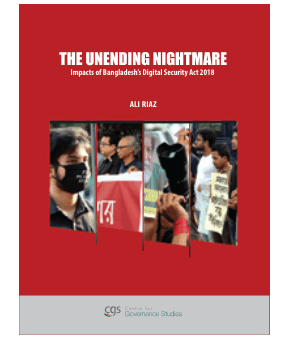
It is against this background, this report presents a comprehensive picture of the implementation of the DSA between October 8, 2018 and September 18, 2023. This report, prepared by the Centre for Governance Studies, builds on an ongoing project, documenting the DSA’s implementation and impacts initiated in early 2020. Four reports documenting how the law has been implemented and who has become the victims of the cases have been published previously. These are ‘Digital Security Act, 2018: How Is It Being Enforced’ (CGS, 2021); ‘The Unending Nightmare: Impacts of Bangladesh’s Digital Security Act 2018’ (CGS, 2022); ‘What’s Happening: Trends and Patterns of the use of the Digital Security Act 2018 in Bangladesh’ (CGS, 2023); ‘The Perpetual Misery: Plights of the Accused Under the Digital Security Act 2018’ (CGS, 2024). The project continues to gather information about the use of the DSA since its introduction in October 2018 and a dedicated website continues to update as we receive and verify the information. All data relevant to this project is available at https://freedominfo.net/.
While this report presents and analyzes data from October 2018 and September 2023, it is necessary to mention two points. First, the replacement of the DSA with the CSA does not mean that the cases filed under the DSA in the past five years have been scrapped. Instead, the Law Minister Anisul Huq has clearly stated that the cases will continue to be pursued (The Business Standard, 2023). As we have mentioned in a previous report, the misery of those accused and convicted, at times, through miscarriage of justice, will continue and has become unending. Second, the newly introduced CSA is by no means an improvement but rather a rebranding at its best and a whitewash at its worst. The Cyber Security Act (CSA) retained many problematic elements. A few sections of the DSA, namely 17, 21, 22, 25, 26, 28, 29, 30, 31, 32, and 40, have been altered, with section 33 being abolished. Consequently, section 34 of the DSA became section 33 of the CSA, and section 40 became section 39. Sections 17, 19, 21, 22, 23, 24, 26, 27, 28, 30, 31, 32, 33, and 34 were non-bailable under the DSA, where under the CSA every section has been made bailable except for the section 17, 19, 27 and 32 (The Perpetual Misery, 2024). Additionally, in various sections, the punishment for a second offense was either doubled or increased under the DSA, but such provisions have been eliminated in the new CSA law. While some sections were altered or abolished, others remained unchanged, including Section 42, granting sweeping arrest powers to the police without warrants.
What’s Happening
Ali Riaz
Trends and patterns of the use of the

Digital Security Act 2018 in Bangladesh