

The Background
Extrajudicial killings in Bangladesh are not new. In the early days of independence, there have been reports of law enforcing agencies, particularly the Jatiya Rakkhi Bahini (JRB), being engaged in deliberate killings of the opposition (Ahmed Musa 1988; Kaiser 1995). The most widely discussed incident of extrajudicial killing was the death of Siraj Sikdar, the leader of the Sorbohara Party (Proletarian Party, a radical underground party). Sikdar was killed after being arrested. The official narrative was that he was shot when he tried to escape from a police van. This can be called the first recorded incident of “crossfire”. On November 3 of the same year, four leaders of Bangladesh’s liberation war – Syed Nazrul Islam, Tajuddin Ahmed, Captain Mansur Ali and A.H.M. Kamruzzaman were brutally murdered inside the Dhaka Central Jail. It was the responsibility of the state and the government to provide security to these leaders detained after the August 15 military coup. But not only were they murdered, but it was revealed during the trial in 2004, that the killings were approved by then head of state Khondoker Mushtaq Ahmed. During the army rule between 1975 and 1990, there have been incidents of killings of military personnel, political activists, and innocent civilians. Records of these incidents are not available.
After Bangladesh embarked on democratization in 1991, during the rule of the Bangladesh Nationalist Party (BNP) and Bangladesh Awami League (BAL), the incidence of unlawful killings continued albeit in small numbers. In 1997, for example, Amnesty International reported 17 cases of custodial deaths; however, deaths such as ‘gunfight/crossfire’ was almost non-existent. During this period, political activists have been killed in intra-party, and inter-party clashes. Besides, police have used heavy-handed measures and there are many instances of police firing. The custodial death of Shamim Reza Rubel in 1998 brought the issue into the limelight. Between October 16, 2002 and January 9, 2003, the government led by Khaleda Zia conducted a security operation against alleged criminals. Various law enforcing agencies, Bangladesh Army, Bangladesh rifles and Bangladesh Navy carried out the operation called ‘Operation Clean Heart’. During the operation at least 40 people died under circumstances where the victims were deprived of their legal rights and due process. These extrajudicial killings were indemnified by the parliament where the incumbent had the overwhelming majority. The indemnity was nullified by the High Court in 2015.
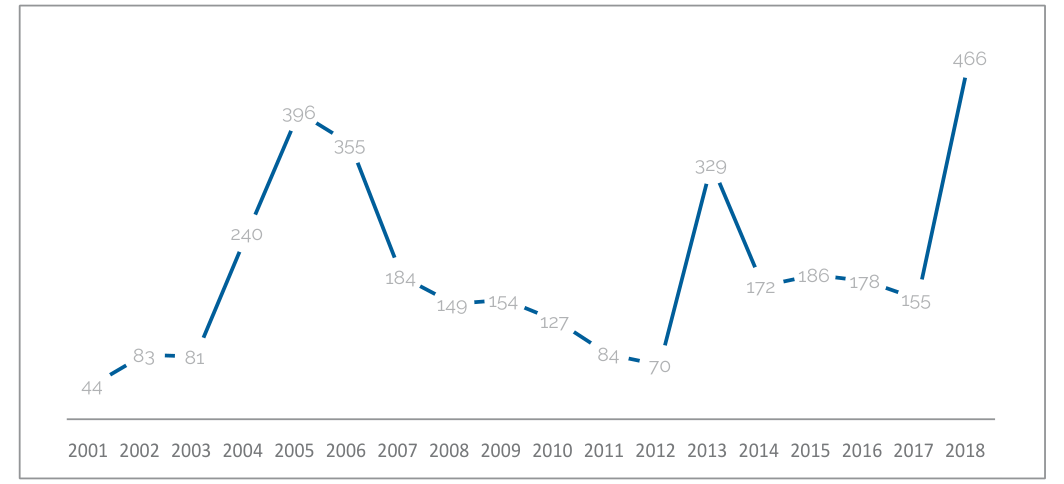
Despite the history of extrajudicial killings since independence, it did not emerge as a pattern until 2004. According to Odhikar, the total number of victims of extrajudicial killings between 2001 and 2018 were 3,453 (Figure 1).
Source: Odhikar, http://odhikar.org/wp-content/uploads/2022/02/Total-KLEA-2001-2021.pdf
Ain o Salish Kendra (ASK) provides a different set of statistics for the period between 2004 and 2018. Its record shows the total number is 3,165 (Figure 2).
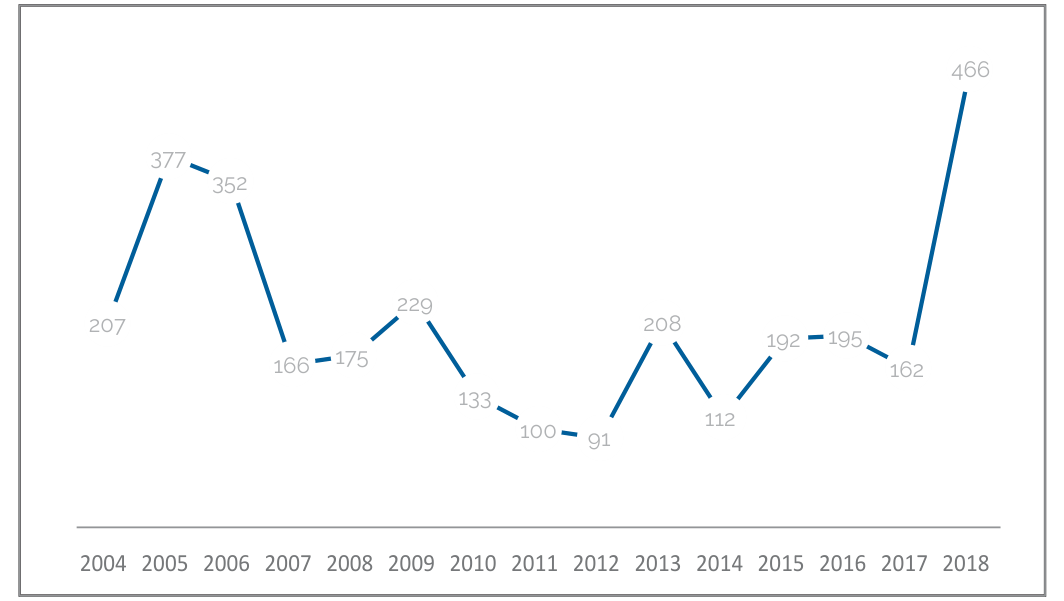
Source: Ain O Salish Kendra, Annual Reports The differences in the number of incidents between the two human rights organizations show the difficulties of getting a comprehensive picture of the occurrence of extrajudicial killings in the country. This discrepancy has not resulted from methodological differences, but instead is due to the challenges gathering data. Law enforcement authorities have been reluctant in providing information and the media have faced enormous difficulties in crosschecking. Reporters, who sought anonymity, have informed us that in some instances families were afraid of informing the press and public. The families feared retribution.
Besides, juxtaposition of the available data gathered by human rights organizations with the political events also reveals that the number of extrajudicial killings had remarkably increased ahead of two national elections held in 2014 and 2018. In 2013, as the opposition launched a nationwide movement demanding restoration of the caretaker government provision, and the Bangladesh Jamaat-i-Islami (BJI) violently protested the convictions of its leaders by the International Crimes Tribunal (ICT) for committing crimes against humanity. At this time, law enforcing agencies used heavy-handed measures and indiscriminate killings. They have enjoyed impunity. The 2014 election was boycotted by all the opposition parties thus delivering a victory to the incumbent Bangladesh Awami League. The year 2018 saw the largest numbers of deaths to date; a combination of the election held in December and the so-called war on drugs contributed to the unprecedented level of deaths in the hands of law enforcing agencies. According to the details of the Odhikar data, of the 466 deaths, 358 were described by the government sources as gunfight/crossfire. In 2018 election the incumbent and its allies secured 288 out of 298 seats.