

Data of Extrajudicial Killings, 2019-2021
This project explored data for three years, 2019-2021. Data were gathered from print media outlets and national and international human rights organizations. Seven newspapers have been analyzed for the period between January 2019 and December 2021. These newspapers are – Prothom Alo, Jugantor, Samakal, Manabzamin, The Daily Star, New Age, and the Dhaka Tribune. Among the human rights organizations, information has been gathered from published reports and databases of Odhikar, Ain O Shalish Kendra (ASK), Amnesty International, the Human Rights Watch and Asian Human Rights Commission.
In addition to the number of incidents, we also gathered details of the individual cases – names of the victims, place of the incidents, cause of death, and the law enforcing agencies allegedly involved (Appendix 1). In most cases, law enforcers accuse the victims of being drug dealers, drug peddlers, or yaba dealers. On the other hand, family members have provided different perspectives. Despite the differing perspectives, it is evident from the available narratives that the victims have not been provided the legal recourse stipulated in international human rights laws and the constitution of Bangladesh. We have also documented ten case studies of incidents which have taken place during the period under review (Appendix 2). In many instances, the families have been denied filing cases in police stations.
During this period, we have gathered detailed data of 591 extrajudicial killings. Disaggregation of the nature of the extrajudicial killings shows that gunfight has been the most frequent mode of deliberated killings as it constitutes 86.63% of the cases we have gathered details about.
Table 1: Different Types of Extrajudicial Killings, 2019-2021
| Torture to Death | 11 |
|---|---|
| Gunfight | 512 |
| Death in Custody | 15 |
| Crossfire | 4 |
| Shootout | 15 |
| Shot to Death | 34 |
| Total | 591 |
Table 2: Types of Extrajudicial Killings by the Year, 2019-2021
| Cause of Death | 2019 | 2020 | 2021 |
|---|---|---|---|
| Torture to Death | 1 | 7 | 3 |
| Gunfight | 306 | 152 | 54 |
| Death in Custody | 3 | 6 | 6 |
| Crossfire | 0 | 4 | 0 |
| Shootout | 11 | 4 | 0 |
| Shot to Death | 11 | 9 | 14 |
| Total | 332 | 182 | 77 |
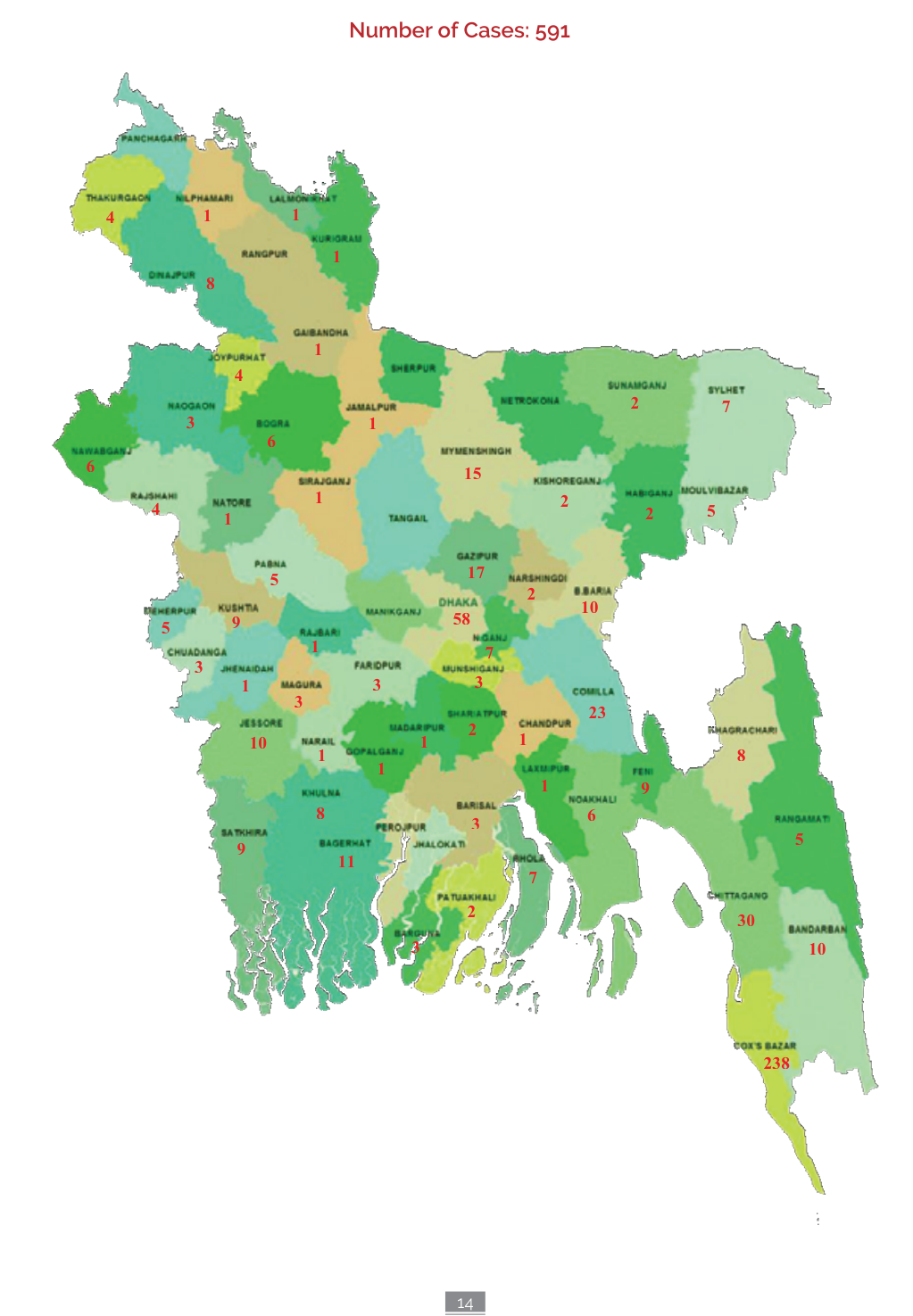
These incidents have taken place in 56 out of the total 64 districts of the country. Table 3 and Figure 3 show the geographical spread of the incidents. The data also show that the largest number of extrajudicial killings have taken place in Cox’s Bazar (238), followed by Dhaka (58), and Chattogram (30).
Table 3: District-wise List of Incidents of Extrajudicial Killings, 2019-2021
| Sl No. | District | Number |
|---|---|---|
| 1 | Bagerhat | 11 |
| 2 | Bandarban | 10 |
| 3 | Barguna | 3 |
| 4 | Barishal | 3 |
| 5 | Bhola | 7 |
| 6 | Bogura | 6 |
| 7 | Brahmanbaria | 10 |
| 8 | Chandpur | 1 |
| 9 | Chapainawabganj | 6 |
| 10 | Chattogram | 30 |
| 11 | Chuyadanga | 3 |
| 12 | Cox’s Bazar | 238 |
| 13 | Cumilla | 23 |
| 14 | Dhaka | 58 |
| 15 | Dinajpur | 8 |
| 16 | Faridpur | 3 |
| 17 | Feni | 9 |
| 18 | Gaibandha | 1 |
| 19 | Gazipur | 17 |
| 20 | Gopalganj | 1 |
| 21 | Habiganj | 2 |
| 22 | Jamalpur | 1 |
| 23 | Jashore | 10 |
| 24 | Jhinaidah | 1 |
| 25 | Joypurhat | 4 |
| 26 | Khagrachhari | 8 |
| 27 | Khulna | 8 |
| 28 | Kurigram | 1 |
| Sl No. | District | Number |
| 29 | Kishoreganj | 2 |
| 30 | Kushtia | 9 |
| 31 | Lalmonirhat | 1 |
| 32 | Laxmipur | 1 |
| 33 | Madaripur | 1 |
| 34 | Magura | 3 |
| 35 | Meherpur | 5 |
| 36 | Moulvibazar | 5 |
| 37 | Munshiganj | 3 |
| 38 | Mymensingh | 15 |
| 39 | Naogaon | 3 |
| 40 | Narail | 1 |
| 41 | Narayanganj | 7 |
| 42 | Narsingdi | 2 |
| 43 | Natore | 1 |
| 44 | Nilphamari | 1 |
| 45 | Noakhali | 6 |
| 46 | Pabna | 5 |
| 47 | Patuakhali | 2 |
| 48 | Rajbari | 1 |
| 49 | Rajshahi | 4 |
| 50 | Rangamati | 5 |
| 51 | Satkhira | 9 |
| 52 | Shariatpur | 2 |
| 53 | Shirajganj | 1 |
| 54 | Sunamganj | 2 |
| 55 | Sylhet | 7 |
| 56 | Thakurgaon | 4 |
In the past three years, the highest number of killings took place in July 2020, when 49 people became victims (Table 3). This is followed by 42 incidents in May 2019 (Table 4).
Table 4: Number of Deaths by Months, 2019-2021
| Months | 2019 | 2020 | 2021 |
|---|---|---|---|
| January | 20 | 24 | 2 |
| February | 33 | 24 | 8 |
| March | 35 | 29 | 15 |
| April | 33 | 9 | 7 |
| May | 42 | 21 | 9 |
| June | 31 | 10 | 1 |
| July | 27 | 49 | 7 |
| August | 36 | 6 | 6 |
| September | 23 | 1 | 4 |
| October | 28 | 5 | 1 |
| November | 8 | 1 | 9 |
| December | 17 | 3 | 7 |
Of our sample of 591 cases, according to police and media reports, 22 people died in fights between groups of drug dealers. In seven cases, particular state agencies could not be identified, although the media have identified them as law enforcing agencies. Of the remaining 562 cases, police have been alleged to be the perpetrator in 288 cases; this number includes the Detective Branch of the Police. Rapid Action Battalion (RAB) is alleged to be the perpetrator in 162 cases (Table 5). The nature of the incidents shows that 512 were so-called gunfights. After excluding the alleged gunfights between the drug dealer groups and one instance where the precise law enforcement agency could not be identified, police and DB police were involved in 48.05% cases, RAB was involved in 31.90% cases. Data available in the public domain were not sufficient to create demographic profiles and political affiliations of the victims. However, we have noticed that there is a clear pattern of portraying the victims as ‘criminal’ and/or ‘drug dealers.’ The implicit intention appears to provide a justification for the killings.
| OTHERS | 6 | 6 | |||||
|---|---|---|---|---|---|---|---|
| NAVY POLICE | 1 | 1 | |||||
| LAW ENFORCES | 1 | 1 | |||||
| TWO GROUPS OF DRUG TRADERS | 22 | 22 | |||||
| SECURITY FORCES | 1 | 1 | |||||
| POLICE & BGB | 2 | 2 | |||||
| DB POLICE | 23 | 3 | 1 | 2 | 29 | ||
| COAST GUARD | 1 | 1 | |||||
| BGB | 88 | 1 | 11 | 100 | |||
| ARMY | 7 | 7 | |||||
| RAB | 156 | 1 | 5 | 162 | |||
| POLICE | 212 | 5 | 7 | 22 | 9 | 4 | 259 |
| Gunfight | Death in Custody | Shootout | Shot to Death | Torture to Death | Crossfire | Total |