

Data About Enforced Disappearances, 2019-2021
It is against the above-mentioned background, in September 2021, the Centre for Governance Studies (CGS) launched a project to investigate the nature and pattern of enforced disappearances that occurred between January 2019 and December 2021. The data were gathered from: (a) seven newspapers: Prothom Alo, Jugantor, Samakal, Manabzamin, The Daily Star, New Age, and Dhaka Tribune; (b) published reports of human rights organizations such as Odhikar, Ain O Shalish Kendra (ASK), Amnesty International, Human Rights Watch and Asian Human Rights Commission.
The project has gathered detailed data about 71 cases of enforced disappearances including those who have returned after being missing for a period of more than two days (Appendix 1). Drawing on available data we have listed the agencies allegedly involved in the incidents. We have created a database with the names and places of the victims of alleged enforced disappearances. Additionally, we have explored seven incidents in depth (Appendix 2).
Of the 71 cases of enforced disappearances, 16 victims are still missing (22.53%) while five have been found dead (7.04%). According to press reports and other sources, 22 have been either arrested, detained, or jailed (30.98%). This is quite significant because the government always denies that they have any idea about those who are allegedly disappeared. Most of the families and friends of those who had disappeared alleged that law enforcement agencies were involved. The status of five victims could not be determined (Table 1).
Table 1: Status of the Victims of Enforced Disappearances, 2019-2021
| Status | No |
|---|---|
| Arrested | 9 |
| Dead | 5 |
| Detained | 2 |
| Jailed | 11 |
| Missing | 16 |
| Returned | 23 |
| Undetermined | 5 |
| Total | 71 |
Of our sample 23 persons (32.39%) have returned. However, those who survived the ordeal and returned have always chosen to remain silent irrespective of their socio-economic status and the length of disappearance. For example, Maruf Zaman, a former ambassador, returned home on March 16, 2019 after 15 months of being missing (The Daily Star 2019). Since then, he has not spoken a word in public like other victims who remained missing for only a few days. The silence of those fortunate enough to have been allowed to return to their loved ones, is both revealing and worrying. Often these persons were dropped in the middle of the night in a busy road. On March 10, 2015, Salahuddin Ahmed, a former MP and a high-ranking leader of the opposition Bangladesh Nationalist Party (BNP), was picked up from his home in the middle of the night by a group of people identifying themselves as members of the Detective Branch of the Police. The police denied they arrested him. Two months later, on May 11, he was found by locals in Shilong, India in the middle of a road, seemingly disoriented. He was handed over to the local police and charged with trespassing without travel documents. How he crossed the international border remains a mystery and he is still in India facing legal battles. These individuals are either unable or unwilling to provide any details of their captors or the place of their captivity. The almost identical descriptions of their abductions provided by them tend to imply that they were kidnapped for ransom (The Daily Star 2017), but no ransom was ever demanded from their families. Police investigators said in one instance of enforced disappearance that they didn’t find involvement of any criminal gangs in the abduction (New Age 2017).
We have been able to gather data about the professions of 51 individuals (Table 2). Eleven are politicians (15.49% of total victims) and equal numbers are businessmen. Eight students (11.26%) constitute the third largest group of victims. Five individuals involved with Islamic education, preaching and clerical jobs have also been subjected to enforced disappearances (7.04%). We could identify individuals belonging to fifteen professions including politicians among those who have been victims in the three-year period of our study. This shows what
| Professions | Number |
|---|---|
| Businessmen | 11 |
| Convicted felons | 1 |
| Driver | 2 |
| Drug Dealer | 1 |
| Film Maker | 1 |
| Former Army Personnel | 1 |
| Imam | 1 |
| Islamic Preacher | 2 |
| IT Specialist | 1 |
| Journalist | 3 |
| Jute Mill Worker | 2 |
| Khatib | 1 |
| Lawyer | 1 |
| Madrasa Teacher | 1 |
| Politician | 11 |
| Private Employee | 3 |
| Student | 8 |
| Unknown | 20 |
| Total | 71 |
the range of victims has been.
Table 2: Professions of the Victims
During the period under study, the largest number of cases have been reported in March of 2021 when ten cases were reported in the press (Table 3). This was followed by eight cases in June 2021.
Table 3: Monthly Disaggregation of Incidents of Enforced Disappearances, 2019-2021
| 2019 | Number | 2020 | Number | 2021 | Number |
|---|---|---|---|---|---|
| January | 6 | January | 1 | January | 0 |
| February | 2 | February | 2 | February | 1 |
| March | 3 | March | 1 | March | 10 |
| April | 6 | April | 1 | April | 0 |
| May | 7 | May | 0 | May | 0 |
| June | 4 | June | 3 | June | 8 |
| July | 1 | July | 5 | July | 1 |
| August | 0 | August | 1 | August | 2 |
| September | 1 | September | 0 | September | 0 |
| October | 0 | October | 2 | October | 0 |
| November | 1 | November | 0 | November | 0 |
| December | 0 | December | 0 | December | 2 |
| 31 | 16 | 24 | |||
| Total | 71 |
Table 4: The Geography of Enforced Disappearances, 2019-2021
| Serial No | District Name | Number of Cases |
|---|---|---|
| 1 | Barishal | 1 |
| 2 | Chattogram | 8 |
| 3 | Cox’s Bazar | 2 |
| 4 | Dhaka | 26 |
| 5 | Feni | 1 |
| 6 | Jashore | 2 |
| 7 | Khulna | 6 |
| 8 | Khustia | 1 |
| 9 | Kishoreganj | 1 |
| 10 | Lalmonirhat | 1 |
| 11 | Madaripur | 1 |
| District Name | ||
| 12 | Mymensingh | 6 |
| Narayanganj | ||
| 14 | Narsingdi | 2 |
| Natore | ||
| 16 | Noakhali | 1 |
| Sirajganj | ||
| 18 | Thakurgaon | 2 |
| Total |
Geographically, these incidents have occurred in 18 districts. Dhaka topped the list of places where the incidents of enforced disappearances had taken place (Table 4). Of the 71 cases, 26 have taken place in Dhaka district, followed by Chattogram with eight cases (Figure 3).
Figure 3: Geography of Enforced Disappearances in Bangladesh, 2019-2021
Number of Cases: 71
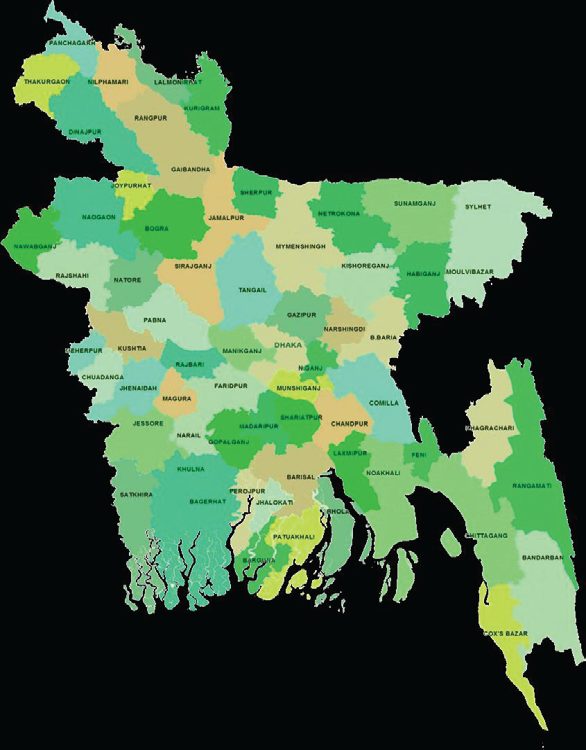
26
Of the 71 cases, we could gather information about the alleged involvement of the law enforcement agencies in 52 cases. The available data regarding the allegations show that Rapid Action Battalion (RAB) is alleged to have been involved in 21 cases (Table 5). That means RAB is alleged to have been involved as perpetrator in 40.38% of cases where the alleged perpetrators have been identified. Detective Branch of Police is alleged to have been involved in 16 cases, that is 30.76% of cases where we could gather an identification of an alleged perpetrator. These allegations are from family members and friends. On some occasions witnesses have also corroborated these claims.
Table 5: Law Enforcement Agencies allegedly involved in Enforced Disappearances, 2019-2021
| Name of the agency | Number |
|---|---|
| CID | 1 |
| DB Police | 16 |
| DMP | 1 |
| Law Enforcement Agency | 1 |
| Law Enforcement Authorities | 6 |
| Police | 6 |
| RAB | 21 |
| Unknown | 19 |
| Total | 71 |