
Background
A. Political and Legal Context: ICT Act
Since 2001, Bangladesh has gone through multiple iterations of cyber security laws.3 The Information and Communication Technology Act (“ICT Act”) was enacted in 2006 ostensibly to prevent cybercrimes and regulate digital communications. Sections 54 to 67 of the ICT Act 2006 defined a range of punishable acts with penalties of up to 10 years of imprisonment and varying fines.4 In particular, Section 57 of the ICT Act allowed for the prosecution of anyone who published or transmitted “in electronic form any material” deemed “fake and obscene,” defamatory, or otherwise likely to “deprave or corrupt” its audience, while also enabling prosecutions arising from any online material that “causes to deteriorate or creates a possibility to deteriorate law and order, prejudice the image of the State or person or causes to hurt or may hurt religious belief or instigate against any person or organization.”
The ICT Act was passed amid serious political upheaval in Bangladesh. In 2004, the thenruling Bangladesh Nationalist Party (BNP) amended the Constitution5 to use the nonpartisan caretaker government (CTG) system,6 which had ensured free and fair elections since 1996, to its benefit for the upcoming 2007 election.7 The Bangladesh Awami League (Awami League) refused to participate in the election and ultimately a “state of emergency” was declared, paving the way for the army to take over in January
2007,8 termed by some as a “soft coup.”9 At the end of 2008, the military-backed civilian government arranged an election, which resulted in a significant majority for the Awami League. The Awami League eventually scrapped the CTG provision in the Constitution in 2011 and retained power in Bangladesh from 2008 until August 2024,10 when Prime Minister Sheikh Hasina resigned and fled Bangladesh following widespread protests.11
The ICT Act was “widely criticized for restricting freedom of expression.”12 In October 2013, key aspects of the ICT Act were amended, resulting in an increase of imprisonment terms for some offenses from 10 to 14 years and modification of certain procedural rules by making many offenses cognizable (meaning that police could make arrests without a warrant) and non-bailable (meaning that courts could impose pretrial detention).13 This included Section 57, which was made cognizable, non-bailable and now carried a potential prison sentence of 14 years.
As per a news report that cites data from the police headquarters, close to 3,000 people faced charges under the ICT Act between 2012 and July 2017, across 1,417 cases.14 Human Rights Watch (HRW) similarly reports that the police submitted close to 1,300
charge sheets to the Cyber Tribunal established under the ICT Act between 2013 and 2018.15 Most of these cases were filed under Section 57.
The police data reflects that 1,492 people were arrested. HRW adds that “scores of people [were]… detained for months at a time before being released pending trial, some simply for political criticism.”16 People were arrested for merely “liking” or “sharing” social media posts deemed critical of the then-Prime Minister Sheikh Hasina or the Awami League Government.17 Those targeted under the ICT Act included journalists (both for their professional writings and personal social media posts), editors of news organizations, members of the opposition and ordinary citizens.18
Civil society raised concerns about the overbroad, “draconian” ICT Act and called for the Bangladeshi government to “work with domestic and international experts to draft a new law that fully upholds the principles of free speech and internet freedom.”19 Section 57 of the ICT Act was also challenged before the High Court, on the ground that it violated rights protected under the Bangladesh Constitution.20
In response to domestic and international pressure, the Bangladeshi government decided to repeal some of the provisions of the Act.21 In its May 2018 report under the Universal Periodic Review mechanism of the UN Human Rights Council, the government affirmed its commitment to repealing the ICT Act, stating that it was planning to introduce a new digital security law called the Digital Security Act that would “establish[] balance between freedom of expression and public morality [and] interest.”22 The petitions challenging
Section 57 on constitutional grounds also stalled as a result of the impending repeal of the law.23
As the government prepared to repeal Section 57 in 2018, civil society organizations “warn[ed] that any new law should protect rights, [instead of being] used to crack down on critics.”24
B. Political and Legal Context: DSA
Like the ICT Act, the Digital Security Act of 2018 (“DSA”) was introduced amidst political upheaval in Bangladesh. In July 2018, a spontaneous movement of students demanding road safety shook the country, which reflected the people’s growing frustration with the Awami League government.25 A general election was scheduled for December that year. The Digital Security Act was introduced in October 2018, ostensibly to rectify the vagueness of Section 57 of the ICT Act.26 However, since its adoption the DSA—much like the ICT Act—was subject to significant criticism for its vagueness and the corresponding risk of abuse.27
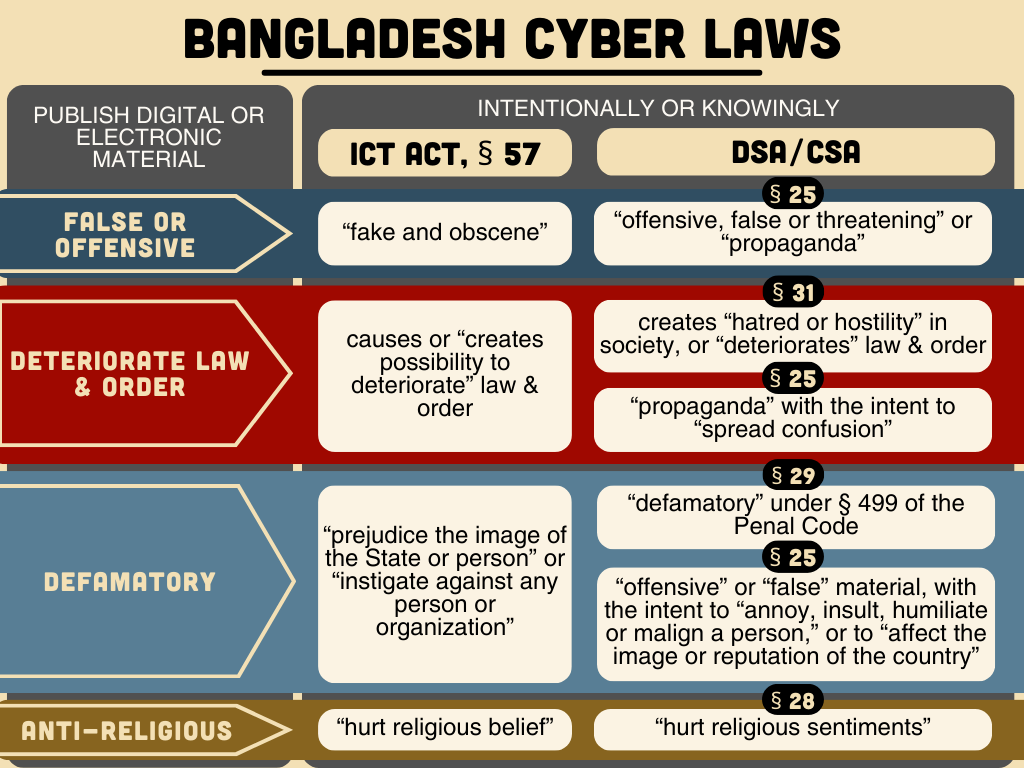
The DSA repealed five provisions of the ICT Act, including Section 57.28 However, in effect, it maintained the substance of repealed provisions, effectively splitting what had been covered by Section 57 of the ICT Act into different offenses under the DSA and imposing similarly severe penalties.29 For instance, Section 25 of the DSA, like Section 57 of the ICT Act, criminalized the transmission or publication of offensive, false, or
threatening information (including with an intention to affect the image or reputation of the country, or to spread confusion) and carried a potential three-year prison sentence, with the possibility of five years in prison for repeat offenders; Section 29 of the DSA criminalized online defamation, mirroring language in Section 57 and carrying a potential prison sentence of up to three years—five years for repeat offenders; Section 28 of the DSA criminalized transmission or publication of information that intentionally “hurt[] religious sentiments and values,” like Section 57, and prescribed a maximum prison term of five years—ten years for repeat offenders; and Section 31 of the DSA criminalized the transmission or publication of information that “deteriorates … law and order,” pulling language word-for-word from Section 57 and carrying a potential seven-year prison sentence—ten years for repeat offenders.30 The absorption of the vague provisions of the ICT Act into the DSA (and later, the CSA) is reflected in this chart:
Many civil society organizations and human rights activists deemed the DSA “even broader and even more alarming” than the ICT Act.31 Likewise, the Editors’ Council, the body comprising Bangladesh’s leading newspaper editors, called for an overhaul of the law on the basis that it would enable prosecutions of journalists, producing a “chilling effect.”32
In June 2022, the Office of the United Nations High Commissioner for Human Rights (“OHCHR”) published a Technical Note addressed to the Bangladeshi government based on its review of the DSA.33 In this note, the OHCHR underscored three major concerns regarding the DSA: first, it expressed alarm over the DSA’s vague and expansive provisions, which led to the “criminaliz[ation of] various legitimate forms of expression[,]with overly harsh sentences”;34 second, it noted that the powers vested in the police and the Bangladesh Telecommunications and Regulatory Commission under the DSA were excessively broad, risking abuse;35 and last, it criticized the fact that many DSA offenses were non-bailable, raising concerns about due process and fair treatment.36
OHCHR specifically called for the repeal of Sections 21 and 28—which criminalized, respectively, the online transmission or publication of “propaganda or campaign against the liberation war of Bangladesh, spirit of liberation war, father of the nation, national anthem or national flag,” and, as mentioned above, the transmission or publication of information that hurt religious values—and recommended the amendment of eight other sections,37 including Section 25, the provision concerning offensive, false or threatening information, Section 29, the provision concerning online defamation, and Section 31, the provision concerning information undermining law and order.38
Subsequently, in March 2023, the UN High Commissioner for Human Rights called on the Bangladeshi government to “suspend immediately its application of the [DSA],” expressing concern that the law was being used to “arrest, harass and intimidate journalists and human rights defenders, and to muzzle critical voices online.”39 The High Commissioner urged the government to undertake a comprehensive reform of provisions in the DSA “to bring them in line with the requirements of international human rights law,” referencing the recommendations made in the June 2022 OHCHR Technical Note.40
Indeed, the DSA had often served as a basis for the authorities to press criminal charges against government critics.41 According to a report from the Centre for Governance Studies (“CGS”), of the 1,534 individuals charged under the DSA between October 2018 and September 2023 whose professions were known, close to 30 percent were journalists and more than 30 percent were politicians.42 Out of the 859 cases where CGS was able to identify the filer of the complaint, 22 percent of cases were filed by law enforcement agencies and almost 40 percent were filed by individuals affiliated with political parties, with the vast majority of these individuals affiliated with the ruling Awami League.43 And with respect to the total number of DSA cases, in September 2023 the then-Minister for Law, Justice, and Parliamentary Affairs, Anisul Huq, stated that over 7,000 cases had been filed under the DSA and that of these cases, approximately 6,000, accounting for 86 percent, were still “awaiting disposal.”44
Importantly, the savings clause of the DSA, Section 61, permitted cases under the repealed sections of the ICT Act, including Section 57, to continue if they had reached a
certain stage.45 On this basis, cases against writers, journalists and human rights defenders that were registered under Section 57 of the ICT Act continued, despite the provision having been repealed.46 One such case––being monitored by TrialWatch––is against photojournalist Shahidul Alam, who continues to face charges under Section 57 of the ICT Act despite the repeal of the provision six years ago.47 The police have not completed their investigation in the case as of the writing of this report (which should have been a basis for terminating the case, since it had not yet reached the stage protected by the savings clause), yet the proceedings linger on,48 requiring Alam to make court appearances on an almost monthly basis. This is typical of cases under the ICT Act––in the more than 30 ICT Act cases reported by Human Rights Watch in May 2018, only 2 had been completed at the time of writing.49 As per the data from the police headquarter cited above, out of the 1417 cases registered under the ICT Act from 2012 to June 2017, only 179 cases were dismissed/concluded.50
Given the disposal rate of 10%, it can be presumed that the vast majority of cases filed under the ICT Act were pending at the time of its repeal. As per recent figures announced by the interim government, there are a total of 1,340 ongoing cases related to “speech offences” (cases filed for expressing opinions online) under the three cyber security laws combined––279 of these are pending under the ICT Act.51
C. Political and Legal Context: CSA
In response to the widespread criticism of the DSA by national and international actors and mounting pressure to repeal the law, the then Government of Bangladesh introduced the Cyber Security Act of 2023 (“CSA”). The government described the new law as a “modernized” version of the DSA without provisions that could be “misused” by anyone.52 However, from the outset, the government faced criticism about restrictions on public involvement in the legislative process.53 For example, the public comment period for the draft of the law was limited to two weeks.54
According to the Bangladeshi human rights organization Nagorik, the given time frame for public comment was “unrealistic” for civil society to make meaningful contributions to the drafting process.55 Other human rights groups as well as civil society organizations and opposition lawmakers also expressed concern, stating that “the call for feedback on the CSA draft was a mere tick box exercise”56 and that the government was “in a hurry [to pass the CSA] without getting recommendations from the stakeholders.”57 They further emphasized the disconcerting similarities between the CSA and the DSA, noting that “the proposed law’s content—particularly its provisions regarding cybercrime and the composition and operation of organizations involved in cybersecurity––is essentially identical to that of the [DSA],” as discussed in more detail below.58
On September 13, 2023, the Parliament of Bangladesh passed the CSA.59 This development unfolded just over a month after the government’s first public announcement, on August 7, 2023, that it intended to repeal the DSA and replace it with
the CSA.60 Notably, both the DSA and CSA were passed shortly before general elections were held––the DSA was passed in October 2018 and elections were held in December 2018, while the CSA was passed in September 2023 and elections were held in January 2024. Critics thus raised concerns that the erstwhile government averted criticism of the ICT Act and then subsequently the DSA, by introducing new laws with superficial changes as an ‘eye-wash’ to garner support ahead of elections.61
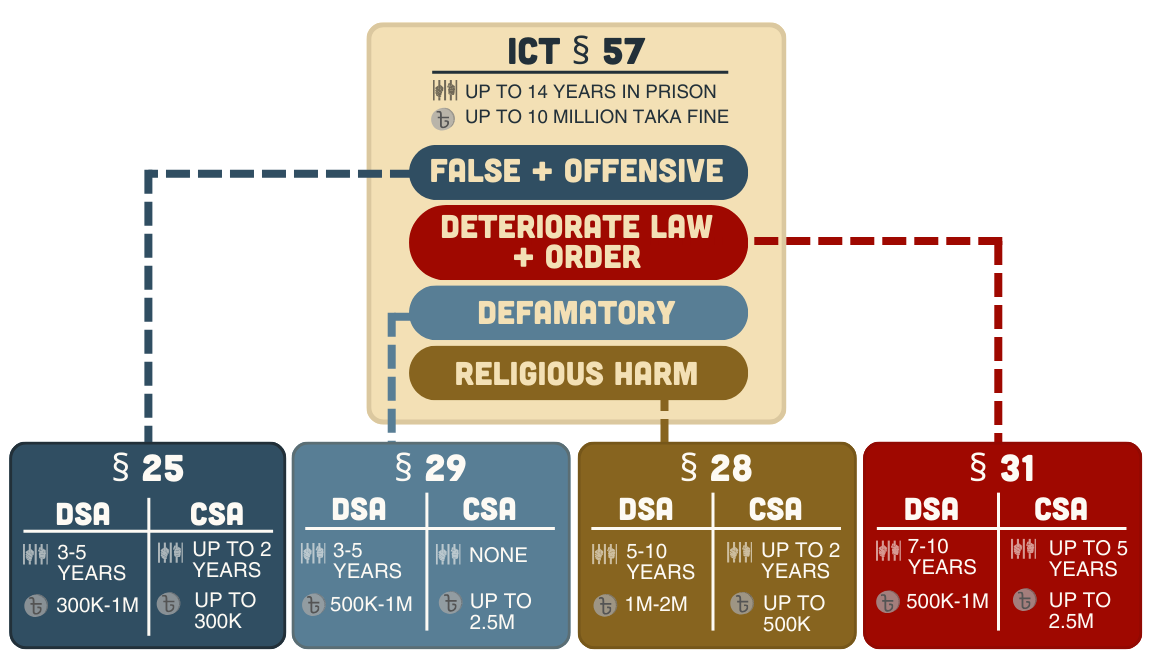
As assessed by human rights NGOs,62 the primary change in the CSA was that it reduced penalties for certain offenses.63 With respect to Section 21 of the DSA, for example, which carried a potential ten-year sentence for the dissemination of “propaganda” against Bangladesh’s Liberation War, the first president of the country, the national anthem, or the national flag, the CSA reduced the penalty to seven years.64 Similarly, the potential prison sentence for the publication or transmission of “offensive, false, or threatening” information under Section 25 was reduced from three years in the DSA to two years in the CSA, the potential prison sentence for undermining law and order under Section 31 of the DSA was reduced from seven to five years and, crucially, Section 29, the online
defamation provision, eliminated imprisonment as a penalty, providing for a fine instead.65 A mapping of the penalties under the three cybersecurity laws is below:
Furthermore, under the CSA most offenses, barring a few,66 became bailable (meaning that accused persons are entitled to bail as a right and pretrial detention is not an option)67 and non-cognizable (meaning that police officers must obtain a warrant to arrest individuals)68.
Although penalties were reduced and offenses made bailable and non-cognizable, the problematic offenses themselves were largely left in place, as seen above, leading numerous civil society organizations to deem the “CSA… essentially a renamed version
65 Id.
of the DSA, with only a few alterations in the form of reduced severity of punishments.”69 As Amnesty International has reported, “the CSA repackages almost all repressive features of the DSA (and Section 57 of the ICT Act that preceded it).”70 Given that Sections such as 21 (the criminalization of online “propaganda” against the government), 25 (the criminalization of online offensive, threatening, or false information), 28 (the criminalization of online information that harms religious values), 29 (online defamation), and 31 (the criminalization of online information that undermines law and order) remained intact, even Former Law Minister Huq acknowledged that “[the DSA] cannot be called invalid, as there are many provisions of the old law in the new one.”71
The replacement of the DSA with the CSA thus mirrored some aspects of the process by which the DSA itself repealed select provisions of the ICT Act. As discussed above, while the DSA repealed Section 57, all of the proscriptions in Section 57 were incorporated into the DSA across four separate sections.
Considering that Section 57 had accounted for 65 percent of all cases filed under the ICT Act and that subsequently this trend continued, with the number of cases filed under the related four DSA sections exceeding 1,500,72 there is significant concern about the CSA merely absorbing the problematic sections of the DSA, just like the DSA absorbed those same sections of the ICT Act.73
D. Impact of the CSA on Ongoing ICT Act Cases
Until 2023, the continuation of ICT Act cases under the repealed provisions was justified by the savings clause of the DSA.74 Section 61 of the DSA allowed for “proceedings or
cases initiated before, or taken cognizance by, the Tribunal under the repealed sections” of the ICT Act to continue if they were “pending at any stage of trial.”75
The CSA, however, repealed the DSA. It contains its own savings clause; which is limited to cases filed under the DSA and does not reference cases filed under the ICT Act. Section 59 of CSA provides: “pending cases under the said Act [DSA] in the relevant Tribunal and appeals against the order, judgment or punishment passed in similar cases in the relevant Appellate Tribunal, shall be conducted and disposed of as if the said Act [DSA] had not been repealed.”76
As explained in the legal analysis below, in the absence of a clause in the CSA “saving” ongoing cases under the repealed provisions of the ICT Act, there is no legal basis for them to continue.
E. Current Political Context
In June 2024, nationwide student protests erupted in Bangladesh after the High Court reinstated a quota system for government jobs, seen by the students as discriminatory and favoring supporters of the Awami League.77 These protests ultimately culminated in the resignation of Prime Minister Sheikh Hasina on August 5, 2024.
The protests were met with a brutal crackdown, with the police and security forces reportedly firing on protestors and using indiscriminate force, leading to the deaths of more than 1,500 people78 and thousands injured.79 On July 18, 2024, the Government imposed a nationwide shut down of broadband and mobile Internet, preventing access to
Foundation for Justice (January 2023), https://cfj.org/wp-content/uploads/2023/07/Shahidul-Alam-Fairness-Report_January-2023.pdf.
websites, social media and web-based mobile phone communications for several days.80 A curfew was imposed and the army was reportedly given “shoot at sight” orders.81 More than 2,500 people were arrested according to Amnesty International,82 with many subject to “incommunicado detention” and reporting mistreatment and even torture.83 Although the Supreme Court rolled back the proposed quota, the protests, which by then were joined by people from all walks of life, continued, demanding Prime Minister Sheikh Hasina’s resignation.84 In a “rapid and dramatic series of developments,” Prime Minister Sheikh Hasina resigned and fled Bangladesh on August 5, 2024.85 The President dissolved the Parliament the next day86 and on August 8, 2024, a civilian interim government with Nobel Laureate Professor Muhammad Yunus at its helm was appointed to oversee a transition to fresh elections.87 The interim government has promised to uphold “democracy, justice, human rights, and freedom of speech.”88
International and national organizations, such as Amnesty International,89 the American Bar Association,90 the Editors Council,91 industry bodies,92 and journalists93 have called upon the interim government to repeal the CSA and withdraw cases under the CSA and DSA. Amnesty International has in particular called on the government to “immediately release all those who remain detained under the ICT Act, DSA, CSA” and drop charges against them.94
The interim government has announced that these laws are under review95 and that the CSA, or portions of it, are likely to be repealed.96 Further, the interim government is reportedly categorising all pending cases under the three cyber laws as related to either “speech offences” (where filed for online speech) or “computer offences” (involving computer hacking or digital fraud etc.) and plans to withdraw speech offence related cases.97 The interim government has not announced when such cases will be withdrawn.
Notes
- The first iteration was the Bangladesh Telecommunication Regulation Act of 2001. See Tanim Ahmed, “The media must do more to protest oppressive laws like the CSA”, Daily Star (September 18, 2023), https://www.thedailystar.net/opinion/views/news/the-media-must-do-more-protest-oppressive-laws-thecsa-3422006. ↩
- The Information and Communication Technology Act 2006, https://samsn.ifj.org/wp-content/uploads/2015/07/Bangladesh-ICT-Act-2006.pdf [hereinafter “ICT Act”]. ↩
- The BNP government in 2004 amended the Constitution to extend the retirement age for Supreme Court judges, meaning that Chief Justice Hasan, who reportedly belonged to the BNP, could become the Chief Adviser of the Caretaker Government (CTG). The Thirteenth Amendment, which constitutionalized the CTG system in 1996, required the position of the Chief Adviser be given to the most recent past Chief Justice of the Supreme Court. See Global Security, “Caretaker Government, October 2006-January 2009”, https://www.globalsecurity.org/military/world/bangladesh/pm-ahmed.htm. ↩
- The Caretaker Government (CTG) managed general elections and served as an interim government during the transition from one elected government to another after the completion of tenure of the former. See The Lawyers and Jurists, “Caretaker Government in Bangladesh”, https://www.lawyersnjurists.com/article/caretaker-government-in-bangladesh/. ↩
- Ali Riaz, “How Bangladesh’s Digital Security Act Is Creating a Culture of Fear”, Carnegie Endowment for International Peace (December 9, 2021), https://carnegieendowment.org/2021/12/09/how-bangladesh-sdigital-security-act-is-creating-culture-of-fear-pub-85951; Bertelsmann Stiftung, “BTI Transformation Index: Bangladesh Country Report 2022”, https://bti-project.org/en/reports/country-report/BGD. 2 ↩
- Somini Sengupta, “Bangladesh Leader Declares State of Emergency”, New York Times (January 11, 2007), https://www.nytimes.com/2007/01/11/world/asia/11cnd-bengla.html. ↩
- “The coup that dare not speak its name”, The Economist (January 18, 2007), https://www.economist.com/asia/2007/01/18/the-coup-that-dare-not-speak-its-name; “BTI Transformation Index: Bangladesh Country Report 2022”, Bertelsmann Stiftung, https://bti-project.org/en/reports/countryreport/BGD. ↩
- For the 2014 election, the incumbent Awami League government did not heed the call by the opposition for the reinstatement of the CTG, and many of its candidates ran unopposed. The 2018 election also resulted in a landslide victory for the Awami League. The next general elections, held in December 2023, were widely regarded as not “free and fair.” They were preceded by violent repression and the BNP and several opposition parties boycotted the election. See Ali Riaz, “How Bangladesh’s Digital Security Act Is Creating a Culture of Fear”, Carnegie Endowment for International Peace (December 9, 2021), https://carnegieendowment.org/2021/12/09/how-bangladesh-s-digital-security-act-is-creating-culture-offear-pub-85951; Aashish Kiphayet, “Bangladesh’s National Election in 2023: The Path of Light Remains Closed”, Modern Diplomacy (April 19, 2022), https://moderndiplomacy.eu/2022/04/19/bangladeshsnational-election-in-2023-the-path-of-light-remains-closed/; “Bangladesh: An election in name only”, FIDH (International Federation for Human Rights) (January 5, 2024), https://www.fidh.org/en/region/asia/bangladesh/bangladesh-an-election-in-name-only. ↩
- See infra pgs. 13-16. ↩
- “No Place for Criticism: Bangladesh Crackdown on Social Media Commentary”, Human Rights Watch (May 9, 2018), https://www.hrw.org/report/2018/05/10/no-place-criticism/bangladesh-crackdown-socialmedia-commentary [hereinafter “HRW, No Place for Criticism”]. ↩
- “Briefing Paper on the amendments to the Bangladesh Information Communication Technology Act 2006”, International Commission of Jurists (November 2013), https://www.icj.org/wp-content/uploads/2013/11/ICT-Brief-Final-Draft-20-November-2013.pdf. ↩
- “Number of ICT cases on the rise again”, Dhaka Tribune, August 10, 2018), https://www.dhakatribune.com/bangladesh/laws-rights/152723/number-of-ict-cases-on-the-rise-again. 3 ↩
- HRW, No Place for Criticism. ↩
- “Bangladesh: Protect Freedom of Expression”, Human Rights Watch (May 9, 2018), https://www.hrw.org/news/2018/05/10/bangladesh-protect-freedom-expression. ↩
- HRW, No Place for Criticism. ↩
- Id. ↩
- Bangladesh: Protect Freedom of Expression”, Human Rights Watch (May 9, 2018), https://www.hrw.org/news/2018/05/09/bangladesh-protect-freedom-expression; see also “Bangladesh: Release Photojournalist Shahidul Alam and Stop Violations to Free Expression”, ARTICLE19 (August 7, 2018), https://www.article19.org/resources/bangladesh-release-photojournalist-shahidul-alam-and-stopviolations-to-free-expression. 19 of the ICCPR.” See id., pgs. 5-7. ↩
- HRW, No Place for Criticism. ↩
- The DSA repealed five provisions from the “Offences and Penalties” part of the ICT Act, namely, Sections 54, 55, 56, 57 and 66 of the ICT Act. See Sajidul Haque, “Bangladesh Passes Digital Security Act Ignoring Concerns It Will Muffle Media”, BDNEWS24 (September 19, 2018), https://bdnews24.com/bangladesh/bangladesh-passes-digital-security-act-ignoring-concerns-it-will-mufflemedia. ↩
- UN Human Rights Council, “Bangladesh National Report Submitted in Accordance with Paragraph 5 of the Annex to Human Rights Council Resolution 16/21”, U.N. Doc. A/HRC/WG.6/30/BGD/1, February 26, 2018, para. 33. 4 ↩
- HRW, No Place for Criticism. ↩
- Id. See also Faisal Mahmud, “Bangladesh Enacts New Law That Could Silence Dissenters”, The Diplomat (October 10, 2018), https://thediplomat.com/2018/10/bangladesh-enacts-new-law-that-couldsilence-dissenters/. ↩
- Ali Riaz, “How Bangladesh’s Digital Security Act Is Creating a Culture of Fear”, Carnegie Endowment for International Peace (December 9, 2021), https://carnegieendowment.org/2021/12/09/how-bangladeshs-digital-security-act-is-creating-culture-of-fear-pub-85951; Arafatul Islam, “Why Bangladesh protests are not just about road safety”, DW (August 8, 2018), https://www.dw.com/en/why-bangladesh-studentprotests-are-not-just-about-road-safety/a-45007297. ↩
- “Factbox: Bangladesh’s broad media laws”, Reuters (December 12, 2018), https://www.reuters.com/article/bangladesh-election-media-idINKBN1OC09I. ↩
- Ali Riaz, “How Bangladesh’s Digital Security Act Is Creating a Culture of Fear”, Carnegie Endowment for International Peace (December 9, 2021), https://carnegieendowment.org/2021/12/09/how-bangladeshs-digital-security-act-is-creating-culture-of-fear-pub-85951. ↩
- Section 61 of the DSA states “[u]pon the commencement of this Act, the sections 54, 55, 56, 57 and 66 of the [ICT Act], hereinafter referred to in this section as repealed sections, shall be repealed.”, Digital Security Act, 2018, https://www.cirt.gov.bd/wp-content/uploads/2020/02/Digital-Security-Act-2020.pdf [hereinafter “DSA”]. ↩
- Ali Riaz, “How Bangladesh’s Digital Security Act Is Creating a Culture of Fear”, Carnegie Endowment for International Peace (December 9, 2021), https://carnegieendowment.org/2021/12/09/how-bangladeshs-digital-security-act-is-creating-culture-of-fear-pub-85951. 5 ↩
- DSA, Sections 25, 28, 29, 31; ICT Act, Section 57. 6 ↩
- “Factbox: Bangladesh’s broad media laws”, Reuters (December 12, 2018), https://www.reuters.com/article/bangladesh-election-media-idINKBN1OC09I. ↩
- Faisal Mahmud, “Bangladesh Editors Protest ‘Chilling’ Digital Security Act”, Al Jazeera (October 16, 2018), https://www.aljazeera.com/news/2018/10/16/bangladesh-editors-protest-chilling-digital-securityact. ↩
- “OHCHR Technical Note to the Government of Bangladesh on review of the Digital Security Act”, OHCHR (June 2022), https://www.ohchr.org/sites/default/files/documents/countries/bangladesh/OHCHR-Technical-Note-on-review-of-the-Digital-Security-Act-June-2022.pdf. ↩
- See id., pgs. 1-5. ↩
- For example, OHCHR stated that the Bangladesh Telecommunications and Regulatory Commission “can be requested by the law … to remove or block ‘any data-information published or propagated in digital media that hampers the solidarity, financial activities, security, defence, religious values or public discipline of the country or any part thereof or incites racial hostility and hatred’ [and noted that these] formulations allow restrictions that go considerably beyond what is considered permissible under article ↩
- See id., pg. 7. Sections 25 and 29 were made bailable but cognizable, meaning that police could still conduct arrests without a warrant. ↩
- Specifically, Sections 8, 25, 27, 29, 31, 32, 43, and 53 of the DSA. See id. ↩
- See id., pgs. 1-7. 7 ↩
- “Bangladesh: Türk urges immediate suspension of Digital Security Act as media crackdown continues”, OHCHR (March 31, 2023), https://www.ohchr.org/en/press-releases/2023/03/bangladesh-turk-urgesimmediate-suspension-digital-security-act-media. ↩
- Id. ↩
- See, e.g., Ali Riaz, “How Bangladesh’s Digital Security Act Is Creating a Culture of Fear”, Carnegie Endowment for International Peace (December 9, 2021), https://carnegieendowment.org/2021/12/09/how-bangladesh-s-digital-security-act-is-creating-culture-offear-pub-85951; Zillur Rahman, “The new CSA: A draconian law made more ‘efficient’”, The Daily Star (August 24, 2023), https://www.thedailystar.net/opinion/views/news/the-new-csa-draconian-law-mademore-efficient-3401151; Bilal Hussain, “Advocates Question Whether Reforms Will Offer Bangladesh Media Greater Protection”, VOA News (August 18, 2023), https://www.voanews.com/a/advocates-question-whether-reforms-will-offer-bangladesh-media-greater-protection/7231154.html. ↩
- “The Ordeal: Five Years of the Digital Security Act, 2018-2023”, Centre for Governance Studies (April 2024), https://cgs-bd.com/cms/media/documents/e7678484-19ac-4716-8224-be3f706bfa66.pdf. ↩
- See, id., pg. 18 ↩
- “86pc DSA cases pending disposal: law minister”, The Daily Star (September 10, 2023), https://www.thedailystar.net/news/bangladesh/news/86pc-dsa-cases-pending-disposal-law-minister-3415241. 8 ↩
- Section 61 of the DSA states that “The proceedings or cases initiated before, or taken cognizance by, the Tribunal under the repealed sections … shall, if pending at any stage of trial, continue as if the said sections had not been repealed.” ↩
- Freemuse, Drik and PEN International, “Joint Submission to the mid-term Universal Periodic Review of Bangladesh by Freemuse, Drink, and PEN International”, (December 4, 2020), https://www.ohchr.org/sites/default/files/Documents/HRBodies/UPR/NGOsMidTermReports/Freemuse-Drik-PEN-International-Bangladesh.pdf; see also CIVICUS, “Bangladesh: Drop charges against Odhikar Leadership & Stop Harassment of Human Rights Defenders”, (December 15, 2021), https://www.civicus.org/index.php/media-resources/news/5517-bangladesh-stop-harassment-of-humanrights-defenders. ↩
- “Photojournalist in Bangladesh Facing 14 Years for Charges Under a Law That No Longer Exists”, Clooney Foundation for Justice (January 30, 2023), https://cfj.org/news/photojournalist-in-bangladeshfacing-14-years-for-charges-under-a-law-that-no-longer-exists. See also Saad Hammadi, “We don’t want more people in jail for their posts on the internet”, The Daily Star (August 11, 2023), https://www.thedailystar.net/opinion/views/news/we-dont-want-more-people-jail-their-posts-the-internet-3391196. ↩
- See TrialWatch Fairness Report, Bangladesh v. Shahidul Alam, Clooney Foundation for Justice (January 2023), https://cfj.org/wp-content/uploads/2023/07/Shahidul-Alam-Fairness-Report_January-2023.pdf. ↩
- HRW, No Place for Criticism. ↩
- “Number of ICT cases on the rise again”, Dhaka Tribune, August 10, 2018), https://www.dhakatribune.com/bangladesh/laws-rights/152723/number-of-ict-cases-on-the-rise-again. ↩
- “Speech offence cases under cyber laws to be withdrawn, arrestees to be released”, Dhaka Tribune (September 30, 2024), https://www.dhakatribune.com/bangladesh/crime/360234/speech-offence-casesunder-cyber-laws-to-be. 9 ↩
- Faisal Mahmud, “Bangladesh to tone down ‘draconian’ digital security law”, Al Jazeera (August 7, 2023), https://www.aljazeera.com/news/2023/8/7/bangladesh-to-tone-down-draconian-digital-security-law. ↩
- Nusmila Lohani, “DSA has a new name: CSA”, TBS News (September 15, 2023), https://www.tbsnews.net/features/panorama/dsa-has-new-name-csa-700830. ↩
- Nowzin Khan, “From DSA to CSA: The same two bottles of agony”, The Daily Star (August 26, 2023), https://www.thedailystar.net/opinion/views/news/dsa-csa-the-same-two-bottles-agony-3403566. ↩
- Nusmila Lohani, “DSA has a new name: CSA”, TBS News (September 15, 2023), https://www.tbsnews.net/features/panorama/dsa-has-new-name-csa-700830. ↩
- Id.; “Bangladesh: Government must remove draconian provisions from the Draft Cyber Security Act”, Amnesty International (August 31, 2023), https://www.amnesty.org/en/latest/news/2023/08/bangladeshgovernment-must-remove-draconian-provisions-from-the-draft-cyber-security-act. ↩
- Ali Asif Shawon, “Why was there such a rush to pass the Cyber Security Bill?”, Dhaka Tribune (September 16, 2023), https://www.dhakatribune.com/bangladesh/325432/why-was-there-such-a-rush-topass-the-csa-bill. ↩
- Id.; Nowzin Khan, “From DSA to CSA: The same two bottles of agony”, The Daily Star (August 26, 2023), https://www.thedailystar.net/opinion/views/news/dsa-csa-the-same-two-bottles-agony-3403566. ↩
- Ali Asif Shawon, “Why was there such a rush to pass the Cyber Security Bill?”, Dhaka Tribune (September 16, 2023), https://www.dhakatribune.com/bangladesh/325432/why-was-there-such-a-rush-topass-the-csa-bill. 10 ↩
- Faisal Mahmud, “Bangladesh to tone down ‘draconian’ digital security law”, Al Jazeera (August 7, 2023), https://www.aljazeera.com/news/2023/8/7/bangladesh-to-tone-down-draconian-digital-security-law. ↩
- See “Govt replacing DSA with CSA to fool people, says BNP”, NewAge (August 8, 2023), https://www.newagebd.net/article/208873/govt-replacing-dsa-with-csa-to-fool-people-says-bnp; “Cyber Security Act: Same product, different package?”, TBS (August 8, 2023), https://www.tbsnews.net/bangladesh/cyber-security-act-same-product-different-package-679274. ↩
- “Digital Security Act 2018 and the draft Cyber Security Act 2023: A Comparative Analysis”, Transparency International Bangladesh (August 30, 2023), https://www.ti-bangladesh.org/articles/position-paper/6752; “Bangladesh: Open letter to the government: Feedback on proposed ‘Cyber Security Act’”, Amnesty International (August 22, 2023), https://www.amnesty.org/en/documents/asa13/7125/2023/en. ↩
- Id.; See also Nusmila Lohani, “DSA has a new name: CSA”, TBS News (September 15, 2023), https://www.tbsnews.net/features/panorama/dsa-has-new-name-csa-700830. ↩
- “Repackaging Repression: The Cyber Security Act and the continuing lawfare against dissent in Bangladesh”, Amnesty International (August 18, 2024), https://www.amnesty.org/en/documents/asa13/8332/2024/en/. 11 ↩
- Sections 17, 19, 27, and 33 of the CSA, which proscribe unlawful access to critical information infrastructure, damage to computers and computer systems, cyberterrorism, and hacking respectively are cognizable and non-bailable. ↩
- “Parliament passes Cyber Security Bill 2023”, Dhaka Tribune (September 13, 2023), https://www.dhakatribune.com/bangladesh/325228/parliament-passes-cyber-security-bill-2023. ↩
- Under Section 42 of the CSA, police officers can still arrest individuals without a warrant where there are “reasons to believe that an offence under this Act has been or is being committed, or is likely to be committed in any place, or any evidence is likely to be lost, destroyed, deleted or altered or made unavailable in any way.” 12 ↩
- “Digital Security Act 2018 and the draft Cyber Security Act 2023: A Comparative Analysis”, Transparency International Bangladesh (August 30, 2023), https://www.ti-bangladesh.org/articles/position-paper/6752. ↩
- “Repackaging Repression: The Cyber Security Act and the continuing lawfare against dissent in Bangladesh”, Amnesty International (August 18, 2024), https://www.amnesty.org/en/documents/asa13/8332/2024/en/. ↩
- “No jail terms in defamation cases, old cases to continue”, Dhaka Tribune (August 7, 2023), https://www.dhakatribune.com/bangladesh/321828/minister-no-jail-terms-in-defamation-cases-under. ↩
- Zillur Rahman, “The new CSA: A draconian law made more ‘efficient’”, The Daily Star (August 24, 2023), https://www.thedailystar.net/opinion/views/news/the-new-csa-draconian-law-made-more-efficient-3401151. ↩
- Nowzin Khan, “From DSA to CSA: The same two bottles of agony”, The Daily Star (August 26, 2023), https://www.thedailystar.net/opinion/views/news/dsa-csa-the-same-two-bottles-agony-3403566; “Cyber Security Act: Same product, different package?”, TBS News (August 8, 2023), https://www.tbsnews.net/bangladesh/cyber-security-act-same-product-different-package-679274. ↩
- In some cases, the continuation of proceedings under the ICT Act is not even justified by the savings clause of the DSA, since the clause saved only those cases that have reached a particular stage. The continuation of ICT Act cases that had not reached that stage, as in the case of Shahidul Alam, appears to be contrary to the DSA itself. See TrialWatch Fairness Report, Bangladesh v. Shahidul Alam, Clooney 13 ↩
- DSA, Section 61. ↩
- Section 59(2), Cyber Security Act, 2023. Unofficial translation. ↩
- The High Court reinstated a quota system reserving 30% of government jobs for descendants of veterans of Bangladesh’s war of independence, an important constituency for the Awami League. This quota system was abolished in October 2018 after massive protests, but this decision was challenged, resulting in the High Court decision that sparked the protests. See “Preliminary Analysis of Recent Protests and Unrest in Bangladesh, Office of the United Nations High Commissioner for Human Rights (OHCHR) (August 16, 2024), https://www.ohchr.org/sites/default/files/2024-08/OHCHR-Preliminary-Analysis-of-Recent-Protests-and-Unrest-in-Bangladesh-16082024_2.pdf [hereinafter “OHCHR Bangladesh Report”], pg. 4. ↩
- “Total death toll in mass upsurge 1581, says health sub-committee”, The Financial Express (September 29, 2024), https://today.thefinancialexpress.com.bd/last-page/total-death-toll-in-mass-upsurge-1581-sayshealth-sub-committee-1727543244. ↩
- Harindrini Corea and Nazia Erum, “What is happening at the quota-reform protests in Bangladesh”, Amnesty International (July 29, 2024), https://www.amnesty.org/en/latest/news/2024/07/what-ishappening-at-the-quota-reform-protests-in-bangladesh/. 14 ↩
- OHCHR Bangladesh Report; Harindrini Corea and Nazia Erum, “What is happening at the quota-reform protests in Bangladesh”, Amnesty International (July 29, 2024), https://www.amnesty.org/en/latest/news/2024/07/what-is-happening-at-the-quota-reform-protests-inbangladesh/. ↩
- “Bangladesh top court scraps most quotas that caused deadly unrest”, Al Jazeera (July 21, 2024), https://www.aljazeera.com/news/2024/7/21/bangladesh-court-scraps-most-job-quotas-that-causeddeadly-unrest-reports. ↩
- Harindrini Corea and Nazia Erum, “What is happening at the quota-reform protests in Bangladesh”, Amnesty International (July 29, 2024), https://www.amnesty.org/en/latest/news/2024/07/what-ishappening-at-the-quota-reform-protests-in-bangladesh/. ↩
- OHCHR Bangladesh Report, pg. 7. ↩
- “Bangladesh top court scraps most quotas that caused deadly unrest”, Al Jazeera (July 21, 2024), https://www.aljazeera.com/news/2024/7/21/bangladesh-court-scraps-most-job-quotas-that-causeddeadly-unrest-reports. ↩
- OHCHR Bangladesh Report, pg. 3. ↩
- Redwan Ahmed, “Bangladesh parliament dissolved a day after resignation of prime minister”, The Guardian (August 6, 2024), https://www.theguardian.com/world/article/2024/aug/06/bangladesh-studentprotesters-to-meet-with-army-chief-after-pm-resigns. ↩
- Ruma Paul, “Nobel laureate Yunus takes charge of Bangladesh, hopes to heal strife-torn country”, Reuters (August 8, 2024), https://www.reuters.com/world/asia-pacific/bangladesh-awaits-installationinterim-government-after-weeks-strife-2024-08-08/. ↩
- “Election after vital reforms: Chief Adviser to Bangladesh interim government”, Asia News Network (August 19, 2024), https://asianews.network/election-after-vital-reforms-chief-adviser-to-bangladeshinterim-government/. 15 ↩
- “Bangladesh: Interim Government must restore freedom of expression in Bangladesh and repeal Cyber Security Act”, Amnesty International (August 8, 2024), https://www.amnesty.org/en/latest/news/2024/08/bangladesh-interim-government-must-restore-freedomof-expression-in-bangladesh-and-repeal-cyber-security-act/. ↩
- “Bangladesh: Flawed Cybercrime Regime Requires Repeal or Reform”, American Bar Association Center for Human Rights (September, 2024), https://www.americanbar.org/content/dam/aba/administrative/human_rights/justicedefenders/bangladesh-flawed-cybercrime-regime.pdf. ↩
- “Scrap cases under CSA, DSA against journalists: demands Editors Council”, The Daily Star (August 13, 2024), https://www.thedailystar.net/news/bangladesh/news/scrap-cases-under-csa-dsa-againstjournalists-3675766. ↩
- BASIS urges interim govt to repeal CSA”, NewAge (August 10, 2024), https://www.newagebd.net/post/country/242148/basis-urges-interim-govt-to-repeal-csa. ↩
- Redwan Ahmed and Kaamil Ahmed, “Bangladeshi journalists hopeful of press freedom as Hasina era ends”, The Guardian (August 9, 2024), https://www.theguardian.com/global-development/article/2024/aug/09/bangladeshi-journalists-hopeful-for-return-to-press-freedom-as-hasinaera-ends. ↩
- “Bangladesh: Interim Government must restore freedom of expression in Bangladesh and repeal Cyber Security Act”, Amnesty International (August 8, 2024), https://www.amnesty.org/en/latest/news/2024/08/bangladesh-interim-government-must-restore-freedomof-expression-in-bangladesh-and-repeal-cyber-security-act/. ↩
- “Asked not to arrest in cybercase: Nahid Islam”, DW (September 27, 2024), https://www.dw.com/bn/সাইবার-মামলায়-গ্রেপ্তার-না-করতে-বলা-হতয়তে-নাহহদ-ইসলাম/a-70348612. ↩
- “Cyber Security Act is being repealed: Asif Nazrul”, Prothomalo (October 3, 2024), https://www.prothomalo.com/bangladesh/edlki78nav. ↩
- “Speech offence cases under cyber laws to be withdrawn, arrestees to be released”, Dhaka Tribune (September 30, 2024), https://www.dhakatribune.com/bangladesh/crime/360234/speech-offence-casesunder-cyber-laws-to-be. 16 ↩