

Research & publications Web edition
The Curfew Days
20th July, 2024
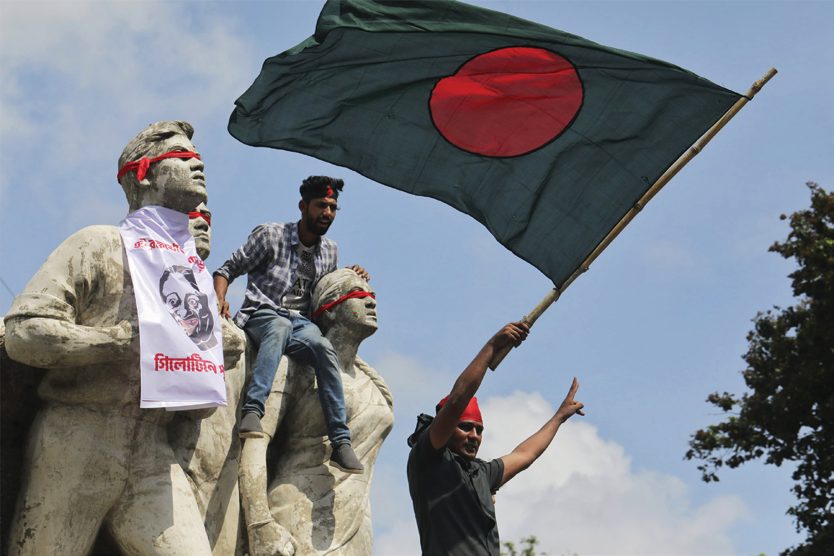
Nationwide curfews and internet blackouts leave the citizens in the dark with a major economic hit. The television media propagated normalcy regarding the whole situation. Despite the curfew, many people defied orders, leading to clashes with law enforcement and military personnel. At least 24 more people were killed on Saturday, bringing the death toll from the protests over job quota reforms to 136 in five days, including 3 journalists. Clashes occurred in Dhaka, Savar, Narsingdi, and Gazipur, and many were injured. The government announced a two-day general holiday on Sunday and Monday and relaxed the curfew for two hours to tighten the grip. DMP reported 267 injured officers between Tuesday and Friday. Arrests were made in Chattogram, and demonstrations occurred in multiple districts, including Khulna, Barishal, Pabna, and Kishoreganj. On the 20th of July, government-enforced disappearances started to happen allegedly by the detective branch (DB) of police along with arresting renowned politicians of BNP-Jamaat. According to New Age, two of the movement’s coordinators Nahid Hasan and Asif Mahmud went missing. Plain clothed DB police picked up Nahid around 3 AM from the capital’s Sabujbagh area. However, no whereabouts were found regarding Asif Mahmud’s disappearance. DB Police arrested BNP standing committee member Amir Khasru Mahmud Chowdhury. He was picked up from his home around 10 pm. Earlier in the day, a Dhaka court placed BNP standing committee member Nazrul Islam Khan and the party’s Senior-Joint Secretary General Ruhul Kabir Rizvi on one-day remands each in a violence case filed with Paltan Police Station. Alongside the BNP leaders, Nurul Haque Nur, convener of the Gono Odhikar Parishad and one of the joint convenors of the 2018 quota reform movement was reportedly taken from his Uttara home by law enforcers. His wife, Maria Nur, stated that the front door was broken down and that the men wore uniforms of Rab, DB, and police. Despite her inquiries at the DB office, officials denied arresting him. The helicopters kept hovering over the capital’s sky to patrol the city throughout the day and the citizens lived another day without the internet in Digital Bangladesh filled with fear.
21th July, 2024
Amid the nationwide curfew on 21st July, the Appellate Division of the Supreme Court operated with heavy security to scrap HC’s verdict on government job quotas and established a new quota system: 5% for children of freedom fighters, 1% for national minorities, and 1% for people with disabilities and third genders. The clashes continued country-wide despite the curfew across the country. Citizens defined the restrictions and went on the street along with the protestors. Ongoing protests in Dhaka and other areas led to significant violence and casualties, with at least 13 people killed on Sunday. The Students’ Movement Against Discrimination platform curfew and urged the people to continue the ‘Complete Shutdown’ programme and hold Funeral Prayers. The platform also claimed that at least three of their coordinators had disappeared along with Nahid and Asif. After 24 hours after Nahid’s disappearance, he found himself battered under a bridge in Purbachal and later went to Gonoshastho Kendre Hospital for treatment. He stated that around 25 DB police picked him up blindfolded and handcuffed. They physically tortured him until he collapsed and threw him under the bridge after he lost consciousness. According to Prothom Alo, 34 cases were filed for arson, vandalism, and attack on police alone in Dhaka. Most of the plaintiffs in these cases were anonymous and the number crossed 61,000. 27 cases among the pile were filed by police in the capital’s 8 police stations including Mirpur, Pallabi, Kafrul, Rampura, Badda, Banani, Jatrabari, and West Uttara. The filed cases foreshadowed an upcoming systematic police crackdown on students or whomever they can get their hands on. The crackdown and arrests of BNP leaders advanced with the number of deaths of the protesters. Over the weekend, several leaders, including Amanullah Aman, Sultan Salauddin Tuku, Aminul Haque, and Nipun Roy, were arrested in the capital. Additionally, law enforcement agencies conducted searches at the residences of BNP leader Moazzem Hossain Alal and the missing BNP leader Ilias Ali. On Sunday, a Dhaka metropolitan magistrate court placed BNP leaders Amir Khasru, Sultan Salauddin Tuku, and Nipun Roy Chowdhury on a three-day remand in a case filed with the Rampura police station. Later that day the magistrate court also placed one-day remand on BNP’s standing committee member Nazrul Islam Khan with one-day remand. The last time BNP leaders faced a police crackdown was before the 2024 election.
On the other hand, the internet blackout slams the citizens of Bangladesh into suffering as most utility services are acclaimed via using online platforms. Apart from digital public services, the freelancer community faced a great economic loss due to
no broadband access for 3 days. The DMP Inspector General Abdullah Al Mamun stated that the BNP-Jamat is using the student movement as a shield to make the protest violent. Home Minister Asaduzzaman Khan declared that the curfew will be continued with relaxed hours until the situation gets back to normal.
22th July, 2024
The ongoing curfew and internet blackout brought great economic loss to the country along with the lives of the students. The premier held a meeting with businessmen at the PM’s office on 21st July. In that meeting, business leaders urged the government to reopen factories and restore internet connections to resume export and import activities. The PM assured that the government would allow the reopening of factories once the situation turned normal. Apart from assurance, the premier also states that BNP and its ally Jamat are using the movement as a shield to spread anarchy. Business leaders expressed solidarity with the Prime Minister. During the meeting, the majority of business leaders lauded the prime minister’s leadership, attributing it to the creation of a business-friendly and investment-conducive environment in the country. The business leaders have created a nexus with the government over the past 16 years that has allowed them to benefit from the current administration. They expressed unwavering support for her continued tenure, emphasizing its importance for Bangladesh’s progress. Information Minister Mohammad Ali Arafat stated that the government was forced to take a violent approach to the protest since the movement had been hijacked by BNP and Jamat. He also delivered a preposterous statement during the business meeting saying, ‘Look at their dress-up, approach and attitude,’ adding that some of the attackers were drugged. After five days of intense clashes surrounding the student movement for quota reform, the military and police took control of the Shimrail-Chittagong road area from Dhaka’s Jatrabari to the Dhaka-Chittagong highway. Chief of Army Staff General Waqar-uz-Zaman and Inspector General of Police Chowdhury Abdullah Al-Mamun, visited the area, emphasizing the need for cooperation to restore normalcy. The coordinators of the anti-discrimination student movement gave a 48-hour ultimatum to the government at 10 PM on Sunday with a new 4-point demand, which will end at 10 PM on Tuesday while the 9-point demand was still in force. The four-point demands include:
1. Restoration of internet connectivity, 2. Reopening of dormitories by making arrangements for students to return to the hall 3. Ensuring security for movement coordinators and 4. Lifting of curfew.
A joint statement titled ‘Joint Statement of 56 Coordinators of the Anti- Discrimination Student Movement on the Prevailing Situation in the Country’ was released to the media. The statement asserted that the government cannot evade responsibility for the murders solely through court verdicts. It accused the government of ongoing repression against students involved in the quota reform movement, alleging over 300 deaths. However, one of the coordinators Sargis Alam denied any such program being informed to the media in favor of the anti-discrimination student movement. Meanwhile, the crackdown on BNP leaders and some anonymous sabotaged cases kept adding up in the capital and Chittagong. Prothom Alo reported that another 37 cases have been filed against anonymous people at 12 police stations in Dhaka. 478 people have been arrested in Chattogram since 16th July in which a major portion of the arrested people are from BNP.
23rd July, 2024
After 4 days of rigorous curfew, violent clashes, and internet blackout, the government declared the reopening of government and private offices, banks, and factories for a limited schedule as it appears the situation of the whole movement is heading toward normalcy. Broadband internet services in Bangladesh resumed on a limited scale after a five-day shutdown. Zunaid Ahmed Palak announced the phased restoration and stated that full internet service would resume soon. Priority for emergency services, financial and business institutions, media, and other critical sectors to get internet access. On the contrary to the government’s effort to portray the situation as normal, the death toll rose to 197 on Tuesday. BNP Secretary General Mirza Fakhrul Islam Alamgir alleged that the Awami League government was destroying the evidence of killings and attacks. The families of the disappeared started visiting morgues in the hope of finding their loved ones’ dead bodies. The anti-discrimination student movement held a press conference at Dhaka Reporters’ Unity (DRU) auditorium on Tuesday afternoon and reiterated the 4-point demand. Sarjis Alam stated at the press conference that a 9-point demand was made to government representatives, followed by 4 urgent demands two days ago. If these four demands are not met, the remaining 9 demands cannot be discussed. Despite a two-day ultimatum, no response has been received. A renewed two-day ultimatum is given to meet the four urgent demands. The end of the movement depends entirely on the government’s actions. Asif Mahmud, Abu Baker Majumder, and Rifat Rashid, one of the coordinators of the anti-discrimination student movement, have been missing since July 18. Among them, Asif’s father Billal Hossain was present at the press conference. The arrest spree continued with law enforcement agencies arresting 2,500 people, including political leaders, activists, and ordinary citizens, in response to violent student protests. News of people getting picked up from police and BGB checkposts in the streets from acquaintances left people in fear of going out even after the government eased up the curfew. Many of the arrested individuals face charges of sabotage, vandalism, and arson, with cases filed under the Special Powers Act 1974.