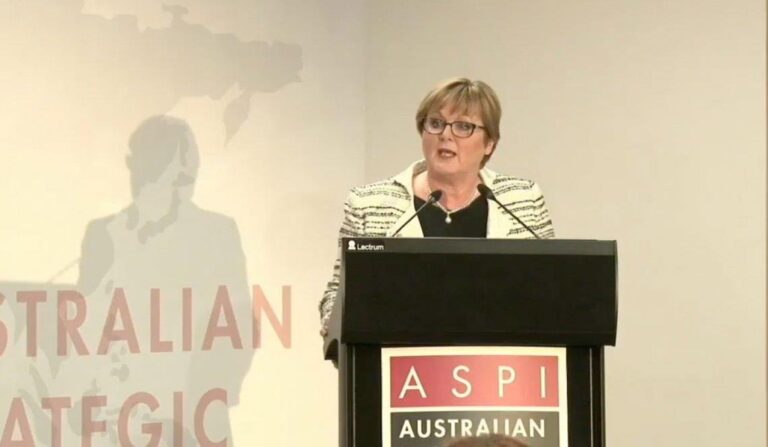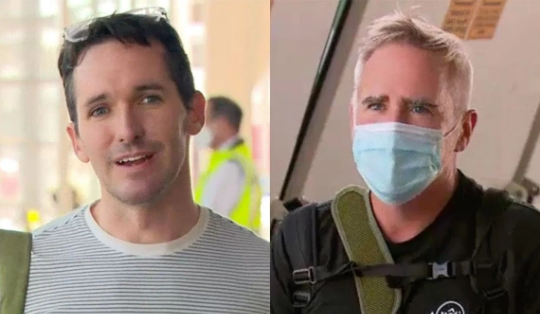
Foreign Minister Marise Payne is remaining diplomatic despite China’s provocative move to interrogate two Australian journalists – ABC correspondent Bill Birtles and AFR’s Mike Smith – who have landed home safely after an extraordinary stand-off. As the ABC reports, the saga began early last week, after Chinese authorities claimed the two journalists were persons of interest. The news follows the shocking detention of another Australian journalist, Cheng Lei, who worked for China’s state broadcaster CGTN. “This is a very disappointing series of events,” Payne told 2GB this afternoon, adding, “We will continue to work, in a bilateral sense, guided by our national interest. We will deal with individual issues as they arise, as they have done here.” Nevertheless, the deterioration of Australia’s relationship with China this year – from a war of words over a World Health Organization inquiry into the origins of the pandemic, to claims of “economic coercion” as China put up trade barriers against Australian goods, to the arbitrary detention of Australian citizens – is downright alarming. Australian government ministers cannot place a phone call to their Chinese counterparts, and Australian media organisations have no journalists on the ground in China for the first time since the 1970s. Australians are officially advised against travelling to visit our largest trading partner, and warned they are at risk of arbitrary detention – a situation that cannot last.
In a statement today, shadow foreign minister Penny Wong was equally restrained, citing a recent speech by the Chinese embassy’s deputy head of mission, Wang Xining, in which he called for “mutual respect” between the two countries. “The media plays a vital role in fostering this respect by deepening understanding, which is vital for a productive relationship,” Wong said. “It is deeply regrettable that there is now no Australian media presence in China. We hope that Australian media organisations will be able to have their people on the ground in China again soon.” At a doorstop press conference in Adelaide today, Wong was asked whether Australia should retaliate in kind, by revoking the visas of journalists from Chinese state-owned media working in Australia. “I think if we are consistent, our position is journalists should be able to undertake your work safely and freely,” answered Wong, “and that is an Australian principle to which we all hold dear.”
For all the diplomacy, we get no sense from the Morrison government of where the Australia–China relationship is heading. Amid naked hostility between the US and China (most recently Attorney General William Barr told Congress that China was a more serious threat to the integrity of November’s presidential election than Russia), Australia has all but picked sides. A group of Coalition and Labor back benchers known as “the Wolverines” stir the anti-communist pot while the US-funded Australian Strategic Policy Institute dominates media commentary. At the same time, the fate of China under the dictatorship of President Xi Jinping grows ever-more frightening. It is a lose-lose situation.
“It’s very disappointing to have to leave under those circumstances,” Birtles said pointedly today, “and it’s a relief to be back in a country with a genuine rule of law.” While Birtles and Smith are safe (and news director Gaven Morris pointed out that ABC staff remain on the ground in other roles), Cheng remains in detention. Minister Payne said that embassy officials had been able to visit her once.
The Media Entertainment and Arts Alliance has expressed outrage at China’s heavy-handed treatment of the Australian journalists, saying Cheng’s secret detention was particularly worrying. “It is clear that China, and by extension Hong Kong through the recent National Security Law, is unsafe for foreign journalists,” said federal president Marcus Strom. “These outrageous attacks on press freedom place any foreign correspondents reporting from China at risk. China is isolating itself from the world’s gaze and demonstrating it will not brook any scrutiny of its activities. It threatens and intimidates journalists using ‘national security’ as a catch-all excuse. This is an extremely disappointing development. It has come swiftly, it is extremely aggressive and it will do great harm to China’s reputation around the world.”
Australia would be much better placed to complain to China if our own free press credentials were stronger. Marise Payne has been silent on the plight of another Australian, Wiki Leaks founder Julian Assange, now on trial in the UK for the crime of journalism and facing 175 years in jail if the US succeeds in extraditing him. Meanwhile, a brief for the criminal prosecution of ABC investigative reporter Dan Oakes languishes on Attorney-General Christian Porter’s desk, waiting on his decision as the weeks roll by, and the secret trial of whistleblower Witness K and his lawyer Bernard Collaery grinds on. The recent recommendations of the Parliamentary Joint Committee on Intelligence and Security on press freedom are charitably described as an opportunity missed. If only it rang truer when Payne says, as she did today, that Australia is a strong advocate of freedom of the press.
Paddy Manning is contributing editor (politics) at The Monthly and has worked for the ABC, Fairfax, Crikey and The Australian.
This article was originally published on The Monthly.
Views in this article are author’s own and do not necessarily reflect CGS policy.