Paddy Manning
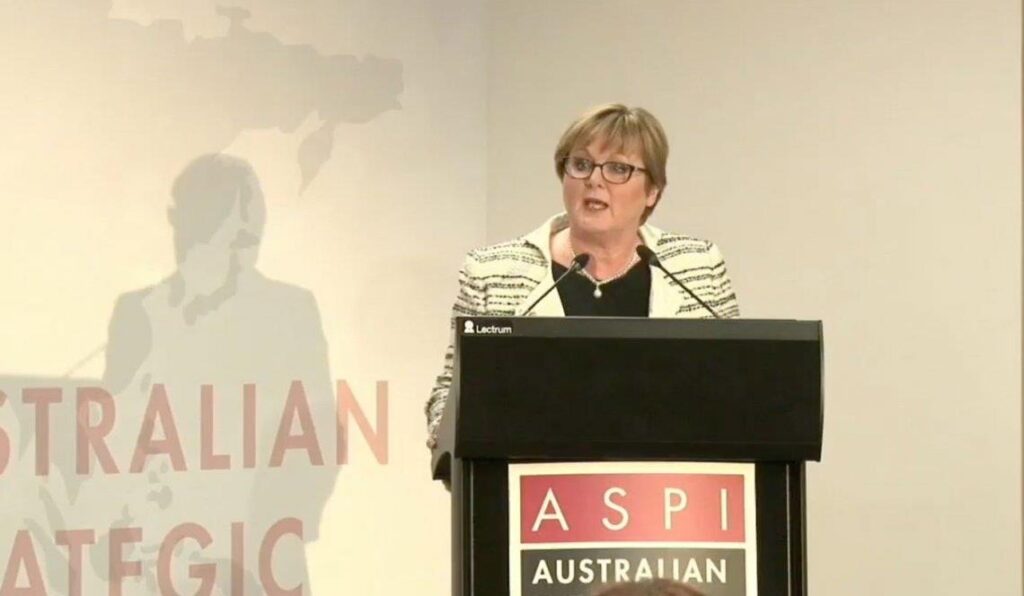
Notwithstanding another beat-up [$] in advance of her speech, Defence Minister Linda Reynolds was surprisingly reassuring as she talked about the government’s $270 billion strategic update at the Australian Strategic Policy Institute today. Far from focusing on what ASPI executive director Peter Jennings called the “fun” stuff – new military hardware – Reynolds spoke about the importance of defence diplomacy, building regional relationships (including among ASEAN countries), and increasing transparency and accountability in procurement. “The world that we grew up in is no more,” said Reynolds during questions, referring obliquely to the end of postwar American dominance of our region and the rise of China. She added that this was “not necessarily a bad thing … but we have to define a new, rules-based order and encourage, very strongly, all major state actors to accord with these rules”. Reynolds was flanked by her departmental secretary, Greg Moriarty, and Australian Defence Force chief General Angus Campbell, and there was an encouraging focus on the history of Australia’s engagement with the region, from the navy aiding Samoa in the 1918–19 Spanish influenza pandemic to military exercises with Indonesia, which has strongly welcomed Australia’s strategic update.
Reynolds – an Army Reservist for almost 30 years and the first woman to achieve the rank of brigadier – was always an interesting pick for the defence portfolio. Her influence is apparent in the new strategic update, which signals a more aggressive posture and invests heavily, but is also squarely focused on our region. “I knew that defence diplomacy was important before I took this role,” Reynolds said today, “but it is very clear to me now just how critically important our relationships are.” In her first few months as minister, Reynolds met with counterparts in 16 other countries and hosted meetings with six countries here in Australia, and she has held virtual meetings since then with more than 30 countries. “It’s not just us worried by the behaviours that we’re now seeing in our region,” she said. “Other regional friends are now coming out more consistently, but really significantly, if you have a look at last week – the secretary-general of NATO came out and very strongly indicated that what happens in our region matters to NATO a lot, as has the president of the EU.”
Also discussed was the “grey zone” between war and peace, and how economic coercion and the increasing threat of cyber-attacks from China or other countries fall in this category. Campbell said the focus of Defence was on ways of imposing costs on activities that breach the rules-based order, saying Australia had to “think grey” if it was to effectively “respond to grey”. Reynolds described our Defence Cooperation Program of military-to-military activities with other Indo-Pacific nations as the “jewel in the crown”, and said one of the best ways to build relations was by sharing some of the information Australia has with our partners – giving them a dose of “the old sunlight” – which was greatly appreciated by our neighbours in the region.
The cost of rearming Australia is staggering. Jennings pointed out that Australia’s defence outlays would total $570 billion over the next decade, including the $270 billion earmarked for new capabilities such as submarines, joint-strike fighters and long-range missiles. Whether such a defence spree is appropriate at a time when the country is recovering from a pandemic, and while the Morrison government is imposing a highly selective austerity, is ultimately for Australian voters to decide.
There is no denying the rise of China has enormous strategic implications for Australia. ANU defence expert Professor Rory Medcalf this morning wrote that the update is a “paradox of both less and more reliance on America”, which has profound significance to the nation’s future as “a blueprint for a military capable of fighting major wars, and thus in principle helping to prevent them from breaking out”. As long as it’s not a substitute for robust diplomacy. As the Australia Institute’s head of the international and security affairs, Allan Behm, wrote yesterday: “Regional and global security requires us to encourage China to be a contributor to a stable world order. China must be engaged, not contained.”
Paddy Manning is contributing editor (politics) at The Monthly and has worked for the ABC, Fairfax, Crikey and The Australian.
This article was originally published on The Monthly.
Views in this article are author’s own and do not necessarily reflect CGS policy.