Academics and rights defenders told a webinar on Saturday that the government enacted the Digital Security Act with vague definitions of offences like ‘defamation’, ‘sedition’ and ‘hurting religious sentiment’ to protect the government not the people.
They said that the law should be repealed in order to protect the victim instead of harassing people by using vague definitions that warranted interpretations.
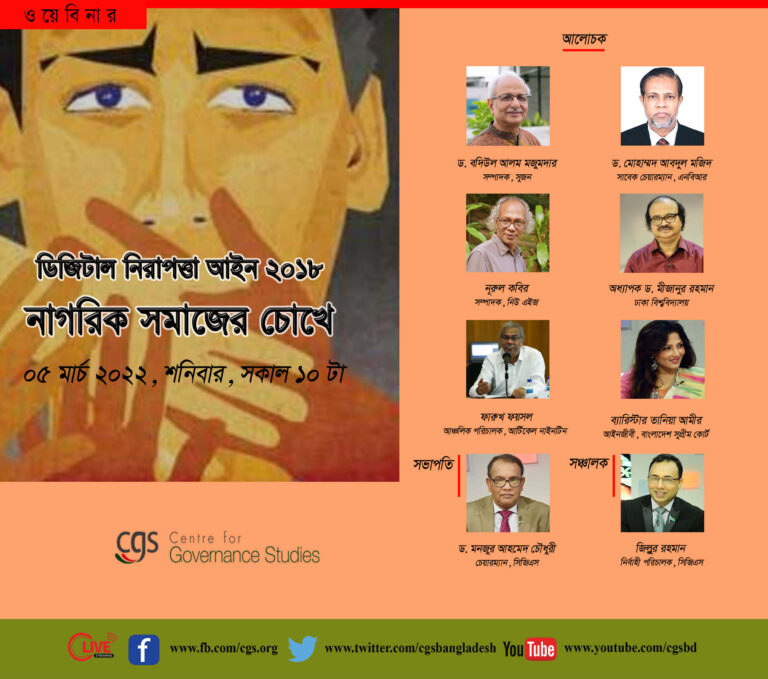
The Centre for Governance Studies organised the webinar on ‘The Digital Security Act 2018: in the eyes of the civil society’.
Most of the 835 cases filed between January 1, 2020 and January 30, 2022 under the act named opposition politicians and journalists, the centre said. It said that a majority of the cases were on defamation charges and most of the defamation cases were not filed by the reported victims.
Dhaka University professor Mijanur Rahman, also former Awami Juba League leader, said that the vague definitions of offences, especially ‘defamation’, ‘sedition’ and ‘hurting religious sentiment’, were leading to misuse of the law.
He said that the law should be repealed as it gave the police an upper hand over the people.
He, however, said that a law should be there to counter cyber threat and the 2018 law should be examined with UN assistance to ensure protection of the people.
The professor also said the act failed to stop anti-government propaganda as the people were spreading information from various countries, including Canada, the United States and European countries.
Board member of the centre, Muhammad Abdul Mazid, also former National Board of Revenue chair, however, believed that but the application not the intention behind the definition was malicious.
During the procurement of spy equipment, the government told the exporting countries that those devices and technology would be used against extremists and criminals but now those are being used against people, he said.
Majid said that the act almost similar to the Special Powers Act 1974 and the successive governments used the repressive 1974 law against its people. No government has repealed the 1974 law despite criticism, he added.
Citizens for Good Governance secretary Badiul Alam Majumdar said that the laws like the DSA usually curbed fundamental rights, including freedom of speech and expression, which are guaranteed in the constitution.
Supreme Court lawyer Tania Amir accused journalists of self-censorship. She said that the DSA was no different from the Special Powers Act.
Journalists need to stand up against the DSA the same way they stood up against the Special Powers Act, she said, adding that the law was made to leave the judgement in the hands of law enforcers violating the basic principle of laws.
Whose security the DSA meant to protect, the public or the government, she posed a question, adding, ‘We can have security when our fundamental rights are guaranteed.’
Article 19 regional director for Bangladesh and South Asia Faruq Faisel said that his organisation reviewed the DSA 2018 when it was enacted and pointed out to the government the instances where it violated international human rights principle.
He said that the law was enacted without consultation with the stakeholders.
Faruq said that the law should be scrapped and a new law should be enacted for the people as it was being used not to curb cybercrime but to punish people critical of the government.
The webinar was presided over by centre chair Manjur Ahmed Chowdhury and moderated by its executive director Zillur Rahman.
News Courtesy:
https://www.newagebd.net/article/164550/dsa-enacted-to-protect-rulers-not-people-webinar