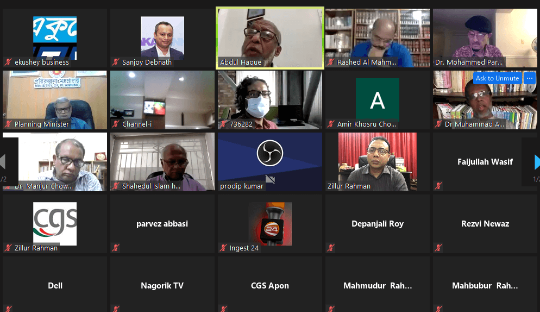
The proposed budget for the fiscal year 2021-2022 was not an inclusive one and the extent to which it would prove beneficial for the masses is a matter of question, said experts at an online discussion on Friday.
They came up with the remarks while addressing an online discussion organised by the Centre for Governance Studies on the proposed National Budget for 2021-2022.
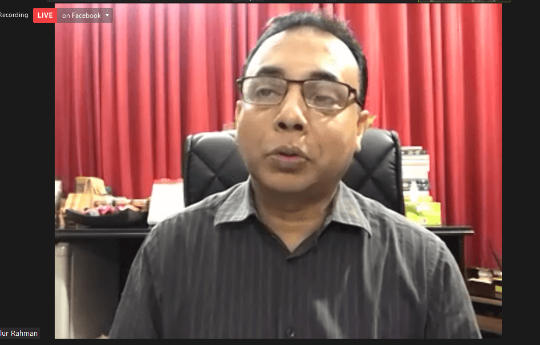
Even though the budget was a process of inclusion and a means to eradicate discriminations, especially for laggards of society, none of the processes was followed in the budget formation so that the discriminations can be eliminated, said Center for Policy Dialogue executive director Fahmida Khatun.
Lack of transparency and accountability was very much evident in the budget formation process as the participation of the lawmakers was absent, making the implementation very weak, she said.
‘We do not even see discussions in parliament at intervals on the progress of the budget implementation to ensure accountability,’ Fahmida said.
Speaking about the government’s claim that the budget was for the businesses, she said that the budget even failed to ensure equality among the businesses.
The budget also lacks measures to accommodate people who are lagging behind in society, Fahmida said.
‘How much the budget would prove helpful for the mass people is a matter of question as it failed to take into account the Covidinduced economic inequality,’ said the executive director, adding that it was not a budget for all.
Even though the finance minister claimed it to be a businessfriendly budget, it was not a budget for all businesses, she said.
Former commerce minister and BNP standing committee member Amir Khasru Mahmud Chowdhury said that the ongoing economic model of the country facilitated the enablers of the government and that was why such enablers were getting the benefits of the economic situation.
‘There is no other option for the government than to patronise such enablers to remain in power,’ he said.
‘We have seen taxes on university education while a section of people are plundering the public money from banks, the power sector and the stock market,’ he said.
‘These have led to one or two per cent of the people to accumulate all the wealth,’ Amir Khasru said.
Former National Board of Revenue chairman Muhammad Abdul Mazid said, ‘We have seen that the budgets usually come with attractive headings but the contents are not consistent with the headings.’
Speaking about the taxation system, he said that when the government allowed an untaxed money legalisation process by paying penalty at the rate of 10 per cent, it was discouraging such individuals from paying taxes regularly.
Even after legalising the untaxed money, no one would question such individuals about the sources of those earnings, said Mazid, adding that it was a conflicting policy.
Even though corporate tax is high in the country, reducing taxes from the corporations in a country where inequality is high will actually increase the inequality further, he said.
The tax facilities are mostly for companies, producers and middlemen while no facility that will directly benefit the mass people is given, he said.
Dhaka University professor Rashed Al Mahmud Titumir gave a keynote presentation on ‘Is Bangladesh heading towards a divergent recovery?’
In the paper, Titumir said that poverty, joblessness and inequality had been apparent even before the coronavirus outbreak which had made the situation even worse.
Titumir said that a section of people had access to all resources while another section of people was becoming financially weak, giving the recovery a ‘K’ shape.
A section of middle-class people and fixed-income groups were becoming poor, he said.
Even though social safety net allocations have increased, per capita allocation has not risen, he said, adding that instead, most of the allocations in this segment would be spent for payment of government employees’ pensions and another significant portion would be spent for payment of interest on national savings certificates.
Subsequently, the government has moved far away from the implementation of the sustainable development goals, he said.
He cautioned that failure to tackle the situation might lead to a change in power as was observed in some other countries.
Economist Muhammed Parvez Imdad said that emphasis should be given on improving efficiency so that the budget allocation could be utilised properly.
For instance, the allocation to the health sector in the last fiscal year remained unutilised due to lack of efficiency, he said.
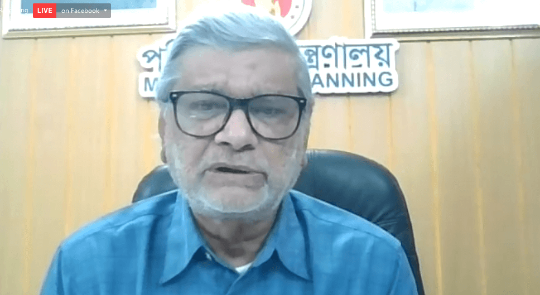
Planning minister MA Mannan said that the government had ensured electricity for all, was implementing a project to provide housing for all helpless people, was ensuring healthcare facilities for the citizens and had strengthened the social safety net programmes as well.
Mannan also mentioned that the aim of the budget was to continue the momentum of the previous budget.
News Courtesy:
https://www.newagebd.net/article/141936/budget-not-inclusive-of-poor-experts