The government has made no case that illegal immigration is a big problem, or that NRC is the best solution for it.
Shivam Vij
The NarendraModi government wants to update India’s National Register of Citizens, and may soon ask every Indian to prove not just their citizenship but even that of their grandparents. That is what just happened in Assam.
We don’t know what cut-off date the Modi government may set for the all-India NRC. Let’s say it says 1971, and you weren’t born in 1971, it’ll ask you to show proof that your parents or grandparents were born in India before 1971.
Here are seven good reasons why the NRC is a bad idea.
1. Is illegal immigration a big problem? The government wants to waste a lot of time and money identifying illegal immigrants among 130 crore people. But it hasn’t made the case that India is over-run by illegal immigrants.
Whenever the government is asked about this in Parliament, the Home Ministry gives a stock reply: “Since entry of such Bangladeshi nationals into the country is clandestine and surreptitious, it is not possible to have accurate data of such Bangladeshi nationals living in the various parts of the country.”
There are two kinds of illegal immigrants: those who cross the borders without passport and visa, and those who arrive with a visa and stay on even after the visa has expired. In a country which gets an estimated 1 crore foreign tourists annually, and many more under other visa categories, only about 50,000-70,000 overstay their visa. Around 6,000-7,000 are deported every year. Only around 1,000-2,000 are convicted under the Foreigners Act.
Here’s another stock answer the MHA often offers: “Detection and deportation of such illegal immigrants is a continuous process. Details of such deportation orders issued by the State Governments/UT administrations are not centrally maintained.” So, if this is a continuous process, why doesn’t the central government actually collate this data to see if the number of such illegal immigrants has grown exponentially?
In 2004, the Home Ministry said there were 1.2 crore Bangladeshi immigrants living in India. In 2016, the Home Ministry said the figure stood at 2 crore. These figures cooked up in thin air sound ludicrous when one notes that the entire Bangladeshi diaspora is said to be less than 80 lakh in number. The total population of Bangladesh is a little over 16 crore. To say that 2 crore Bangladeshis are living in India is a white lie, recently exposed by the Assam NRC. “Let me tell you,” the outgoing Bangladeshi High Commissioner to India said recently, “that a person of my country would rather swim in the ocean and reach Italy instead of coming to India.”
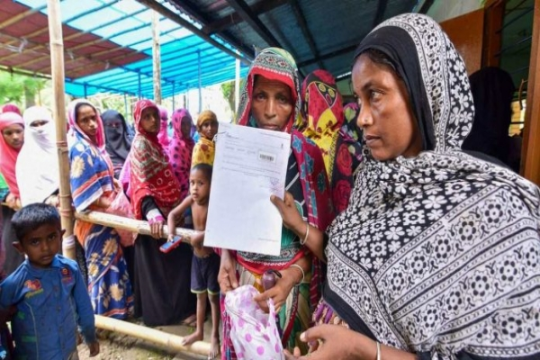
The state said to be the worst-hit by illegal immigration is Assam. The recently-concluded NRC updation exercise in Assam found that only 1.9 million or 19 lakh people were unable to prove their ancestors were Indian citizens, as opposed to the expectation that the list would run into many more lakhs. Out of these 19 lakh, a large number were non-Muslims, as against the hype that most illegal immigrants in Assam are Muslim.
Since 1985, Assam has had Foreigners’ Tribunals. Between 1985 and 2014, the Foreigners’ Tribunals looked into the citizenship of 9.4 lakh people. Out of these, the Foreigners’ Tribunals were able to declare only about 61,000 as Bangladeshi until 2014. Less than 2,500 of them have been deported to Bangladesh.
So, where is the evidence that illegal immigration is such a huge problem that 130 crore people must prove the citizenship of their grandfathers/ancestors?
2. Needle in a haystack: Surely, there must be illegal immigrants in India. Most countries have some. But the NRC process is like looking for a needle in a haystack. The data, or the lack of it, shows there are so few illegal immigrants among 130 crore people that it is simply not practical to go around checking the family tree of every Indian.
3. Guilty until proven innocent: The principle of natural justice is that one is innocent until proven guilty. But the NRC exercise presumes every Indian to be a potential ‘illegal immigrant’ until they can prove otherwise.
What will be the fate of those who refuse to submit documents, for instance? Do I become a stateless citizen despite having Aadhaar, passport, PAN card and myriad other documents, just because I can’t find my dead grandfather’s documents? Such are the anxieties the government is about to impose on 130 crore people to solve the non-existent problem of large-scale illegal immigration into the country.
4. Cost benefit analysis: Given the government’s inability to show that illegal immigration into India is a big problem, we also need to think about the waste of tax-payer’s money. In Assam alone, the NRC cost Rs 1,220 crore. At that rate, an all-India NRC might cost more than Rs 2 lakh crore. Is illegal immigration really such a big problem that the Indian government should be spending so much money checking documents of every Indian’s grandparents?
If even 0.5 per cent of the population is excluded in an all-India NRC, that would be 65 lakh people. That’s double the population of Jaipur. It’s insane to build detention centres to hold so many people in them for years, possibly forever. For comparison, India’s largest jail, Tihar in Delhi, has a capacity of roughly 6,250 prisoners.
5. NRC’s proven track record of failure: External Affairs Minister S. Jaishankar recently joked that Albert Einstein would have been known for his definition of insanity had he been a political scientist. Insanity, said Einstein, was doing the same thing again and again and expecting different results. Jaishankar may well have been talking about his own government’s persistence with the National Register of Citizens (NRC).
Despite its spectacular failure to produce the desired result in Assam, the government wants to implement the NRC across India. The very people who demanded an NRC in Assam have rejected it twice. How does Amit Shah justify scaling up a failed idea?
6. Are illegal immigrants a threat to India? There could be Pakistani terrorists in Kashmir who the Indian security forces are already hunting down. But are poor Bangladeshi immigrants in India — to that extent that they may be present — really posing any threat to India’s security and sovereignty?
If they are stealing jobs, why don’t we feel the same way about Nepali citizens who are legally allowed to walk into India and find work?
If a few thousand illegal immigrants here and there are a burden on the limited resources of a populous developing country, why are we so eager to import non-Muslims from Afghanistan, Pakistan and Bangladesh with an amendment to the Citizenship Bill?
7. Designed to target Muslims: India has already assured Bangladesh it won’t deport anyone excluded in the NRC. Why is it that the government wants to identify illegal immigrants but not deport them? Does it not speak of mala fide intent?
The real intent is to disenfranchise Muslims. Non-Muslims who can’t prove their citizenship will be just presumed as refugees and given citizenship under the new Citizenship (Amendment) Bill (CAB). Muslims excluded in NRC may continue to live in India as stateless citizens, fulfilling the Sangh objective of making Muslims second-class citizens. Officially and legally. The NRC’s real name should thus be MDS, the Muslim Disenfranchisement Scheme.
Sabka Vinash
NRC is the opposite of SabkaSaath, SabkaVikas, SabkaVishwas. It is neither about inclusiveness, nor development, nor trust. The mayhem it will cause can better be described as SabkaVinash, all-round destruction.
While the NRC exercise will be disastrous for the nation, it may be useful for the BJP. It will make sure it’s all we talk about, and not the sinking ship called the economy. How will you have the time to complain about unemployment when Modi is making you run around to find your grandfather’s birth certificate?
The xenophobic fear of illegal immigration, together with the NRC-CAB plan to disenfranchise Muslims, will be used to polarise voters for many elections to come. Modi can’t give Hindus jobs, but he may be able to give them the schadenfreude of reducing Muslims to second-class citizens.
Shivam Vij is a contributing editor at The Print.
The article was originally published on The Print.
Views in this article are author’s own and do not necessarily reflect CGS policy.