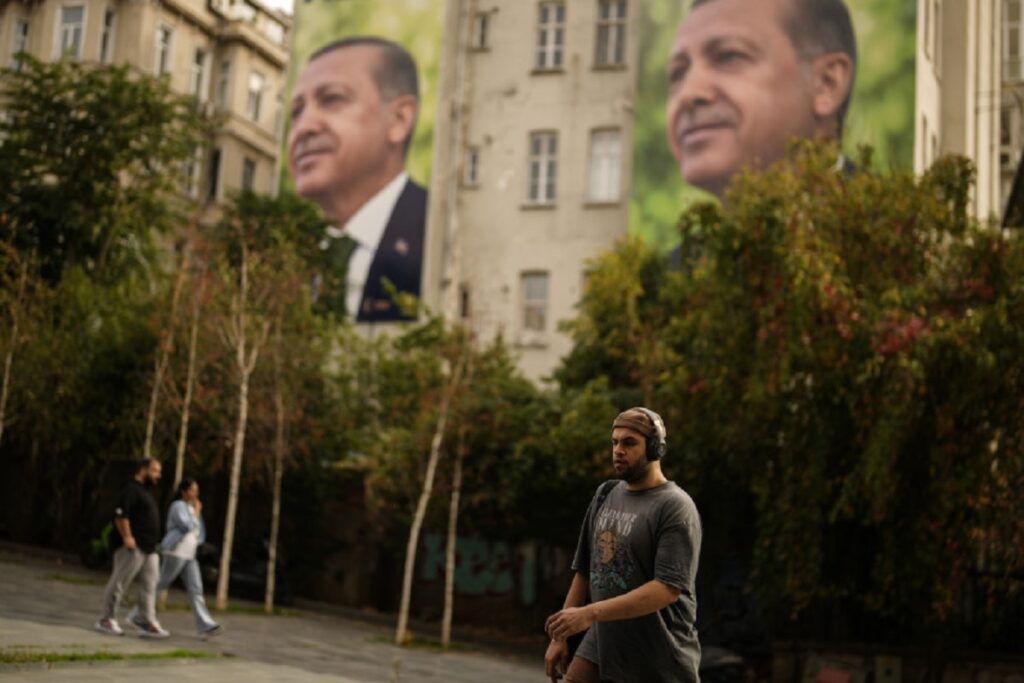
From the beginning of the war in Ukraine, Turkey has performed a delicate balancing act, portraying itself as an ally to the warring sides while reaping economic and political benefits from its relationship with both.
Turkey has condemned Russia’s invasion and extended diplomatic and material assistance to Ukraine’s war efforts. At the same time, the country’s leader, RecepTayyip Erdogan, has pointedly opted not to join the Western-led sanctions against Russia or cut ties with Moscow.
But Turkey’s neutrality in the Ukraine conflict is seemingly meeting with growing impatience in Washington and Moscow, and may be difficult to sustain amid a shifting geopolitical landscape.
In September 2023, the U.S. Treasury Department imposed sanctions on Turkish companies and a businessman accused of helping Russia to circumvent U.S. sanctions. Meanwhile, Erdogan has failed to revive a deal with Russian President Vladimir Putin that allowed the export of Ukrainian grain shipments via Turkey’s Bosphorus and Dardanelles straits and eased global food prices.
The developments suggest that both Washington and Moscow are seeking to pressure Turkey into taking a decisive stand. Already there are signs of Erdogan bending. On Oct 25, Erdogan signed Sweden’s NATO accession protocol and sent it to the Parliament for ratification, having earlier refused to endorse the move – much to the annoyance of Turkey’s NATO allies.
The move may be interpreted as a sign that Turkey’s balancing strategy is reaching its limits. But it may also be another tactical move in Erdogan’s geopolitical chess game, which has expanded as he seeks to position Turkey as a diplomatic force amid escalating violence in the Middle East.
As an expert on Turkish politics and international affairs, I have watched as Erdogan walks a fine line between the country’s commitments as a longtime NATO member and its reliance on Russia for trade, economic resources and energy imports. But this balancing act is becoming increasingly difficult the longer the war goes on.
The middleman strategy
Erdogan’s approach aligns with Turkey’s historical foreign policy trajectory. Turkey has maintained a balance between Western European powers and Russia since the latter emerged as an ambitious regional player along Turkey’s northern border in the early 18th century.
The balancing act allowed the Ottoman Empire, Turkey’s predecessor, to survive the 19th century largely intact despite mounting pressures from the Russian Empire and European powers. Failure to utilize a balancing strategy in the First World War facilitated the empire’s demise. Joining forces with the losing Central Powers, Turkey had to share a catastrophic fate. In contrast, in World War II, a strategy of neutrality helped Turkey to weather the war unscathed.
Against a mounting Soviet threat during the Cold War, Turkey took refuge under Western security guarantees, joining NATO in 1952.
Relieved of the Soviet threat in the 1990s, Ankara sought greater foreign policy autonomy. However, it lacked the necessary economic and military resources and domestic political will to fully realize this ambition, leading to alignment with U.S. policies in the Middle East and Balkans until the early 2010s.
Splintered support
But U.S. support to Kurds in northern Syria, aligned to the militant separatist Kurdistan Workers’ Party, and the 2016 coup attempt against Erdoğan marked the beginning of a more confrontational relationship between Washington and Ankara.
Blaming the U.S. and its Persian Gulf allies for complicity in the coup, Erdogan began to court Putin, who openly stood behind him during and after the attempted coup. Ankara’s acquisition of Russian-made S-400 surface-to-air missiles led to its removal from the U.S.‘s F-35 Joint Strike Fighter program and a set of U.S. sanctions on Turkey’s defense industry. Coupled with its repeated military interventions in Syria, Turkey’s closeness with Russia has, critics say, reduced it to a status of “unreliable partner” in the North Atlantic alliance.
But it didn’t take long for Ankara’s flirtation with Moscow to reach a deadlock. The death of 34 Turkish soldiers in a Russian bombardment in northern Syria in February 2020 prompted a renewed effort to seek reconciliation with the U.S. However, the Biden administration hesitated to reset relations due to concerns over Erdogan’s increasingly authoritarian rule.
The balancing act and Ukraine
War in Ukraine offered a new boost to Erdogan’s balancing act. Turkey’s control of two major straits and established ties with Ukraine and other states along the Black Sea provided significant leverage for a multifaceted and neutral approach. Erdogan seemingly hoped that maintaining trade relations with Russia and arms sales to Ukraine would bolster the struggling Turkish economy and rehabilitate his image in the West.
But Erdogan’s early blocking of Sweden’s and Finland’s entry into NATO stirred resentment in Washington and Brussels.
As the Ukraine conflict continued and Erdogan’s domestic popularity dipped in the lead-up to the May 2023 elections, the sustainability of Turkey’s balancing act seemed uncertain again.
In need of financial and political support, Erdogan has turned to the West and Persian Gulf countries. He approved Finland’s NATO accession and forged economic deals with West-friendly Saudi Arabia and the United Arab Emirates – Turkey’s two bitter rivals in the Middle East.
In summer 2023, Erdogan announced a new cabinet that projected a pro-Western outlook. He mended ties with Egypt, another traditional regional rival, aligning with the new balance of power that the U.S. and its regional allies were shaping in the Middle East. And then, at the July 2023 NATO summit in Vilnius, Lithuania, Erdogan announced the withdrawal of his veto against Sweden’s accession to NATO.
Erdogan’s pro-Western moves have prompted a cautiously optimistic approach by Western leaders, using both incentives and punitive measures: extending a US$35 billion World Bank credit to aid Turkey’s economy, while penalizing Turkish entities for violating U.S. sanctions. The latter has been taken as a not-so-veiled message to Ankara to take a definitive stance in its foreign affairs.
Erdogan has received a similar message from Putin. Disappointed in part by Turkey’s reconciliation with the West, Putin chose not to renew the Ukrainian grain deal despite Erdogan’s earlier successful brokerage. It was a considerable blow for Erdogan, who sought to position himself as a crucial power broker in the Ukraine-Russia conflict.
Although Erdogan faces pushback from the U.S. and Russia, this does not necessarily signal the demise of his middleman strategy. Turkey’s location on the Europe-Asia boundary and historical ties to neighboring regions provide Erdogan opportunities to sustain and even expand a strategy of neutrality among regional and global actors.
Developments in the South Caucasus and the escalating conflict between Israel and Hamas in the Gaza Strip are two recent examples. They add a new layer of complexity for Erdogan’s balancing act, but also more room for him to maneuver. Turkey has been a key backer of Azerbaijan’s military offensive in Nagorno-Karabakh – something that has exposed Russia’s waning influence in the region and created a major geopolitical setback for Iran. Meanwhile, Erdogan’s ties with both Hamas and the Israeli government provide an opportunity for him to play a mediator role there.
Ozgür Ozkan is a Visiting Scholar, Fletcher School of International Law and Diplomacy at Tufts University.
This article was originally published on Japan Today.
Views in this article are author’s own and do not necessarily reflect CGS policy.