When enterprises cannot work and consumers cannot consume, a recession is inevitable. The measures taken to neutralize the triple economic shock have not yet helped: economists urge governments not to doubt the choice of funds and their scale.
Olga Kuvshinova and Olga Volkova
With the COVID-19 pandemic still getting out of hand, the best option for the economy to rely on is a deeper recession than the financial crisis of 2008, writes New York University professor, “Dr. Doom » Nuriel Roubini. The recession in the global economy has already begun , three quarters of the economists surveyed by Reuters say. According to McKinsey’s forecast , 2020 will end with a recession of all three major economic centers of the world – the USA, China and the eurozone, including in the II quarter the recession in the USA can reach 8–11% (compared with the IV quarter of 2019), the global economy – 1.5–4.7% (in the crisis year of 2009, it decreased by 0.1%). According to the forecast of Goldman Sachs, the US economy will shrink in the I quarter, compared with the same period last year, by 6%, and in the II quarter – by almost a quarter.
Forecasts were made even before shocking data on unemployment in the United States arrived: last week the number of applications for benefits increased to 3.3 million from 282,000 the previous week. “This is a number that cannot be understood,” quoted Marth Gimbel, FT economist at the Schmidt Future Fund. It means that the unemployment rate in the country in only one week increased by about one and a half times. In terms of the number of job loss, this is the largest increase since 1967, when the Ministry of Labor began to publish weekly data. During the global financial crisis, the weekly maximum reached 665,000 in October 2009.
In Canada, over the same week, the number of applicants for benefits exceeded 900,000 , which may mean doubling the unemployment rate. In France, about 100,000 companies appealed to the government to compensate them for the reduction or termination of 1.2 million employees, according to Reuters , in the UK for the benefit paid to the unemployed and low-income people, in the past nine days 477,000 people applied, six times more than in the same period last year. Job cuts will continue: the International Labor Organization, which only at the end of last week predicted an increase in global unemployment this year by 5–25 million people, depending on the development of the pandemic, now expectsthat unemployment growth will be “well above 25 million.” For comparison: in 2008–2009. 22 million people lost their jobs.
At the G20 online summit on Thursday March 26, country leaders agreed on an additional fiscal stimulus of $ 5 trillion , or about 6% of global GDP, to offset the social, economic and financial consequences of the pandemic. Given the measures previously announced by governments and central banks, the cost of supporting the economy is likely to exceed 15% of global GDP.
The pandemic in China is slowing down, since March 17, WHO has ceased to publish detailed data for the Chinese provinces and to separate the global incidence statistics for “outside of China” and “in China”, removing country data from the cover page of daily summaries – now the summary numbers by region are published there of the world. In the world, the incidence continues to pick up speed: the number of confirmed cases in the second half of March doubled every week, by March 26, exceeding 465,000; the number of daily new cases recorded in two weeks increased 6.5 times. The death toll is quadrupled, exceeding 21,000. In Italy, over the past two weeks, the incidence has grown exponentially, doubling every five days.
Two curve equation
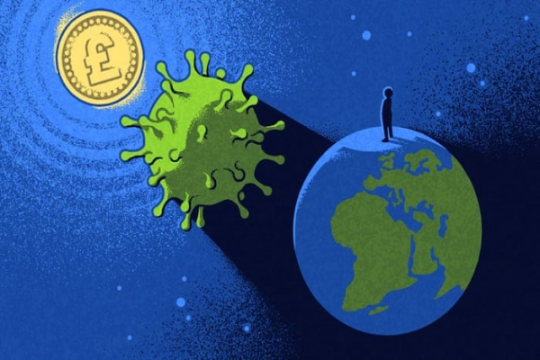
Governments around the world, faced with a choice between economy and life, are choosing policies to reduce real GDP. The fight against the pandemic puts the economy under a threefold blow: supply shocks, demand and financial shock. When governments do not allow workers to work, exacerbating the decline in supply, and consumers to consume, exacerbating the decline in demand, a recession is deliberate and inevitable, writes Richard Baldwin , founder of VoxEU.org.
Without containment measures, the virus spreads faster, and the number of deaths from it is higher due to the fact that health systems can not cope with the load. The economy in this scenario is still shrinking due to the impact of the pandemic and the uncertainty caused by it, but the recession is relatively small and short-term. Tough isolation measures allow you to distribute the burden on medical services, reducing morbidity and, to a much greater extent, mortality, the economic downturn, and, according to theoretical modeling for the United States, it is four times deeper and lasts longer.
However, economic policy can reduce both the scale of the recession and its duration (see chart).
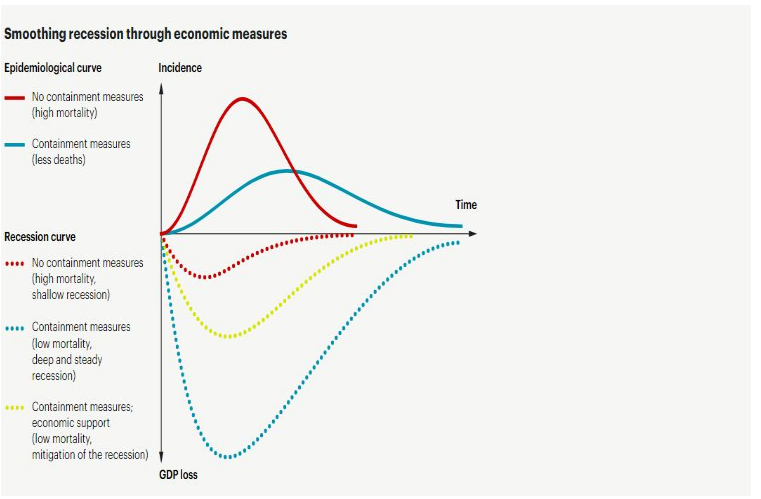
While most predictions come from the fact that the crisis will be V-shaped – a quick recovery from a deep recession – it’s time to admit that the COVID-19 crisis is something very special, says Roubini. The compression that is happening now has nothing to do with either the V-, U-, or L-shaped trajectory, it looks like an I — a vertical line: each component of aggregate demand — consumption, capital expenditure, export — is in free fall.
Recently published statistics from China, showing double-digit numbers for declines in production, retail, and investment, can give an idea of what other economies have to go through. At the same time, despite the large-scale fiscal and monetary stimulus measures taken by the Chinese authorities, the impact of the economic blockade there seems to be only intensifying, estimates by economists at the University of Chicago based on data on the country’s domestic freight and passenger traffic show : “At the moment, China is facing a serious problem of economic recovery, especially since the worsening pandemic situation around the world leads to an almost complete halt of its export sector. ”
At best, the global economy may return to growth by the end of 2020, but for the best case, several conditions are needed, Roubini argues. Central banks have already done in a month what they took three years after the global crisis, but more opportunities are needed to encourage the banking sector to lend to illiquid, but still viable enterprises: zero and negative interest rates, quantitative easing, asset repurchases, including companies, he lists. The action plan for the fiscal authorities is large-scale fiscal stimulation, including direct cash payments to the population. Given the magnitude of the economic shock, the budget deficit in advanced economies will need to be increased from 2-3% of GDP to about 10% or more, he said.
Traditionally, during the weakening of economic activity, governments support demand, while the supply side – entrepreneurs – takes care of itself, but now the first blow fell on production, Baldwin recalls: “GDP is a measure of both consumption and production at the same time, and like it or no, but prices and quantity will synchronize them. ” A policy of supporting consumption under a policy of containing production will not be able to match supply and demand without a significant change in prices. It would be more correct to call “stimulus packages” “protection packages”, he argues, it is necessary to protect everyone: jobs, companies, banks – and, in addition, inspire confidence that the economy will return to growth.
The economy cannot be turned off and on like a light bulb – rather, it is like turning off a nuclear reactor: you need to be very careful, otherwise it can lead to disaster
– John Cochrane, Stanford Professor
Governments must act quickly and not stand behind the price, using all their financial firepower, call in the new CEPR , the European economic think tank, the leading economists of the world, among them – IMF chief economist Gita Gopinat and who held this position during the global financial crisis Olivier Blanchard, former World Bank chief economist Pinelopi Goldberg, Barack Obama economic adviser Jason Furman.
Even if the quarantine measures introduced reduce economic activity by 50% in the first month and by 25% in the next month, this already means a 6.5% loss in annual GDP, writes Pierre-Olivier Gurinchas from the University of Berkeley. Add another month with a decrease in activity of 25% – and the losses will reach 10% of GDP. According to Gurinchas, as a first approximation, governments will have to spend an amount comparable to the release missed due to a pandemic – and this does not include additional health costs.
Households and businesses suffering from supply disruptions and falling demand can be supported by cash subsidies, salary compensation, tax breaks to stay afloat; central banks should be prepared to provide sufficient liquidity to banks and non-banking financial companies, lists the necessary measures Gita Gopinat.
Do not stand behind the price
The textbook on the economics of a pandemic is still being written. Governments and central banks were able to quickly deploy tools tested in the past crisis, but the unusual causes of the economic shock and its magnitude may require new innovative solutions. Some economists are calling for monetization of the budget deficit – “helicopter money.” This is the provision by central banks of loans to the government at zero percent, which are then sent to business and the public. This idea of modern monetary theory ( MMT) differs from the applied “quantitative easing” – repurchase of securities from banks in the expectation of an increase in lending to the economy. However, with a sharp decline in economic activity, when governments are fighting the coronavirus, and the markets do not respond to any incentives, some economists are thought that it is time to send helicopters, Reuters notes : such “converts” include, for example, White House economic adviser Larry Cadlow.
For politicians, the moment has come “do everything you can,” and this should include, among other things, non-standard measures, such as “helicopter money,” calls in an article for the CEPR collection by Jordi Ghali from Pompeu Fabra University. His argument is simple: saving the economy requires a significant increase in government spending, but its high levels pose risks for many states. It will be much worse if the economic crisis caused by COVID-19 turns into a public debt crisis.
Life in a world of very low interest rates has long been a new reality; Nobel laureate Paul Krugman doubts the danger of rising public debt. At the current rate level, there is room for debt buildup: even if rates around the world go up due to increased borrowing by states, by historical standards they are likely to remain very low for many years to come. Whereas the response of the fiscal authorities may come to a standstill if the monetization of deficits leads to high inflation, especially if a series of negative supply shocks provoked by the virus hit potential growth, Rubini points out: “And then who will save governments, companies, banks and households? “
Among the new non-standard tools may be “coronond bonds” – the issue of joint bonds of the eurozone countries, which is offered by nine European states and, according to FT, supports the head of the ECB, Christine Lagarde: there must be a common response to a common shock. So far, this possibility is in great question because of the possible moral hazard – the temptation of some countries to solve their problems at the expense of other countries. Due to fears of this, similar Eurobonds, discussed earlier, were rejected; and the program adopted in 2012 for the purchase of government bonds of troubled eurozone countries (Outright Monetary Transactions, OMT) was never launched. However, in the current exceptional circumstances, it would be advisable to discard the moral hazard problem, said Charles Viplosh, professor at the Geneva Institute for International Studies. But, given the urgency of the situation, it is unlikely that an agreement on “coronabond” can be reached within an acceptable time frame, he said. but the OMT mechanism could already become a coordination mechanism – and a way to avoid a second recession. It is not ruled out if the implementation of large-scale measures to support the economy will shake the stability of budgets. The need to put moral hazard aside will be a serious test of the ability of Eurozone countries to coordinate their actions in a situation of general shock, concludes Viplosh.
Olga Kuvshinova, Editor-in-Chief of Econs.online.
Olga Volkova, Editor, Econs.online.
The article was originally published on Economic Conversation.
Views in this article are author’s own and do not necessary reflect CGS policy.