Russia’s invasion of Ukraine presents governments in South Asia with difficult diplomatic and economic choices. India and Pakistan are each in a particularly delicate bind. As I wrote recently, New Delhi maintains close ties with Moscow and Washington and has traditionally avoided criticizing Russian aggression, including the 2014 annexation of Crimea.
India’s public statements on the current crisis have so far pleased Russian officials. This week, New Delhi’s ambassador to the United Nations declined to explicitly criticize Russia’s moves, instead calling on all sides to exercise the “utmost restraint.” In a Thursday call with Russian President Vladimir Putin, Indian Prime Minister Narendra Modi called for dialogue and a cease-fire. But Russian aggression in Ukraine poses major threats to Indian interests, from driving Moscow into Beijing’s arms to distracting Washington from countering Chinese power in the Asia-Pacific.
Furthermore, because India’s relations with the United States have strengthened since 2014, staying quiet on Russia’s moves has become a bigger gamble. New Delhi is already in the hot seat for its acquisition of the S-400 missile defense system from Moscow last year. Washington will likely waive sanctions on India for the purchase, but recent events suggest the Biden administration will ratchet up pressure on India to reduce future Russian arms imports.
India’s refusal to call out Russia also risks sparking tensions within the Quadrilateral Security Dialogue. The three other members—Australia, Japan, and the United States—have announced sanctions on Russia. India’s position could also rankle countries in Europe, many of which it counts on for trade and arms and for support in countering China. The more Moscow expands its invasion, the more it will expose India’s awkward differences with key partners.
In Foreign Affairs this week, Manjari Chatterjee Miller argued that now is the time for India to change course and press Russia to de-escalate. But old policies die hard for New Delhi. Even after a deadly border conflict with China in 2020, India declined to declare an alliance with the United States. Moreover, given Putin’s uncompromising position on Ukraine, it’s unlikely India could deter him even if it tried. For India, Russia remains a challenge to be managed—not a threat to be countered.
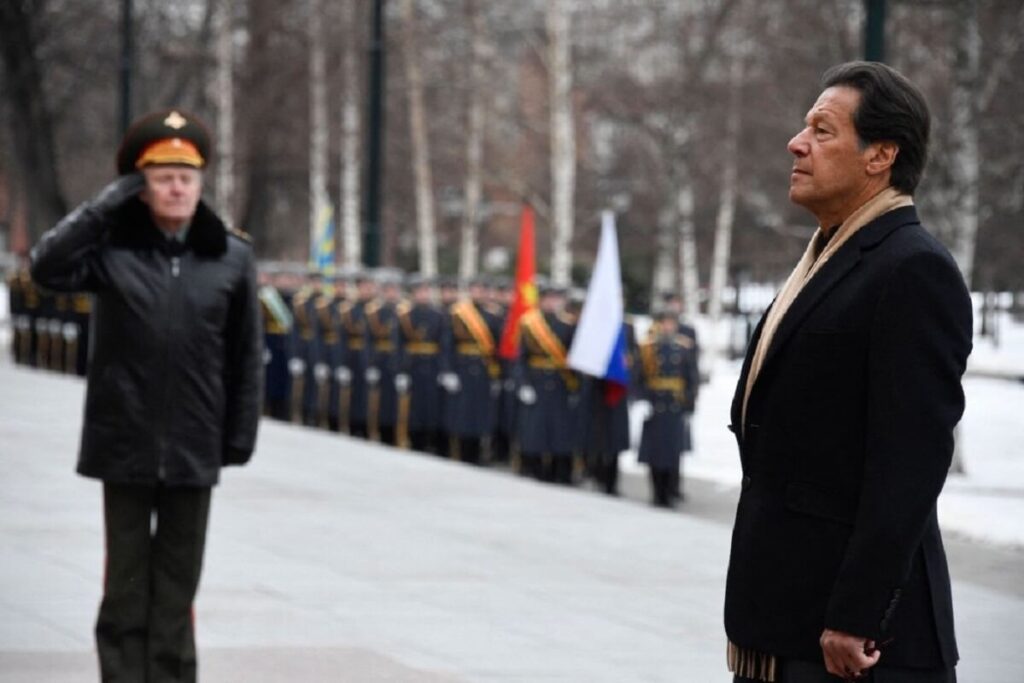
Pakistan’s conundrum is less severe but more immediate. Pakistani Prime Minister Imran Khan wrapped up a visit to Moscow after Putin announced the military operations in Ukraine. Relations between the two countries have been growing for several years, thanks in great part to geopolitical conditions: Russia’s deepening relations with China, Pakistan’s ally, and some lost momentum in India-Russia relations.
Khan’s trip to Moscow focused solely on bilateral cooperation, but its timing may give the impression that Pakistan indirectly endorsed Putin’s decree on breakaway regions in eastern Ukraine and even the invasion—launched just hours after Khan touched down in Moscow. But Islamabad likely doesn’t support the moves: Two days before Khan’s visit, Pakistan’s ambassador in Kyiv expressed support for Ukraine’s sovereignty and territorial integrity, according to a Ukrainian readout.
Pakistan’s challenge will be to strengthen relations with Russia without alienating its Western trade partners, all while balancing a growing defense relationship with Ukraine. Islamabad’s balancing act is less intricate than New Delhi’s: Its relationship with the United States is tenuous, and it has long sought to leverage its alliance with China to work more closely with Russia, especially in Afghanistan and Central Asia. But Islamabad must be careful not to edge too close to Moscow, given its commercial relationships with Europe and its desire to play a greater role on the global stage.
For Afghanistan, the danger is that the Russia-Ukraine conflict will distract from its own humanitarian crisis. The United Nations was already struggling to meet the $4.4 billion appeal it had announced for humanitarian assistance—still less than it estimates it will need to ease the crisis this year. Now, bandwidth for developing a strategy to increase assistance to the country will certainly be limited. Seeking to reorient global attention back toward Afghanistan, the Taliban have called for a swift resolution of the Russia-Ukraine crisis.
Elsewhere in South Asia, the conflict could generate economic opportunities: With Russia facing possible devastating sanctions, it will seek new markets, and South Asia’s could be attractive, especially if Russia rides on the coattails of China’s robust investment presence there. Russia doesn’t currently have a deep footprint in the smaller South Asian states, but it has explored some trade and investment, especially in the energy sectors in Nepal and Bangladesh and in Sri Lankan tea, of which it is a major importer.
However, the region’s smaller states—because of their economic fragility and desire to maintain working ties with the West—won’t want to risk running afoul of sanctions regimes. For South Asia, like much of the world, the best resolution of the Russia-Ukraine crisis would be a quick and peaceful one. That appears increasingly unlikely by the hour.
Michael Kugelman is the writer of Foreign Policy’s weekly South Asia Brief. He is the Asia Program deputy director and senior associate for South Asia at the Wilson Center in Washington.
This article was originally published on Foreign Policy.
Views in this article are author’s own and do not necessarily reflect CGS policy.