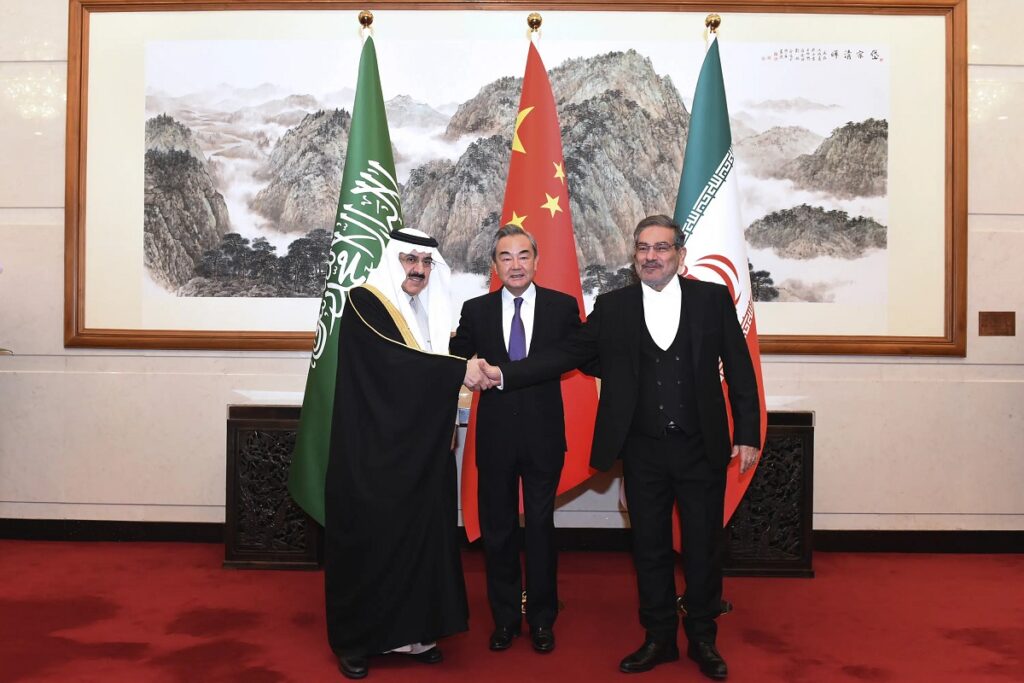
In the midst of the Ukraine-Russia conflict, the world has experienced a new geopolitical switch with the restoration of diplomatic relations between Saudi Arabia and Iran. They are currently on the verge of establishing embassies and a security agreement. This historical bond was the result of diplomatic discussions held on March 17, 2023, in Beijing. The parties have agreed not to interfere with one another's internal affairs and to reactivate the security agreement signed in 2001.
Since the post-Iranian Revolution era, the two nations in the Middle East have been at odds, as Saudi Arabia viewed the emergence of another Islamic republic as a potential threat to their dominance. Nonetheless, Saudi Arabia supported Iran during the Iraq-Iran war. In 2005, when President Mahmoud Ahmadinejad assumed office, the tension between them re-emerged. Later, the 2001 Arab Spring exacerbated the tension and led to multiple proxy wars between them. In Yemen, where Saudi Arabia supported Yemen's internationally recognized government and Iran supported the Houthi rebel group, the conflict reached a new peak. In 2016, Saudi Arabia severed ties with Iran, in response to which Iran suspended participation in Hajj. The rivalry reached its pinnacle in 2017 when Saudi Arabia and its allies imposed a blockade on Qatar, accusing them of their closeness to Iran.
Every year from 2011 to 2022 comes with new significant events, often proxy wars, that affect the relationship between these two countries. The Middle East has always been a field of interest for global powers, including China. There were and have been attempts to interfere in the internal affairs of the Middle East countries by the dominant member states. The restoration would help in the process of establishing non-interference by external countries. As such, the two leading nations, Saudi Arabia and Iran, need to take responsibility for shaping and balancing all the tensions that exist in the region.
Many may view this agreement between these two leading Arab nations as an undeniable victory for Beijing. However, one fact that should not be overlooked is President Biden's announcement that the United States will no longer support Saudi-led operations in Yemen. The announcement was made in February 2021, and direct negotiations between Saudi Arabia and Iran began in April 2021. Consequently, it would be unjust not to consider the indirect effect that Biden's announcement had on the initiation of this negotiation process. Following this agreement, President Biden remarked, "Any improvement in relations between Israel and the Arab states of the region will benefit all." This is indeed a good sign of relief as far as the existing tensions are concerned. Relations between Saudi Arabia and Iran will undoubtedly alter the current geopolitical landscape of the Middle East. In light of this, would it be unreasonable to expect a fair agreement between the United States and Iran despite the existing disagreement that affects their relationship and the Middle East as a whole?
Mahtab Uddin Chowdhury, Research Assistant, Centre for Governance Studies