Subho Basu
South Asia is a region characterized by many contradictions. According to 2012 statistics nearly 23 per cent of the world’s population live in South Asia with 15 per cent of the world’s arable land, but the region has only 6.0 percent of world’s Purchasing Power Parity (PPP) based on global gross domestic product(GDP). It shares 2.0 per cent of world’s goods trade, and attracts only 3.0 per cent of world’s foreign direct investment . Despite having such smaller share of global trade in comparison to her size of population, in terms of wealth generation and economic growth the region performed moderately well by global standard. Between 2014 and 2019, according to Asian Development Bank, South Asia grew more than 7% in average with India and Bangladesh acting as the engine of growth followed by Bhutan, Maldives and Nepal. Yet the region has a very high concentration of absolute poverty. Only recently in 2012 the area was surpassed by sub-Saharan Africa in terms of concentration of poverty. This obviously meant that a vast number of people in the region subsist below a necessary level of basic living standards in relation to food, shelter and housing. In terms of world bank’s sensational blogging language 49% of South Asians had a spending capacity below $3.20 a day as late as 2015. While two South Asian countries had produced in recent past nuclear weapons and three countries sent satellites in outer space, they could not provide basic health care, nutrition and meaningful jobs to their citizens. More importantly, though South Asia for the last five thousand years witnessed the evolution of connected civilizations in a shared space, there exist intense rivalries among nation states in relation to the interpretation of pasts. Partisan interpretations of past histories generate significant degree of animosities for the present. Long back in 1987 political scientists Llyod Rudolph and Susan Rudolph characterized India, a pivotal state in South Asia as a weak-strong state and rich-poor economy. This description applies to most of South Asian states.
This essay proffers a hypothesis to explain this paradox. It submits that an incomplete decolonization, marked by centralized state or top-heavy military bureaucratic structure has disenfranchised popular social classes from exercising meaningful role in the governance process. This has rendered many states partially unresponsive to their citizens’ rights and needs. At the core of this stood the pattern of interaction between ruling classes and state spaces and most problems occur when ruling classes impose a centralized unitary control over divergent ecological, cultural and ethnic spaces subverting the inherent plurality of the society. This essay thus presents an argument that democratic decentralization, federalization of polity and right based approach towards governance will create conditions for a more connected and collective response among South Asians to issues concerning everyday lives from social inequalities to environmental degradation. This will enable a region fractured by nation state rivalries, deep social inequalities and ethnic unrests to develop collective economic responses to global opportunities.
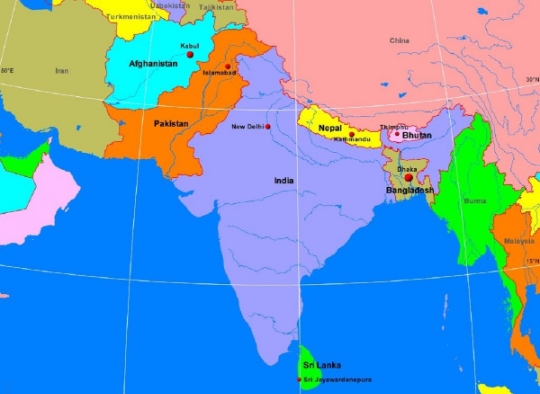
Let me further elucidate this point of incomplete decolonization by referring to the contradiction inherent in the term South Asia itself . The term South Asia is of recent origins and clearly symptomatic of post-colonial recognition of diverse nation states in the region. Yet this postcolonial description of geopolitical territory contained within its embryo a signature of colonialism in the very structure of territorially bound ‘nation-states’ marked by rigid boundaries. Though territorial states in Europe are regarded as a by-product of treaty of Westphalia signed in 1648, in Asia it depended on two crucial factors first the mapping of territorial possessions of European empires and second the gradual transfer of power to indigenous elites in these territorially defined states. To elucidate this point further we have to look at the mapping of the subcontinent. Colonial rulers who gradually came to conquer the region from 1757onwards, earnestly started mapping the territories that were under their control. As a consequence, three lines defined the region Durrand line, the border between Afghanistan and Pakistan, Mc Mahon Line, the border between India and Tibet and the more infamous Radcliff line the border between Pakistan and India and India and Bangladesh. But the border making in South Asia did not stop at the former core territory of British Indian Empire. The neighbouring region of Afghanistan was also defined by great game, the infamous euphemism, for British and Russian rivalry over influence in central Asia. In mid 1880s a joint Russian and British boundary commission defined the northern boundary of Afghanistan through a line drawn as a border along the Amu Darya River. Nepal and Tibet were surveyed in a clandestine way and became the subject of romantic tales for geographers. Even Sri Lanka, an island nation state, became aware of its topographical interior through colonial surveys. This colonial border making has enormous influence on contemporary geopolitics in the region. Indeed, what Lord Curzon, the famous British viceroy of India said in 1907 in the Sheldonian Theatre at Oxford is true for South Asia today. He declared in unequivocal terms “Frontiers are indeed the razor’s edge on which hang suspended the modern issues of war or peace, or life or death to nations. . . . [T]he integrity of her borders is the condition of existence of the state.” In South Asia with colonial mapping as A T Embree remarked frontiers were transformed into borders and today we are noticing borders are transformed into fences and are marked by quotidian instruments of war. These are true about all borders between India and Pakistan, partly about Pakistan and Afghanistan and India and Bangladesh and recently even border disputes have occurred between India and Nepal. An incomplete process of decolonization of mind actually led towards recolonization of politics of governability in relation to space. The result is the restriction on the movement of people, increase in violence and stigmatizing of other South Asians across the border. Obviously acts of state sponsored terror remain constant feature of low intensity conflicts on sensitive borders between India and Pakistan and Pakistan and Afghanistan. Thus international politics in South Asia remains in a constant state of tension.
Despite such fragmented and painful coexistence, South Asian nations had a commonality from 1990 in terms of economic policy making. They liberalized their market structures under the impact of globalization. In 2006 there came into existence South Asian Free Trade Area (SAFTA) Agreement with the ultimate objective of turning the region into a full-fledged free trade area (FTA). Under conditions of globalization SARC countries like their northern neighbor China participated in global vaule chain in order to expand their national economies. Between 1990 and 2008 there took place an impressive rise of 12 percentage points and the share of GVC trade in world trade touched the peak of 52% in 2008, i.e. in the year of global financial crisis.
As South Asia is trying to cope with dynamics of globalization, her northern neighbor China emerged as a crucial player in global economy. Though China is regarded as an outside player in the region, through the ‘autonomous region’ of Tibet she has a long border with South Asian nation states of India, Bhutan, Nepal and Pakistan. In 1950s after a brief honeymoon China and India parted from each other’s company rather violently after border disputes in 1962. India viewed Chinese China’s growing bonhomie with other states in the region as an attempt to encircle India. From 1966 onwards China developed long standing all weather partnership with Pakistan. In turn Pakistan helped China to bridge the gap with the United States through Henry Kissinger’s diplomatic manoeuvrings in 1971. Rejected by United States India sought alliance with Soviet Union and such alliance became a global partnership for a long period till 1992 when Soviet Union disappeared from global map. After the demise of Soviet Union India slowly rebuilt her relationship with United States to counter Chinese influence. Today China is expanding territorially reaching out to the region through road connections, penetrating new markets and establishing critical presence in infrastructure. The most ambitious of these projects is the Belt and Road Initiative. In Pakistan this manifested in China Pakistan Economic Corridor that planned to link up Chinese mainland with Gwadar port in Baluchistan. In Sri Lanka in December 2017 China acquired Hambantota port as a payoff for BRI costs. China provided 71.8% of weapons to Bangladesh military between 2008 and 2018. In 2013 China offered two used Type -035G Ming -class submarines at $100 millions each. In 2016 Chinese navy visited the port of Chittagong. On October 12 and 13 Chinese President Xi visited Nepal and signed nearly twenty projects under BRI program. This included $ 2.75 billion trans-Himalyan connectivity net work including a tunnel road from Jilong/Keyrung to Kathmandu and an extension of railway line from Lhasa to Kathmandu. This Chinese intervention implies that her neighbors gains more bargaining capacity with India. Given the violent tension at the border between China and India at Dokhalam and Galwan India had reasons to be concerned at Chinese presence in its neighborhood.
This tension, however, is moderated by high volume trade between China and India. As the largest economy of Asia with $13.6 trillion GDP China is bound to explore, invest and trade with the market of third largest economy of Asia namely India with $2.7 trillion GDP. India constitutes the seventh largest trade destination for Chinese goods. It is estimated that in 2019 alone China had $4.14 billion dollar investment in the Indian market. Chinese investors also invested in new startups and roughly 18 of 30 unicorns are approximately Chinese funded. India is known for its pharmaceutical products and exports nearly $ 14 billion worth of goods to US market. Yet in response to a question in Rajya Sabha India’s upper house in 2018-19 India imports nearly 2/3 of its ingredients from China. Nearly 5% of total Indian exports go to China but India imports over 14% of its goods from China. In other words, in a globalized world with Global value chain trade being the most critical source of enhancement of national income India and China are interlocked in market ties and it will be difficult to untangle such ties. Interestingly, in contrasts to other dominant extra regional and regional powers what was surprisingly different for China is its lack of soft power. The British popularized English as the language of communication and cultural articulation and left a lasting imprint on elite mentality in the region and Americans added to English language world the seductive charm of Hollywood. The reach of India’s Bollywood movies and songs are far wider than any other Indian products. China does not have such cultural tools to mesmerize the world. Todays’ China is interested simply in attracting investments and disseminating its influence through trade and arms supply. China’s presence in the region can be regarded as strategic and economic.
To conclude, South Asia is in the most important stage of its transition. The region is being united through its participation in global trade and commerce despite its poor track record in terms of neighborly relationship. The fractured response and nation state rivalry can complicate the global economic integration. The colonial inheritance of the problems in relation to border and the deeper post-colonial anxiety can deprive the benefits of globalization. The regional economy is clearly under the shadow of another supra-regional power. To access and benefit from global economy it has to reform, compromise and reinvent some of the political practices rather than continue with the current state of affairs. As a person whose origin is the mud plain of Bay of Bengal littoral I have much hope in Multi-Sectoral Technical and Economic Cooperation in the region than old irredentist nation state rivalries of colonial origins.
Dr. Subho Basu, Associate Professor, Department of History and Classical Studies, McGill University, Canada. He is also an External Fellow at Centre for Governance Studies.
Views in this article are author’s own and do not necessarily reflect CGS policy.