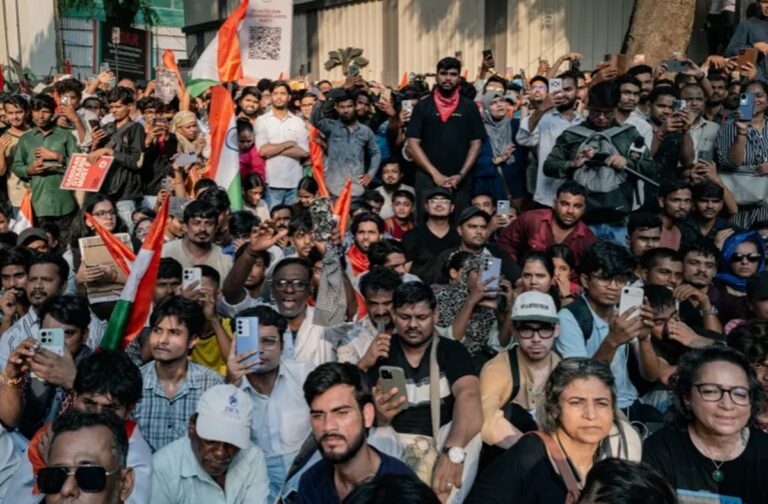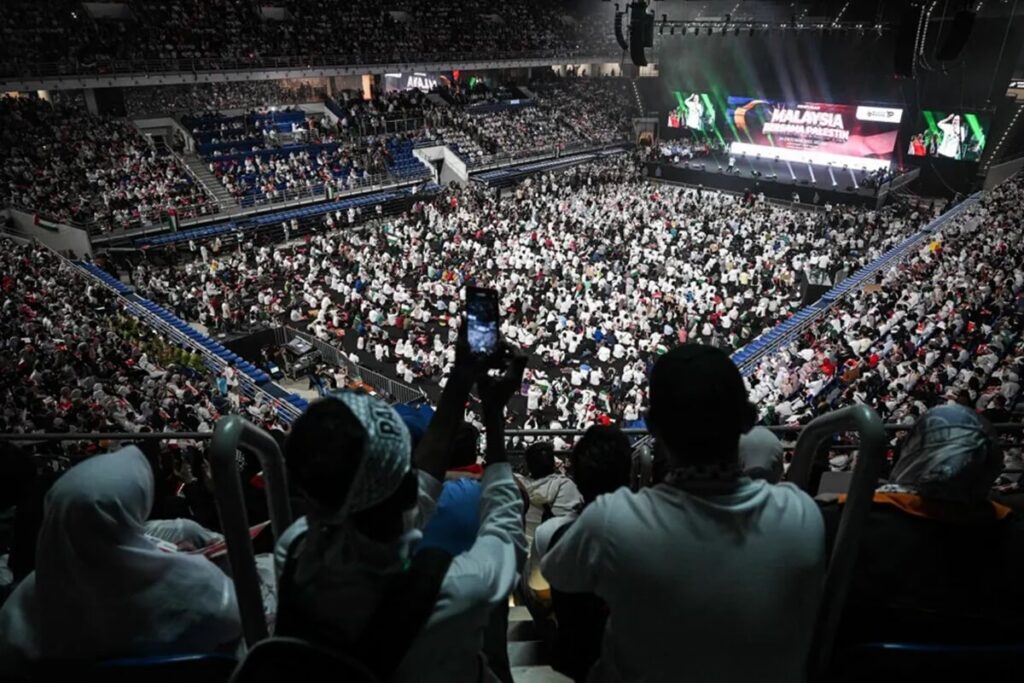
In Indonesia, a presidential candidate and the foreign minister addressed hundreds of thousands of protestors. In Malaysia, the prime minister, draped in a Palestinian keffiyeh, led his own rally describing the situation as “insanity” and “the height of barbarism.” In Singapore, the government has simply banned displaying either side’s flag.
In Thailand and the Philippines, sympathy for civilian victims competes with anger over Thai and Filipino citizens who have been killed or kidnapped. And in Vietnam, Laos, and Cambodia, the governments have issued carefully neutral statements—even as memories of the countries’ own past experiences of bombing stir.
Roughly 42 percent of Southeast Asia’s population is Muslim—and that’s played a key role in the region’s reaction to the Israel-Hamas war. Three broad responses have emerged: Muslim-majority democracies are uncompromisingly critical of Israel, quasi-democracies and democracies with substantial Muslim minorities adopt a more neutral position, and those outright dictatorships with few Muslim citizens are trying to ignore the conflict as much as they can.
The Muslim-majority states of Malaysia and Indonesia are unsurprisingly the most fervently pro-Palestinian voices in the region. Both remain among the few countries that have never recognized Israel diplomatically, and the Palestinian cause has long been publicly popular in both countries, used by politicians to burnish their credentials. In the wake of the Abraham Accords, some Israeli diplomats raised the hope that normalization of relations with Indonesia and Malaysia might follow. But the hope was always a thin one, despite quiet internal discussions by the Indonesian government.
Both countries have grown more pious in recent decades—with Palestine proving an important rallying point for Islamic political movements. Outside of Iran, no Muslim leader has taken a harder line on Palestine than Malaysia’s Prime Minister Anwar Ibrahim, who has personally addressed rallies and loudly voiced support for not just Palestinians but also Hamas. Anwar took a call with Ismail Haniyeh, the head of Hamas’s political bureau, on Oct. 17, and has also resolutely opposed U.S. efforts to ramp up sanctions against Hamas.
None of this is surprising. Anwar entered Malaysian politics as a student Islamic activist. His patron (and later rival), former Prime Minister Mahathir Mohamad, frequently castigated Israel and its Western supporters and vociferously supported the Palestinian Liberation Organization.
Often this veered into anti-Semitism, with Mahathir accusing Jews of controlling the global media and undermining Malaysia’s economy. Popular opinion today remains virulently anti-Semitic in Malaysia. For Anwar, who leads a coalition supported mainly by ethnic minorities and is struggling to retain support from the Malay Muslim majority, leaning into the Palestine issue is a no-brainer.
Yet, the stridency of this support has sometimes placed non-Muslim ethnic minorities in difficult positions, said James Chin, director of the Asia Institute at the University of Tasmania. This is not due to a lack of pro-Palestinian sympathies; ethnic minority politicians have resolutely displayed support for Palestinians. But a proposed Palestine Solidarity Week in schools stirred controversy as pictures of children in schools apparently dressed as Hamas fighters, complete with toy guns, emerged.
“The thing that people will worry about is that Solidarity Week will end up as sort of glorifying Hamas,” Chin said. “People worry about the radicalization.” But minority groups’ concerns have put them in the crosshairs of Islamists, who question where the groups’ sympathies lie.
It is exactly this sort of division that Indonesia—which has numerous non-Muslim minorities—is keen to avoid. While Indonesian President Joko Widodo has adopted a lower-key approach than Anwar, public opinion is still universally condemnatory toward Israel. Much attention has focused on the bombing of the Indonesia Hospital in Gaza, which was built with donations from Indonesia.
But the way the conflict is framed has changed in important ways. For decades, the secular-nationalist forces that dominated Indonesian politics framed the conflict in anti-imperialist terms, in the same way the USSR did when it backed Egypt and other Arab states. Overly Islamic, let alone Islamist, politics were seen as a threat to national unity. Islamic understandings of Israel-Palestine only gained traction following the end the Suharto dictatorship in 1998, according to Broto Wardoyo, a Middle East expert at the University of Indonesia.
Joseph Rachman, a freelance journalist covering Indonesia and other stories from around Southeast Asia.
This article was originally published on The Foreign Policy.
Views in this article are author’s own and do not necessarily reflect CGS policy.