A PARADOX, A PUZZLE OR MIRAGE?
INTRODUCTION
Reports in late August and early September suggest that the Bangladeshi economy is making a comeback from the COVID-19 induced downturn. Bangladesh entered the seventh month of the pandemic in September with a death toll of at least 4,500 and more than 338,000 cases. Conflicting information about the economy, the state of public health and underlying politics have become available. Some have become euphoric, while others have expressed healthy skepticism about the trajectory. Questions have been raised whether a ‘paradox’ is in the making or is it simply a ‘puzzle’ yet to be solved. A deep dive into some of the available data offers a different perspective and raises a different question – is it a mirage?
THE GOOD AND THE NOT-SO-GOOD NEWS
The optimism of some economists about the recovery is spurred by good news in a few sectors. These include the highest ever increase in a single month of exports in July. Out of a total of USD $3.91 billion in exports, a significant portion of the increase was due to a rebound in the Ready made Garments (RMG) sector. For the first time in 2020, RMG exports rose, showing 44.63% growth year-on-year. The RMG sector remains the backbone of the country’s economy. In previous years, about 83% of Bangladesh’s total export earnings came from the garment industry, which generated about $32 billion every year and contributed about 11% of GDP. At the beginning of the pandemic, it was widely reported that the sector will be the worst hit and millions of jobs would be lost.
However, despite the apparent rebound of the RMG sector, it continues to experience negative growth in one of the largest markets. In the first six months of the year, exports to the USA fell by 19%.The turnaround also has not prevented rising unemployment: 325,000 workers have lost their jobs since the pandemic began. Nor have all export-oriented sectors witnessed such an increase. For example, leather goods and footwear exports dropped 25% year-on-year in the first eight months of 2020.
Among other positive news was the increase in remittances, contributing to the record high foreign reserve at over $39 billion in August. While the country has continued to receive record remittances, serious questions remain whether the flow remittances will be as high in the coming months as thousands of migrant workers have returned home in the past months. More than 125,000 migrant workers have returned home as of September 14, many of them penniless. The number of returnees has increased since late August. Counting those who came on vacation before the pandemic and now are stuck, and those who were supposed to take new jobs overseas but now cannot travel, the total number of lost migrant jobs stands at 400,000 and is likely to grow in the coming months. This is aworrying sign for the economic recovery as remittances account for at least at least 8% of Bangladeshi GDP. About 700,000 Bangladeshi workers go abroad for jobs annually. The returnees are not only jobless, the possibility of them returning to work soon is very slim as it is depends on the host countries’ economic recovery. A quick solution to the situation cannot be expected so long as the global economic outlook looks less than promising.
These positive economic developments and signs of recovery were accompanied, however, by news that shows that the situation demands closer scrutiny. Low private sector credit growth in July, and a significant gap between revenue collection targets and realization, demonstrate the immediate challenges.
MANUFACTURING POSITIVE NEWS
The government has seized on the positive news to send a message that the worst of the public health crisis is over, and it has thus far paid off. In July, the government claimed that the country achieved a remarkable 5.4% GDP growth in FY 2019-20 (between July 2019 and June 2020); and that consequently per capita income has risen by $155 to US$2,064.16 The growth rate claimed by the government is significantly higher than the forecasts of the World Bank (WB, 1.6%), International Monetary Fund (IMF, at 3.8%), the Asian Development Bank (ADB, at 4.5%), and the Centre for Policy Dialogue (CPD, at 2..5%).
Notwithstanding the different periods used for measurement by these organizations and the Bangladeshi government, leading economists quickly pointed out these figures are ‘misleading’ and ‘do not hold water.’ Economists pointed to a number of indicators – for example, FDI, registration of investment projects, import of capital machinery, and domestic resource mobilization – and blasted the government for providing an unrealistic picture of the economy.
THE STATE OF THE PANDEMIC
Highlighting positive news and painting an unrealistic picture of GDP growth was intended to put a gloss on the COVID-19 situation. Bangladesh continues to witness rising COVID-19 infections, although government statistics report a low number of deaths. The accuracy and reliability of these figures have been questioned for various reasons. The rate of testing has declined significantly in late August and received serious criticisms for high cost and lack of encouragement from the government, but also allegations have been voiced that the government is hiding the real picture. Some alleged that the death rate from COVID-19 was as much as “four times higher” than the recorded figure. Despite the reduction in tests the rate of positives has remained as high as 20% according to experts 22 and data provided by the government as of September 4, 2020. The number of deaths from coronavirus symptoms crossed the 2,000 mark in early September. Yet the government has decided to lift the restrictions of public transports and resume various activities, and reduced the number of dedicated hospitals for COVID-19 citing low patient numbers.
INTERNATIONAL ASSISTANCE AND CORRUPTION
The projections of recovery are also based on the significant amount of foreign assistance received by the government for various projects related to COVID-19 and budgetary support. As of early September, Bangladesh has requested and received about USD $4.7 billion from various multilateral bodies and donor countries to address the fallout of the pandemic. This figure includes $1.8 billion from the World Bank, $732 million from the IMF, $681 million from the ADB, $395 million for the EU, $350 million from the Asian Infrastructure Investment Bank (AIIB), $329 million from Japan, $173 million from the US, and $233 million from various other sources.
Since the beginning of the pandemic, multilateral bodies have recognized the need for immediate and unprecedented assistance to the developing countries. But concerns have also been expressed that this assistance will engender corruption due to lack of transparency. Various watchdogs including Transparency International have warned about the possibility of waste and corruption contributing to global inequality.
As Bangladesh continues to receive a significant amount of money, reports have been published in the local media of misappropriation and corruption in various projects funded by the donors.
According to the head of the Bangladesh chapter of Transparency International, ‘No other country has so much corruption in tackling coronavirus.’ One must ask whether this assistance is becoming something akin to the ‘corrosive capital’ phenomenon, which enables an unaccountable system of governance and bolsters an authoritarian system.
PREVENTING THE ‘CORROSIVE’ IMPACTS
The potentially corrosive impacts of foreign assistance are particularly pertinent to Bangladesh for two reasons: the growing authoritarian bent of the incumbent government, and the misplaced priorities of the recovery plan.
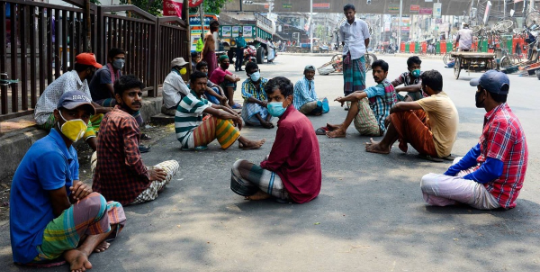
First, in the past decade, the country has gradually moved away from an inclusive system of governance. Mechanisms for accountability and transparency have deteriorated to the point of nonexistence. Secondly, the signs of recovery remain far from inclusive. Despite repeated calls to plan the stimulus packages focusing on those who were affected the most, they were left out and still face enormous hardship. A vast number of poor people have been severely hurt by the downturn.
According to one estimate the poverty in Bangladesh has doubled, with the ultra-poor among the worst affected, reaching 20.5 percent of the population as of June. However, the poorest have received the least attention. A prominent economist has noted, “the cash transfer scheme for the poor came very late, was too small in amount, and failed disastrously in its implementation. What should have been in the hands of the poor in April was "inaugurated" in May, and by July, only a small proportion of the target beneficiaries were reached.” While the government is relying on the 19 stimulus packages for economic recovery, implementation remains slow, and they are highly skewed towards large and export-oriented enterprises. Small and medium enterprises have been left to fend for themselves, as have women entrepreneurs, particularly online women entrepreneurs. For those left by the wayside, the ‘recovery’ seems nothing but a mirage.
THE WAY FORWARD
With the serious limitations of the recovery and profound challenges ahead, it is imperative that the government, donors, watchdogs, and private enterprises take a close look at the current trajectory of Bangladesh. The government has already muddled its response – both on the public health and economic fronts. It should take immediate steps to correct course. The pandemic is not yet over and the end is not in sight. It is anticipated that there will be a second wave, the scale of its impacts cannot be predicted. Neighboring India’s current situation should make Bangladeshi policymakers deeply worried. The stimulus packages should be refocused to ensure that the country does not repeat the mistakes of the past, but instead engenders an inclusive economy. This requires steps to open political space and move away from the government’s penchant for persecuting its critics. Donors and multilateral bodies must uphold their commitment to combat corruption during the global pandemic and put in place systems to ensure transparency. The international community cannot remain oblivious to a system of governance which precludes any inclusive recovery.
Global watchdogs such as Transparency International must remain vigilant. They must document instances of malpractice, create awareness and offer tools to the citizens to fight back. Private enterprises, especially SMEs, have much to gain from creating a pathway for an inclusive and resilient recovery. They need to build ways to come together and raise their voices. They will need support from international organizations such the Center for International Private Enterprise (CIPE). The path is not easy, but it is necessary for a better future.
Dr. Ali Riaz is a well-known author, a Senior Non-Resident Fellow with the Atlantic Council and a Distinguished Professor at the Department of Politics and Government of Illinois State University. He also holds the Thomas E Eimermann Professorship (2018-2020) and the member of Advisory Board at Centre for Governance Studies (CGS).
This article was originally published on Center for International Private Enterprise (CIPE).
Views in this article are author’s own and do not necessarily reflect CGS policy.