There’s a lot standing in the way of Xi’s ambitions; not the least are the challenges of his own making.
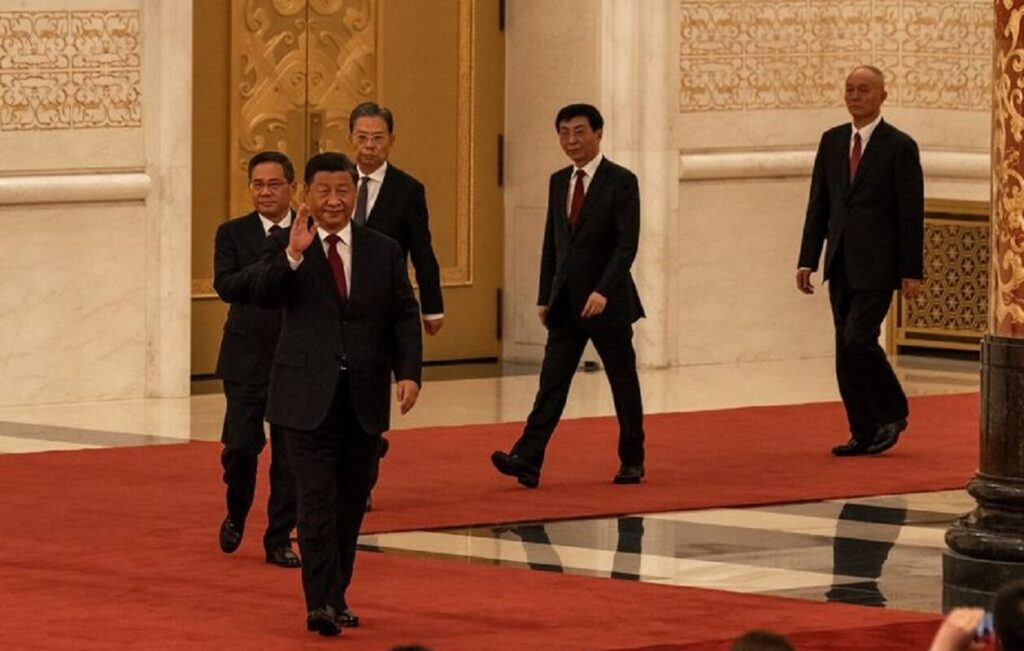
The line up for the new leadership of China’s Communist Party is out. It’s a clean sweep for President Xi Jinping.
The new Politburo Standing Committee — China’s most powerful governing body — is stuffed with his men, including Shanghai party secretary Li Qiang, Guangdong province’s party chief Li Xi, Beijing party secretary Cai Qi, and Xi’s chief of staff Ding Xuexiang. Li Qiang, who oversaw Shanghai’s brutal lockdown earlier in the year, is likely to become China’s next premier, judging by the order of the names that appeared. For the first time in 25 years, there is no woman in the 25-member Politburo, even though Xi vowed in his party congress speech last weekend to uphold gender equality.
Premier Li Keqiang, an economist by training, is no longer on the Central Committee, which includes China’s 205 most senior politicians — almost all are men. Wang Yang, floated as a possible candidate to succeed Li as the next premier, is out too. Their exit marks the first time in at least three decades that a member of the Politburo Standing Committee has retired early, according to data analysis by Bloomberg News.
Some other important names are missing from the new Central Committee too, including People’s Bank of China Governor Yi Gang and banking regulator Guo Shuqing. In theory, all these bureaucrats are still young enough to be eligible for another five-year term under the unwritten two-decade rule that requires those aged 68 to retire. How should we read into this major reshuffle?
Is it possible that liberal-minded politicians who favor market principles, such as premier Li, possibly got nudged out? At his speech last weekend, Xi issued a stern warning against “power centers,” groups of politicians that affiliate with and promote each other. Premier Li and Wang, for instance, are both veterans of the Communist Youth League, an incubator for the country’s future political elites that Xi has sidelined. But equally likely, they may have decided not to take on the demanding burden of executing Xi’s economic agenda either. Sometimes, it’s better to exit the stage early.
After all, Xi’s opening remarks at the 20th party congress, which sets the agenda for the next five years, were full of conflicts: He is demanding his cadres achieve the impossible.
For instance, the president vowed to grow China into a “medium-level developed country” by 2035, which, according to economists, requires an average 4.7% annual growth rate going forward. How can that be achieved, if Beijing still hangs onto its Covid-Zero policy? With arbitrary snap lockdowns in industrial heartlands and commercial hubs, China will be lucky to escape negative growth.
Or consider Xi’s emphasis on developing industrial technology, in areas such as aerospace, quantum computing, and satellite navigation. He recognized that top-notch scientists and engineers are the key to realizing his dream; in fact, he even added a separate section on talent development in his speech. Yet all the talk of common prosperity and wealth redistribution cannot be assuring to aspiring engineers who want to develop their intellectual property into startups. They’re better off opening shops in Silicon Valley instead.
Meanwhile, the party cadres are gripped with fear as the anti-graft campaign — Xi’s signature policy — rages on, implicating even his old friends. Last year, party enforcers punished some 627,000 people for disciplinary violations, four times the number when Xi took office in 2012. Increasingly, bureaucrats are being punished for laxity. In other words, if a politician can’t fulfil Xi’s mandates, he is at risk of getting swept away in investigations.
Xi touted his new development model last weekend, which centers on the state’s role in economic activities and the notion of common prosperity. He advocated it as an alternative way toward modernization, compared to the unchecked capitalism in the west, which results in a wider wealth gap and soaring cost of living. However altruistic it may sound, this model is untested, vague and theoretical at best. Only his most loyal lieutenants are there to somehow carry it out. As for others, it’s better to retire early.
Shuli Ren is a Bloomberg Opinion columnist covering Asian markets. A former investment banker, she was a markets reporter for Barron’s.
This article was originally published on Bloomberg.
Views in this article are author’s own and do not necessarily reflect CGS policy.