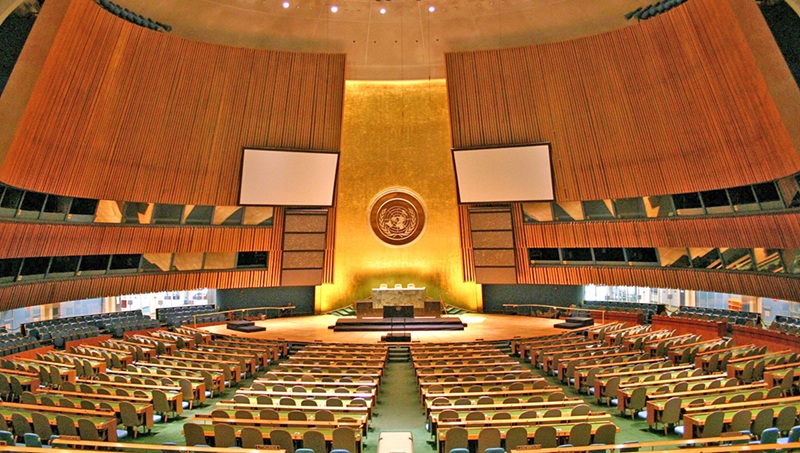
ON JUNE 2, delegates from the 193 member states of the United Nations are scheduled to meet to hold an election to choose a new president for the 81st session of the United Nations General Assembly. Unlike other positions in the UN, the role of the General Assembly president, though still important, is mostly ceremonial. It pales in significance compared to, for example, the UN secretary general or the Security Council. However, the ongoing struggle between the two candidates for the position, namely Dr Khalilur Rahman from Bangladesh and Andreas Kakouris from Cyprus, is gradually emerging as an important geopolitical battle, signalling a shift in influence within the international system.
As is common practice, the UN conducts elections of this nature on a geographical and regional basis. Normally, the region responsible for holding the seat for a given year can reach a consensus on the candidate. In this case, however, the situation is different, as two countries are vying for the spot.
The actual process of selecting the UNGA president, although straightforward, is quite interesting from a diplomatic perspective. Essentially, all UN member states receive one vote each, either in favour of one candidate or the other, in a secret ballot. A simple majority of the members voting at the General Assembly automatically ensures a candidate’s victory. Naturally, the voting process does not reflect the months, sometimes years, of lobbying, building alliances, reciprocating favors, and geopolitical maneuvers behind the scenes that lead up to the election.
What makes Cyprus’s candidature different and potentially more successful than that of Bangladesh is the timing of its campaign. From a diplomatic perspective, this is of great importance, as time translates into networking and connections. According to sources, Nicosia began its campaign relatively early and thus had enough time to build important relationships in other regions as well.
Another advantage enjoyed by the Greek Cypriot candidate is his extensive diplomatic experience. As someone who served in various diplomatic capacities and represented his country on European issues, Mr Kakouris underscores the advantages of Cyprus’s integration into the European diplomatic community.
Similarly, Bangladesh foreign minister Dr Khalilur Rahman also possesses impressive diplomatic credentials. A seasoned diplomat and former UN official, he is recognised in the multilateral community for his expertise in development, climate diplomacy, migration, and negotiations.
The official campaign by Bangladesh, which started relatively late, has focused heavily on showcasing the country’s contributions on the global stage. Among others, the country is well-known for its contributions to global peacekeeping efforts, as well as managing one of the largest groups of refugees in the world, close to one million Rohingya living on its territory.
One thing needs clarification, though: Bangladesh does not seem to have officially positioned itself as a ‘Global South’ candidate. At least that is the case according to governments’ usual diplomatic language. However, viewed from an international perspective, Bangladesh’s candidature fits quite naturally into this framework.
Given the country’s profile and international reputation, Bangladesh’s position and campaign are interpreted by many foreign diplomats as a voice of the developing countries and nations of the Global South in multilateral organisations and global forums.
This fact must be understood in the light of current diplomatic practices, as nowadays the ability to maintain a subtle balance of narratives plays a crucial role in foreign policy. Typically, Bangladesh strives to maintain neutrality and balanced relations with other geopolitical centres, despite their mutual differences.
Despite these nuances, there are certain geopolitical undertones in the struggle for this post, and this cannot be overlooked.
To begin with, the positions of both China and Russia seem clear. In line with their foreign policies, both countries are inclined to strengthen the positions of developing nations within global institutions. Moreover, Bangladesh has become an increasingly important partner for both Beijing and Moscow lately.
India’s position in this election is more delicate and strategically important. Traditionally, New Delhi prefers nominating its own candidates for the seats available for South Asia. Nonetheless, the current diplomatic relations between Dhaka and Delhi have cooled off since Bangladesh’s recent political changes and its shifting allegiances in the region.
Therefore, India is unlikely to support either contestant, preferring to maintain a neutral stance, as a clear demonstration of support would carry negative implications for its image and diplomacy in South Asia and the developing world.
Finally, there are the United States and its European allies, who have historically dominated the General Assembly. Although it remains unclear whether the US administration will put in the effort to ensure Cyprus’s victory, Washington may see the nomination of the Greek Cypriot candidate as advantageous to it.
Indeed, Andreas Kakouris has extensive experience working inside the Western diplomatic system, representing Cyprus’s European membership. On the other hand, if Bangladesh can secure support from a few countries and regional blocs, Washington may opt out of this process.
Bangladesh’s chances of success may ultimately depend on one critical factor: whether it can secure unified backing from the Organisation of Islamic Cooperation member states, something that, at least for now, remains far from guaranteed.
This election, as unusual as it may seem, marks a broader geopolitical transformation of international politics.
Since the end of the Cold War, global politics has been mostly controlled by the West and its dominant narratives and policies. Recently, however, international relations have become much more multipolar, with middle powers, regional players, and issue-based alliances becoming key.
That is why even a small election within the United Nations takes on geopolitical significance.
From Bangladesh’s perspective, the very fact that the country is vying for a relatively important post is a sign of change. What used to be known as a poverty-ridden, cyclone-prone nation with little to no global presence is now actively seeking to enter the halls of global multilateral diplomacy.
From Cyprus’s side, this struggle showcases the ability of small countries and states with proper connections to wield influence through institutional politics and multilateral relations.
The June 2 election should be viewed as a part of this geopolitical evolution as much as anything else.
Zillur Rahman is a political analyst and president at the Centre for Governance Studies. He hosts ‘Tritiyo Matra’ on Channel i.
This article was originally published on Newage.
Views in this article are author’s own and do not necessarily reflect CGS policy.