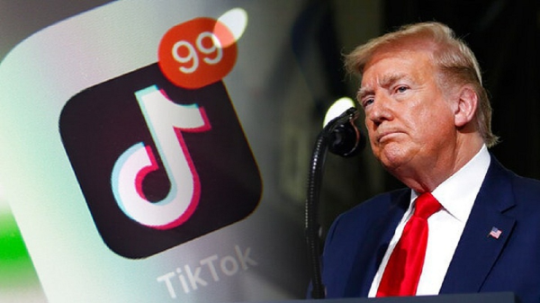
Donald Trump wants to force a sale of TikTok to Microsoft. The app from China is dangerous. Is he right? Anna Sauerbrey talks with China expert Kai von Carnap.
Kai von Carnap deals with technological trends and the digital development of China. He has special knowledge in the field of cryptocurrency and blockchain technology. Von Carnap holds a double degree (MA) in Chinese-European Economics and Business Studies from the Berlin School of Economics and Law and the Southwestern University of Finance and Economics Chengdu.
The American president has threatened to ban the Chinese short video platform TikTok from the US market . On Monday he added: If there is no sale to Microsoft by September 15, he will do it seriously. What is behind this threat?
Behind the threat is the perception that Byte Dance – the Chinese parent company of TikTok – is very close to the interests of the Chinese Communist Party. American government officials fear that the data of American TikTok fans could be used in the interests of the Chinese leadership. Trump's push for Microsoft to buy is a new step in politicizing tech companies. The US is doing what it is actually accusing the Chinese of: Microsoft, too, is now being taken into the service of American political interests.
How legitimate are fears that Byte Dance is close to the Chinese government?
There are legitimate reasons for concern. The legal situation in China is clear: the Chinese government secures the right to intervene by law. For example, there is a cyber security law that allows cyber security authorities to query data from tech companies. Within most Chinese private companies, especially in the tech sector, there are party cells that make decisions with or alongside the company management. These party cells have a great influence on the management of the company – although we at Byte Dance don't know exactly how the interaction works. Most Chinese tech companies are also required to store their data on Chinese servers. TikTok tries to get around that. The company has the policy
TikTok says it stores its data outside of China; the company's US headquarters are in Los Angeles. Is the data really not being exported?
The export of the data itself is less important than the analysis. Byte Dance lives – like Facebook or Google – from evaluating the data that is generated through use. This is central for the company in order to further develop its algorithms and, for example, to be able to place targeted advertising – that's the business model behind TikTok.
TikTok has now initiated a whole series of measures that are likely to increase confidence in data security: It has publicly announced that it will separate the analysis of TikTok's data from the analysis of the data from the Chinese version of the service, Douyin. In May it was announced that Byte Dance had hired K evin Mayer, an American executive who was previously responsible for Disney's streaming services and is now CEO of TikTok . In addition, the media quoted from an internal guideline that provides for a "minimum data exchange" between TikTok in the USA and the Chinese parent company. But to what extent the separation should take place technically or has even taken place is not yet known.
TikTok has a wealth of data. The app has been downloaded 1.9 billion times worldwide and 172 million times in the US. What are the fears that the Chinese leadership could do with the data analysis?
Since 2019 at the latest, Chinese political narratives and Chinese media formats have been much more present than before on social media in the West such as Twitter, Youtube and Facebook. China tries to influence public opinion in Western countries through these channels. Of course, the more it knows about the users, the better it can do that. Content can then be used more precisely. At least since the scandal surrounding the data analysis company Cambridge Analytica, which bought Facebook user data, evaluated it and sold the data to Donald Trump's election campaign team, among others, there has been an awareness that such data can be used in an attempt to political To influence or even turn moods. The prerequisite, however, are very large data sets. TikTok is an ideal source.
Is the TikTok platform itself also used for Chinese propaganda?
Yes, there were signs of that, including censorship. There were videos about the suppression of the Muslim Uyghur minority in the Chinese province of Xinjiang, who disappeared from service after just a few hours. There was a leaked document, a catalog of terms and topics compiled by the Chinese Communist Party. The algorithm is supposed to either filter out videos on these terms and topics entirely or to ensure that fewer people see them, for example about Tibet, Taiwan, Xinjiang and the massacre on Tiananmen Square in 1989.
So is Donald Trump right about his security concerns?
Social media generally have great influence on a society – not just Chinese. Therefore the concern is justified. Liberal democracies must also ask themselves how to handle this power, including in their own businesses. Trump may also act out of economic interests – it's also about giving American companies an advantage, in this case Microsoft.
Does the American election campaign play a role in Trump's approach?
It should be in Trump's interest to keep the Chinese government's ability to influence public opinion in the USA as low as possible, especially during election campaign times. In terms of content, it is important for him to appear as tough as possible towards China – with this he is trying to distinguish himself – in trade policy and now also with his approach in the TikTok case. Attacking such a large and well-known platform generates a lot of attention.
The American government is also taking action in the case of the Chinese telecommunications provider Huawei: The provider is being excluded from expanding American cellular networks, and Huawei components that have already been installed are to be removed and replaced. Is TikTok a similar case?
The strategic component is much stronger at Huawei than at TikTok. In the case of Huawei, it is about the digital infrastructure, which is absolutely central in the 21st century. In China, on the other hand, entire value chains are involved. The argument is correspondingly tough. China also reacted much more sharply in the case of Huawei and clearly stood in front of Huawei. For example, when Huawei top manager Meng Wanzhou was arrested in Canada, China arrested Canadian business people in China in return. In the case of Byte Dance, it is questionable whether it is worthwhile for China to react in a similar way – they are certainly interested in the data, but could also procure it differently.
How great is the response in China to the TikTok case? Some Chinese state media have reacted, the "China Daily" speaks of "theft"?
It was mainly other Chinese tech companies that reacted, with several well-known managers speaking out in public. They defend themselves against the assumed closeness to the state and believe that TikTok is just an entertainment platform that is not strategically important. The prevailing tenor in the media is that Trump is only concerned with the economic interests of the United States. Most Chinese people shouldn't care what happens to TikTok itself, as the service is not available in China and a sale in the USA would have no influence on the sister service Douyin.
Would a sale have any impact on the European market?
Probably not. The app will probably continue to work as it is. As a user or producer of videos, you shouldn't feel anything. Perhaps one or the other would notice if content is available on political topics that China does not like to see, but TikTok is more successful with entertainment, not a political channel .
In the case of Huawei, the US is also calling on its allies to accept the American line, i.e. to exclude Huawei from expanding cellular networks or even to remove built-in components. Is something similar to be expected in the case of TikTok?
No, not really. As I said, the Huawei case has a completely different strategic weight. There is simply not enough evidence that social media or services like TikTok can undermine public opinion in the western world to suggest that such massive political capital would have to be deployed here. That can of course change, depending on how strongly China continues to pursue the path of wanting to influence public opinion in Western countries.
Anna Sauerbrey, German journalist.
These Interviews were originally published on Der Tagesspiegel.