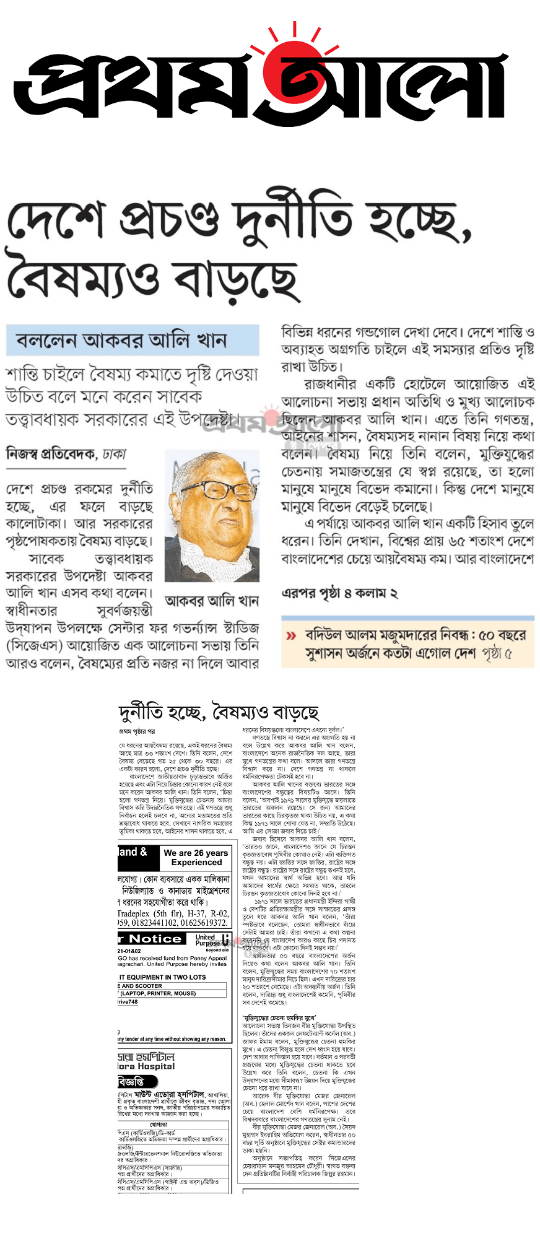
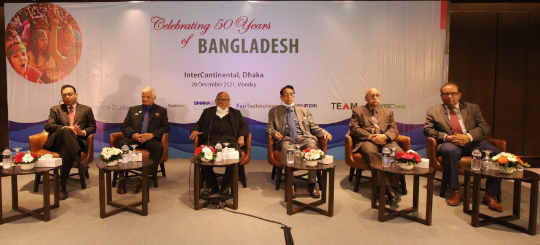
Economist Akbar Ali Khan at a discussion on ‘50 years of Bangladesh’ said on Monday that disparity among people was widening in the country, primarily due to corruption, black money and government patronisation.
Corruption, black money and the government patronisation are responsible for widening disparity among the country’s people,’ said Akbar Ali, also a former caretaker government adviser and a freedom fighter.
He made the remarks while delivering his keynote speech at the discussion organised by the Centre for Governance Studies, a non-government think-tank, at a city hotel.
Speakers at the programme recalled the contributions of neighbouring India during the 1971 Liberation War, particularly at the fag end of the war hastening the defeat of Pakistani occupation forces.
Responding to a point, former cabinet secretary Akbar Ali, however, said that there was no reason to assume that Bangladesh would remain thankful forever to India for their undeniable support during the Liberation War.
‘The sense of thankfulness cannot be sustainable if the interests of the two nations are contradicting,’ he remarked.
Quoting from renowned British statesman and prime minister Palmerston, Akbar Ali said, ‘We have no eternal allies, and we have no perpetual enemies. Our interests are eternal.’
He said that Bangladesh made commendable achievements in social and economic indicators since its independence in 1971, but could not make progress in all areas equally.
‘Out of four fundamental principles—nationalism, socialism, democracy and secularism—as set in the constitution, we have fully achieved nationalism. We want liberal democracy where rule of law and the role of civil society is very important. But these are still weak. Secularism will not be sustainable without democracy,’ Akbar Ali observed in his speech.
He said people would be deprived of political rights if democracy was not established.
‘At least 70 per cent people of the country were under the poverty level in 1971 and now only 20 per cent of the people are under the poverty level. Poverty has decreased all over the world—not only in Bangladesh.
‘If we consider the global standard of poverty reduction, 40 per cent of people of Bangladesh are still under the poverty line,’ he added.
Retired major general Syed Muhammad Ibrahim, Bir Pratik, retired major general Helal Morshed Khan, Bir Bikram, and retired lieutenant colonel Jafar Imam, Bir Bikram, also spoke at the discussion followed by an award-giving ceremony for an open essay writing competition hosted by CGS.
The speakers criticised write-ups by some Indian writers and films projecting Bangladesh’s Liberation War as an Indo-Pakistan war undermining the sacrifices of the people of this country.
The retired military officers described the war as the war of the people from all walks of life adding that young students and farmers, in particular, had a tremendous role in defeating the Pakistani occupation forces.
Muhammad Ibrahim said, ‘I am shocked as a freedom fighter in these 50 years of independence. We have been treated unfairly, not only as individuals but as freedom fighters on the battlefield.’
‘We are grateful to India but there needs to be a limit to gratitude. Everybody needs to be given their due share of credit and honour,’ he added. In his speech, Helal Morshed Khan recalled his time spent in the resistance army during the war.
Jafar Imam said foreign scholars took advantage as Bangladeshi scholars were not producing scholarly write-ups on the basis of comprehensive research on the Liberation War.
CGS executive director Zillur Rahman gave the opening speech at the event while its chairman Manjur A Chowdhury gave the closing speech.
News Courtesy: